KCSA certification: exam format, cost, domains and passing score
KCSA — Kubernetes and Cloud Native Security Associate — is the Linux Foundation’s pre-professional certification for Kubernetes and cloud native security. It is a 90-minute online, proctored, multiple-choice exam; it costs US$250 including one retake, you need 75% to pass, there are no prerequisites, and the certification is valid for two years.
- Certification
- Kubernetes and Cloud Native Security Associate (KCSA), from the Linux FoundationLinux Foundation Education KCSA page, checked 10 October 2026
- Exam fee
- US$250 exam only; US$495 bundled with a THRIVE-ONE annual subscriptionLinux Foundation Education KCSA page, checked 10 October 2026
- Format
- Online, proctored, multiple choiceLinux Foundation Education KCSA page, checked 10 October 2026
- Duration
- 90 minutesLinux Foundation Education KCSA page, checked 10 October 2026
- Questions
- Not published by the Linux FoundationKCSA page and Multiple Choice Exams FAQ, checked 10 October 2026
- Passing score
- 75%Linux Foundation Multiple Choice Exams FAQ, checked 10 October 2026
- Retake
- One retake included; 12 months to schedule and take the examLinux Foundation Education KCSA page, checked 10 October 2026
- Prerequisites
- NoneLinux Foundation Education KCSA page, checked 10 October 2026
- Validity
- 2 years; passing CKS renews KCSA automaticallyKCSA page and Multiple Choice Exams FAQ, checked 10 October 2026
Know if you're ready for KCSA — before you book.
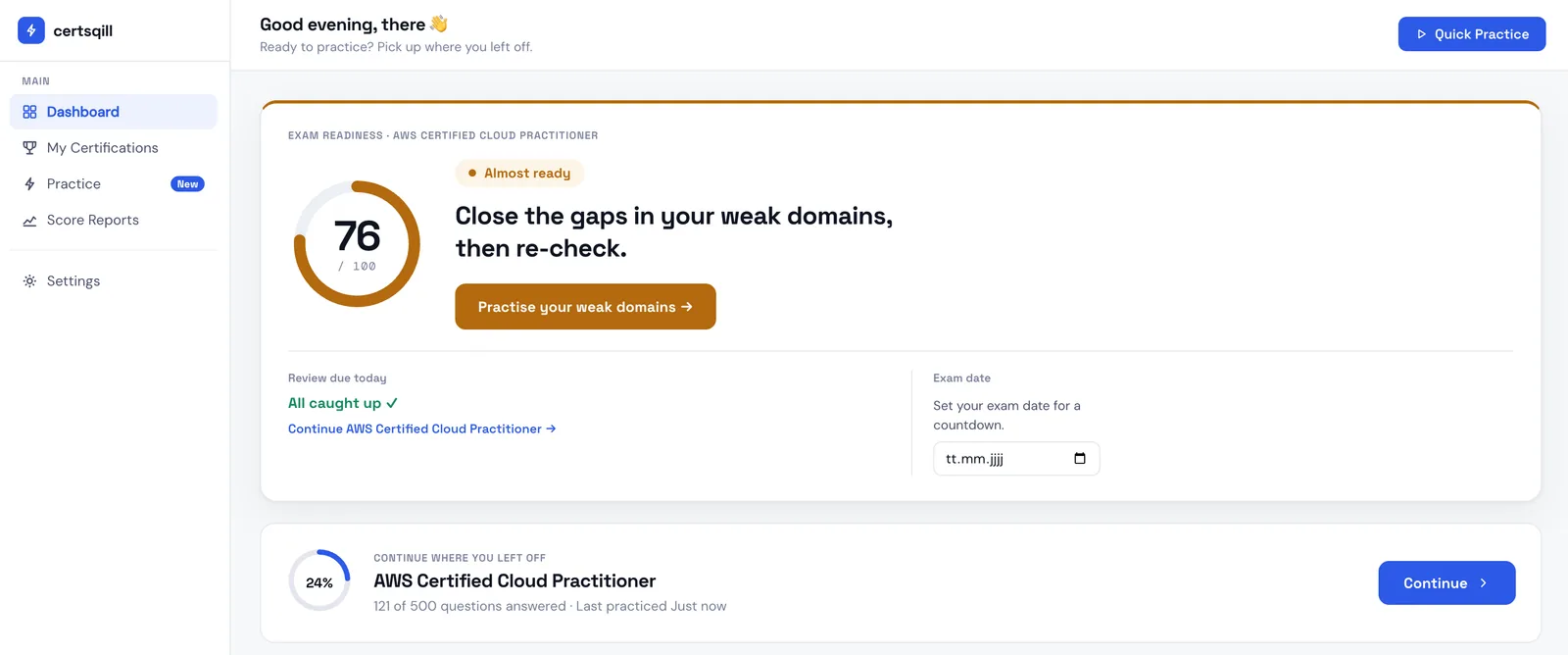
Certsqill measures your KCSA readiness across every official exam domain — one 0–100 score from coverage, accuracy and consistency that tells you whether to book, keep studying, or sit.
Why people switch to Certsqill
Everything you need to walk in ready
Know where you stand, understand every mistake, and study in your language — one payment, no subscription.
Your KCSA Readiness Score, not a guess
One number from three signals — coverage, accuracy, and consistency — tells you whether to book the exam or keep studying.
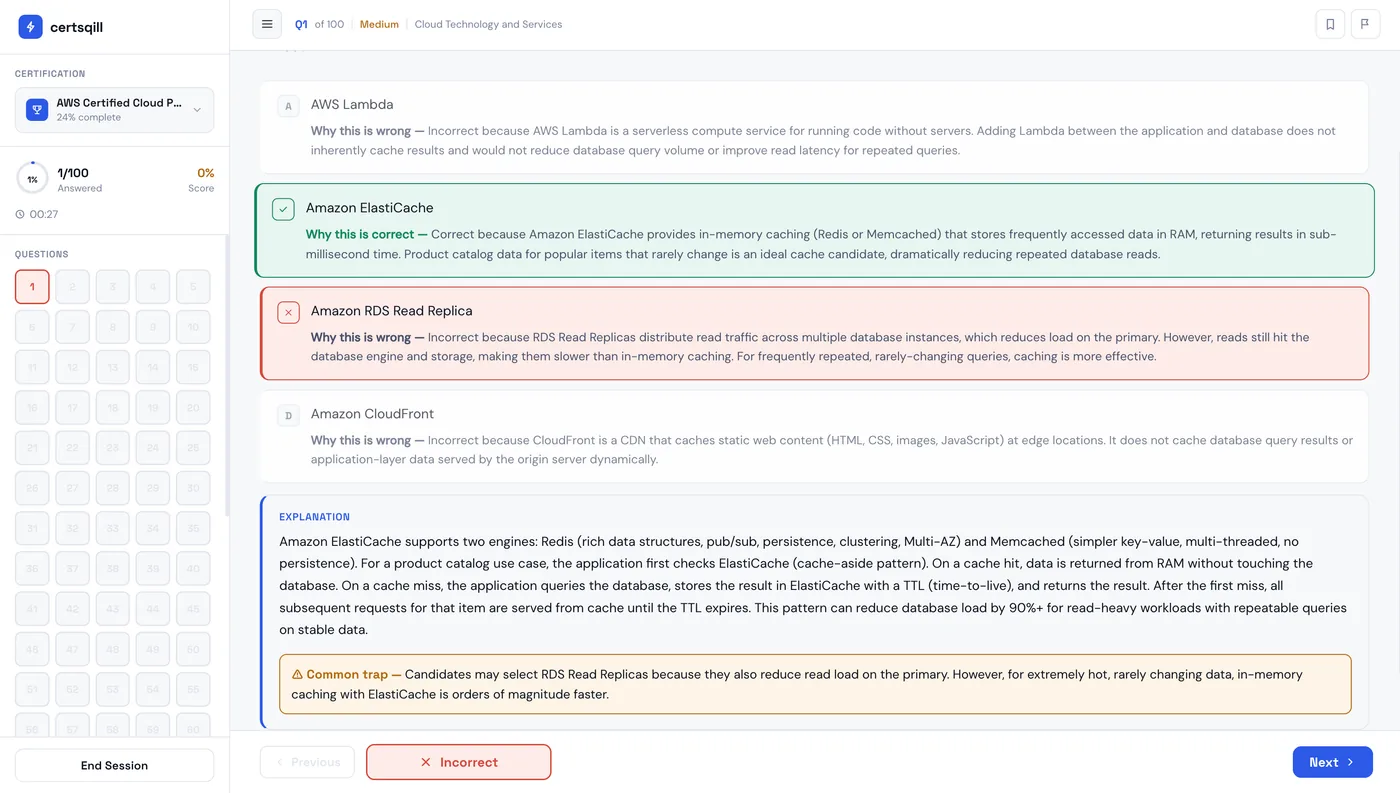
Understand every KCSA mistake
When you miss a question, it explains why — using your own answer history to catch the patterns you keep repeating. Included, no subscription.
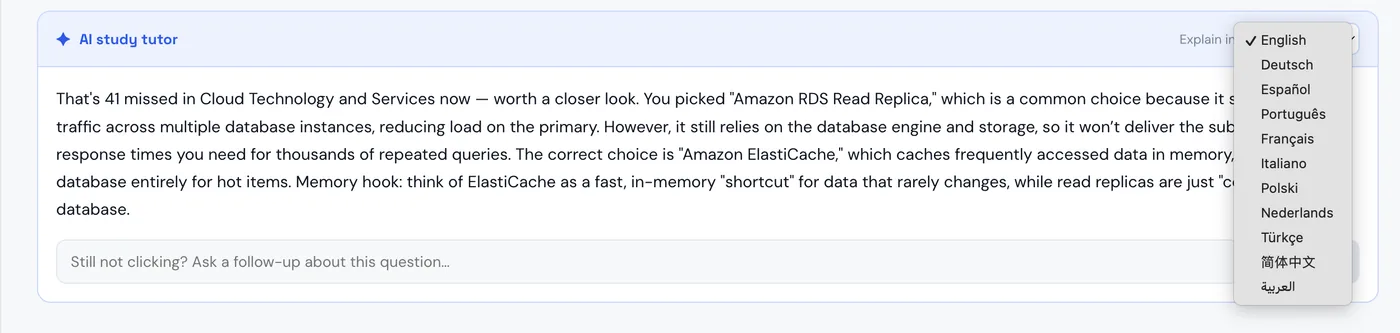
Explanations in your language, questions stay exam-accurate
Get every explanation in your language while the questions stay in exam-accurate English. Technical terms stay in English — the way the exam writes them.
Everything you need to pass
Why you can trust these KCSA questions
What is the KCSA certification?
The Kubernetes and Cloud Native Security Associate (KCSA) is a Linux Foundation certification. The Linux Foundation calls it a pre-professional certification for candidates who want to advance to the professional level by demonstrating foundational knowledge and skills of security technologies in the cloud native ecosystem.
It is pitched at beginners: there are no prerequisites, and the Linux Foundation’s own line is that you do not need years of experience to start a cloud security career. Because KCSA is multiple choice, it tests whether you understand cluster security, threat models and compliance frameworks, not whether you can type configurations under time pressure.
Source: Linux Foundation Education — KCSA. Checked 10 October 2026.
How much does the KCSA exam cost?
The KCSA exam costs US$250 on its own. That price includes one retake and gives you 12 months to schedule and take the exam.
The Linux Foundation also sells KCSA bundled with a THRIVE-ONE annual subscription for US$495, which it describes as access to more than 100 educational products. Whether that is worth it depends on whether you would use the training library anyway; for the exam alone, the US$250 option is the relevant price.
Source: Linux Foundation Education — KCSA. Checked 10 October 2026.
KCSA exam format
KCSA is an online, proctored, multiple-choice exam with a duration of 90 minutes. The Linux Foundation does not publish the number of questions on the KCSA page or in its multiple-choice exam FAQ.
The exam is proctored remotely through streaming audio, video and screen sharing, on PSI’s Bridge platform with the PSI Secure Browser. There is no test-center option listed. Plan a quiet room and a compatible computer, and run the system check well before exam day.
Results come by email: the Linux Foundation states that a score report is sent within 24 hours of finishing the exam, barring exceptions or technical problems.
Source: Linux Foundation — Multiple Choice Exams FAQ. Checked 10 October 2026.
What score do you need to pass the KCSA?
You need 75% or above to pass. The Linux Foundation’s FAQ for its multiple-choice exams states that a score of 75% or above must be earned to pass, and KCSA is one of those exams.
Seventy-five percent leaves room for only one wrong answer in four, so weak domains cost you quickly. The domain weighting below shows where to concentrate.
Source: Linux Foundation — Multiple Choice Exams FAQ. Checked 10 October 2026.
KCSA exam domains and weights
The Linux Foundation publishes six domains with fixed weightings. Cluster component security and security fundamentals together make up 44% of the exam, so understanding how the components of a Kubernetes cluster are secured, and the security fundamentals Kubernetes provides, is the core of KCSA preparation.
Threat modelling and platform security are 16% each, and the remaining 24% splits between an overview of cloud native security and compliance and security frameworks. The last domain is small but often neglected by engineers; read it as carefully as the technical ones.
- Overview of Cloud Native Security — 14%
- Kubernetes Cluster Component Security — 22%
- Kubernetes Security Fundamentals — 22%
- Kubernetes Threat Model — 16%
- Platform Security — 16%
- Compliance and Security Frameworks — 10%
Source: Linux Foundation Education — KCSA. Checked 10 October 2026.
KCSA training and course options
The Linux Foundation lists its own preparation resources on the KCSA page: the free Introduction to Kubernetes course and the Kubernetes & Cloud Native Essentials course (LFS250), plus free cloud and container courses and subscription access to its e-learning catalogue.
There is no mandatory course. A practical prep plan is to cover Kubernetes basics first, then work through each of the six domains against a real test cluster, so that the security controls you read about are things you have seen in action rather than definitions.
Source: Linux Foundation Education — KCSA. Checked 10 October 2026.
How long is the KCSA certification valid?
KCSA is valid for two years. To keep it, you can retake and pass the exam before the expiration date.
There is a second route: the Linux Foundation states that passing the Certified Kubernetes Security Specialist (CKS) exam will automatically renew your KCSA. For anyone planning to move on to CKS, that makes KCSA renewal a by-product of the next step.
Source: Linux Foundation — Multiple Choice Exams FAQ. Checked 10 October 2026.
KCSA vs CKS
KCSA and CKS both cover Kubernetes security, but at different levels. KCSA is the pre-professional, multiple-choice certification with no prerequisites, aimed at candidates who want to advance to the professional level. CKS, the Certified Kubernetes Security Specialist, is the Linux Foundation’s security specialist exam, and passing it renews an existing KCSA automatically.
On its KCSA page, the Linux Foundation’s “What comes next?” section points to LFCS and CKA as follow-on certifications. If your goal is a security specialisation, KCSA gives you the vocabulary and the threat model to build on.
Source: Linux Foundation Education — KCSA. Checked 10 October 2026.
Are KCSA dumps allowed?
No. The Linux Foundation’s Global Certification and Confidentiality Agreement expressly prohibits disclosing, publishing, reproducing or transmitting any exam and related information. It names seeking or obtaining unauthorised access to examination materials — braindump material — and any unauthorised publication of exam questions, with or without answers, as violations.
The consequences are set out in the same agreement: the Linux Foundation may revoke any and all certifications you have earned, withdraw active credentials and bar you from taking other Linux Foundation exams. KCSA dumps put every LF certification you hold at risk, and they do not teach the security reasoning the exam is built on.
Source: Linux Foundation — Global Certification and Confidentiality Agreement. Checked 10 October 2026.
KCSA practice questions
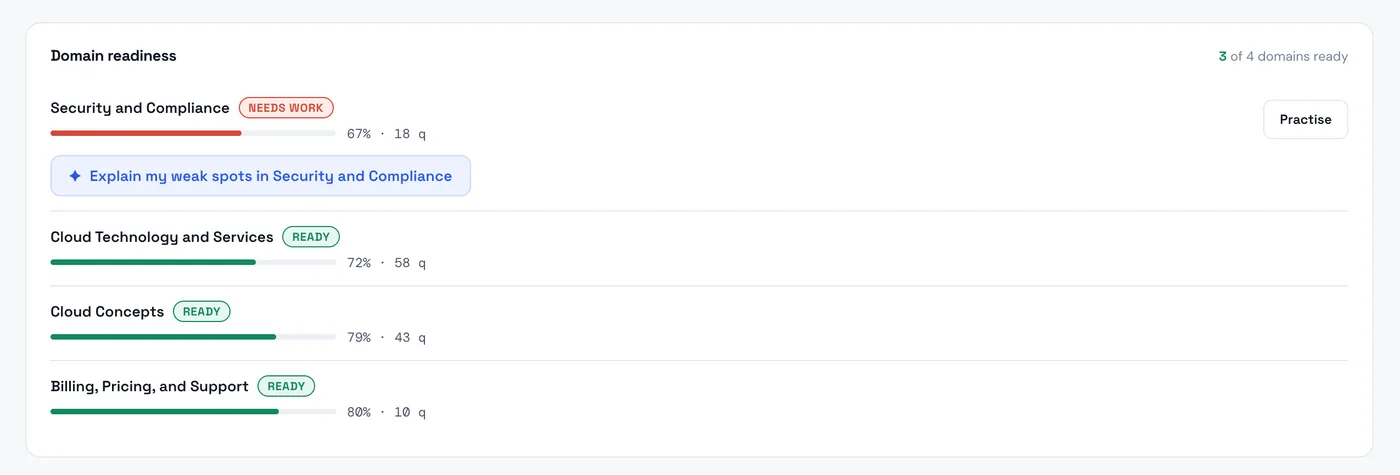
Certsqill’s KCSA practice questions come with an explanation for every answer option, and readiness is scored per domain across the six KCSA domains — so you know before exam day whether you are clear of the 75% pass mark everywhere, not just on average.
KCSA questions people ask
What is the KCSA certification?
The Kubernetes and Cloud Native Security Associate, a pre-professional Linux Foundation certification on cloud native security fundamentals. Source: Linux Foundation, checked 10 October 2026.
How much does the KCSA exam cost?
US$250 for the exam only, including one retake; US$495 bundled with a THRIVE-ONE subscription. Source: Linux Foundation KCSA page, checked 10 October 2026.
How long is the KCSA exam?
90 minutes, online, proctored and multiple choice. Source: Linux Foundation KCSA page, checked 10 October 2026.
How many questions are on the KCSA exam?
The Linux Foundation does not publish the number of questions. Checked 10 October 2026.
What is the KCSA passing score?
75% or above. Source: Linux Foundation Multiple Choice Exams FAQ, checked 10 October 2026.
Are there prerequisites for KCSA?
No. Source: Linux Foundation KCSA page, checked 10 October 2026.
How do I pass the KCSA exam?
Study all six domains against their weights, with most time on cluster component security and security fundamentals (22% each), and aim well above 75% in every domain.
How long is KCSA valid?
Two years. Passing CKS renews it automatically. Source: Linux Foundation, checked 10 October 2026.
Are KCSA dumps safe to use?
No. The Linux Foundation’s certification agreement prohibits braindump material and allows revocation of all your LF certifications. Checked 10 October 2026.

