Certified Medical Assistant (CMA AAMA): exam, eligibility and certification
A certified medical assistant is a medical assistant who holds the current CMA (AAMA) credential, awarded by the Certifying Board of the American Association of Medical Assistants after passing a 200-question exam. You qualify through one of AAMA’s eligibility routes, such as graduating from a CAAHEP- or ABHES-accredited program. The exam fee is $125 for AAMA members and recent graduates or $250 for nonmembers, the passing score is 405 on a 200 to 800 scale, and the credential must be renewed every 60 months.
- Credential
- CMA (AAMA), awarded by the Certifying Board of the AAMAAAMA Certification page, checked 18 October 2026
- Questions
- 200 multiple choice (180 scored, 20 pretest)AAMA Exam Content Outline, checked 18 October 2026
- Exam time
- 160 minutes in four 40-minute segmentsAAMA Certification page, checked 18 October 2026
- Passing score
- 405 on a scale of 200 to 800AAMA Certification page, checked 18 October 2026
- Exam fee
- $125 AAMA members and recent graduates, $250 nonmembersAAMA Eligibility page, checked 18 October 2026
- Eligibility
- CAAHEP- or ABHES-accredited program, Alternative Pathway, educator route or previous CMA (AAMA)AAMA Eligibility page, checked 18 October 2026
- Delivery
- PSI test center or live remote proctoringAAMA Testing options page, checked 18 October 2026
- Attempts
- Up to 6 within 12 months, no waiting period, new fee each timeAAMA Certification page, checked 18 October 2026
- Validity
- 60 months, renewed by continuing education or examAAMA Recertification page, checked 18 October 2026
Know if you're ready for CMA (AAMA) — before you book.
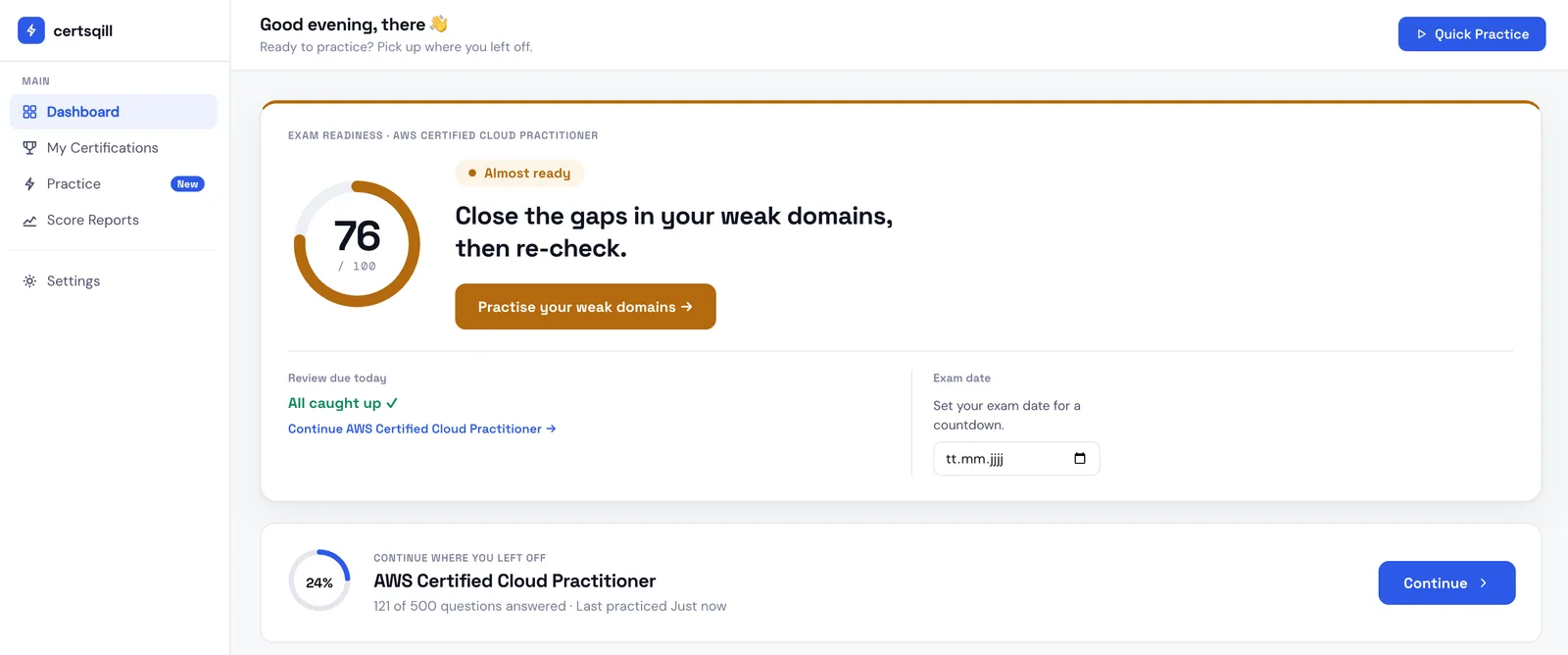
Certsqill measures your CMA (AAMA) readiness across every official exam domain — one 0–100 score built only from first-try answers and kept deliberately conservative, so a high number has to be earned. It tells you whether to book, keep studying, or sit.
Why people switch to Certsqill
Everything you need to walk in ready
Know where you stand, understand every mistake, and study in your language — one payment, no subscription.
Your CMA (AAMA) Readiness Score, not a guess
One conservative number from your first-try answers across every exam domain tells you whether to book the exam or keep studying.
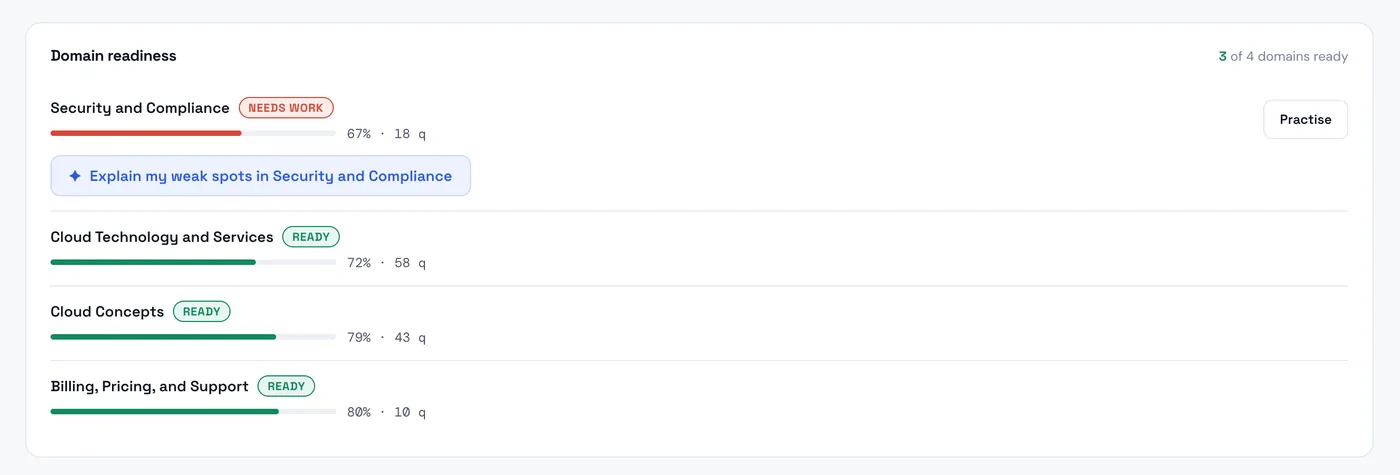
Understand every CMA (AAMA) mistake
When you miss a question, it explains why — using your own answer history to catch the patterns you keep repeating. Included, no subscription.
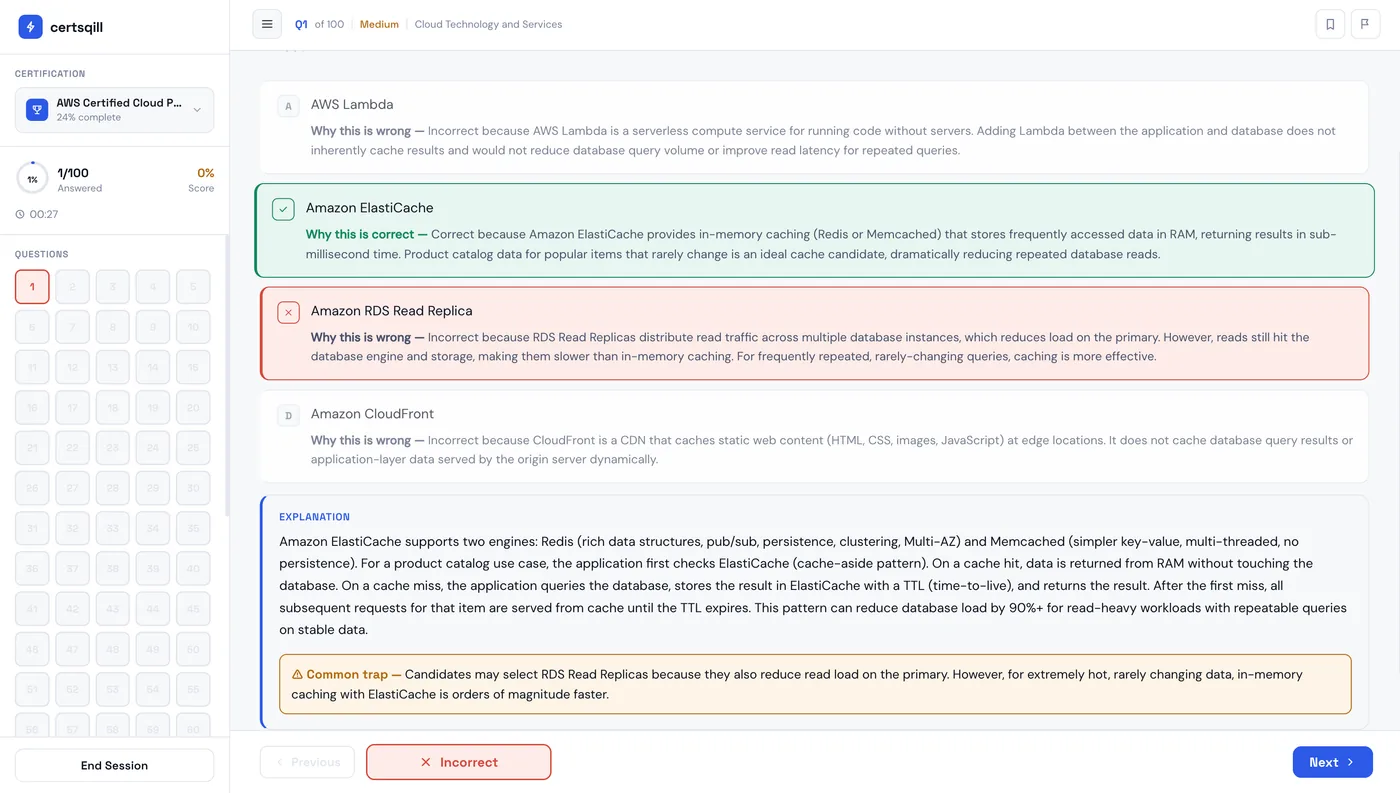
Explanations in your language, questions stay exam-accurate
Get every explanation in your language while the questions stay in exam-accurate English. Technical terms stay in English — the way the exam writes them.
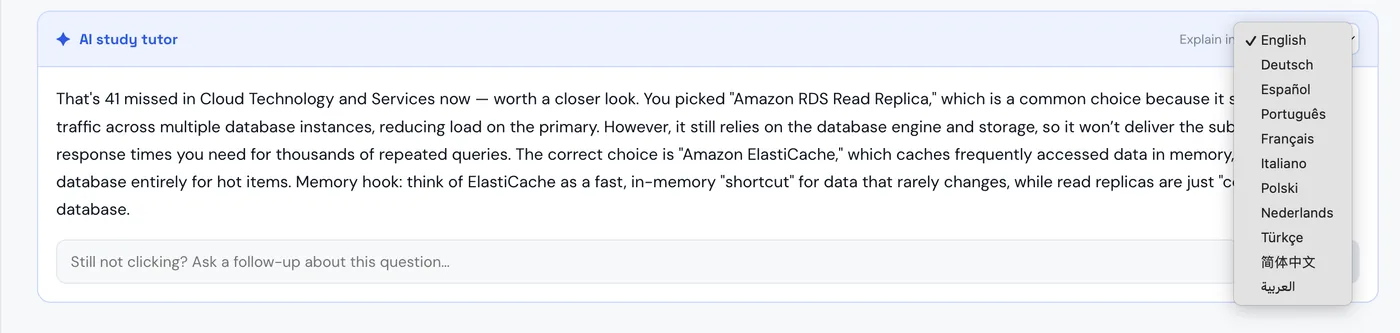
Everything you need to pass
Why you can trust these CMA (AAMA) questions
What is a certified medical assistant?
In AAMA’s usage, a certified medical assistant is a medical assistant who holds a current CMA (AAMA). The credential represents a medical assistant who has achieved certification through the Certifying Board of the AAMA and has been educated and tested in general, clinical and administrative responsibilities. AAMA calls it its flagship certification, and its certification program is accredited by the National Commission for Certifying Agencies (NCCA).
The title matters. Only people with a current CMA (AAMA) may use the CMA (AAMA) initialism or the title Certified Medical Assistant, and AAMA says the phrase certified medical assistant should not be used as a generic term for all medical assistants. If a job ad asks for an AAMA certified medical assistant, it means the certified medical assistant CMA certification described on this page, not the Certified Management Accountant, which shares the abbreviation.
Source: AAMA — The Misuse of Medical Assisting Credentials May Have Legal Consequences. Checked 18 October 2026.
What does a certified medical assistant do?
Certified medical assistant work combines clinical and administrative tasks. AAMA’s own lists include the following, and the exam tests the same mix. Medical assistants work alongside physicians, mainly in outpatient or ambulatory care facilities, and AAMA notes that most full-time medical assistants work a regular 40-hour week.
- Clinical: taking medical histories, preparing patients for examinations and assisting during them, collecting and preparing laboratory specimens, performing basic laboratory tests, phlebotomy, taking electrocardiograms, wound care, and preparing and administering medications, including intramuscular, intradermal and subcutaneous injections
- Administrative: welcoming patients, answering telephones, scheduling appointments, updating and filing medical records, coding and filling out insurance forms, arranging hospital admissions and laboratory services, billing and bookkeeping
Source: AAMA — Medical Assisting. Checked 18 October 2026.
CMA (AAMA) medical assistant certification exam: format and passing score
The certified medical assistant exam is computer-based: 200 multiple-choice questions in four 40-minute segments, 160 minutes of answering time in total. Of the 200 questions, 180 are scored and 20 are pretest items that do not count. PSI Services builds and administers the exam for AAMA.
Your score is based on the number of correct answers and reported on a scale from 200 to 800. The minimum passing score is 405. You see a pass/fail result as soon as you finish, and AAMA emails the official score report about 24 hours later.
Candidates get six opportunities to pass within 12 months of their first attempt. There is no waiting period between attempts, but each medical assistant exam attempt needs a new application and fee.
Source: AAMA — Certification. Checked 18 October 2026.
What the medical assistant test covers
AAMA publishes a content outline for its test for medical assistant certification. For exams before July 2027 the 180 scored questions split into three categories. From July 2027 a new outline applies, based on AAMA’s 2025 occupational analysis, with more weight on clinical content; the exam page for this certification lists both versions in detail.
- Clinical Competency: 106 questions (59%), covering clinical workflow, safety and infection control, procedures and examinations, and pharmacology
- General: 38 questions (21%), covering legal and ethical issues and communication
- Administrative: 36 questions (20%), covering billing, coding and insurance, scheduling appointments and health information management
Source: AAMA — CMA (AAMA) Exam Content Outline. Checked 18 October 2026.
Certification to be a medical assistant: who can take the exam
The CMA (AAMA) is not open to everyone. AAMA lists four routes. Most candidates come from certified medical assistant programs in the everyday sense: a medical assistant certificate program, diploma or degree that is accredited by CAAHEP or ABHES. AAMA states that the CMA (AAMA) is the only medical assisting certification that requires graduation from a postsecondary medical assisting program accredited by a body recognized by the U.S. Department of Education or CHEA.
So if you are asking how do I become a certified medical assistant, start with the program: check its accreditation before you enroll. The requirements page for this certification covers each route in detail.
- Student or graduate of a CAAHEP- or ABHES-accredited medical assisting program
- Alternative Pathway: graduate of a qualifying postsecondary medical assisting or apprenticeship program at an institution accredited by a USDE- or CHEA-recognized body
- Medical assisting educator with at least 1,000 hours in a postsecondary program
- Previously certified CMA (AAMA)
Source: AAMA — Eligibility. Checked 18 October 2026.
Online medical assistant certification programs
Medical assistant certification online is possible in part. The program can be delivered at a distance: under the policies for CAAHEP-accredited medical assisting programs, a distance education program lets students complete the entire curriculum through distance education, but students must still be placed in an on-ground practicum of at least 160 hours. Hybrid programs mix on-ground and distance instruction.
The exam itself can also be taken online: AAMA offers it at a PSI test center or by live remote proctoring. What does not exist is a fully online route that skips hands-on training. A certified medical assistant online certification still requires an eligible program, and medical assistant certification training without a practicum or accredited program does not qualify you for the CMA (AAMA) unless it meets the Alternative Pathway rules.
Source: MAERB — Policies and Procedures Manual for CAAHEP-Accredited Medical Assisting Programs (Feb. 2026). Checked 18 October 2026.
Applying for the AAMA medical assistant certification
You apply online through AAMA. Once AAMA approves your application, you contact PSI to schedule, and you have a 90-day period in which to take the exam. Fees are nonrefundable and cannot be moved to another candidate or another 90-day period.
The exam fee is $125 for AAMA members and $250 for nonmembers. Completing students and recent graduates of CAAHEP- or ABHES-accredited programs, meaning those who apply within 12 months of graduation, pay $125. Recent graduates do not have to send documents; the program director verifies program completion, including the practicum.
Source: AAMA — CMA (AAMA) Certification Exam Application and Policies (Rev. 1-26). Checked 18 October 2026.
Recertification: keeping your medical assistant certificate current
The CMA (AAMA) is current for 60 months. You recertify either by continuing education or by passing the exam again. By continuing education you need 60 CEUs, at least 10 each in administrative, clinical and general topics, and 30 of the 60 must be AAMA CEUs.
Current status is required to use the credential. If it has been expired for more than three months, you can no longer recertify by continuing education and must retake the exam.
Source: AAMA — Recertification. Checked 18 October 2026.
Medical assistant license vs. certification
A medical assistant license and a certification are different things. AAMA’s legal counsel puts it this way: a license is required by law; a certification is, with limited exceptions, not required by law. So in most cases certification for a medical assistant is an employer requirement or preference rather than a legal one. AAMA says many employers prefer, or even insist, that their medical assistants are CMA (AAMA) certified.
Some states do have a license for medical assistant roles. AAMA cites the medical assistant-certified (MA-C) and medical assistant-registered (MA-R) issued by the Washington State Department of Health. Rules vary by state, so check your state’s law. If you are looking for a national medical assistant certification rather than a state license, the CMA (AAMA) is issued by the Certifying Board of the AAMA, not by a state.
Source: AAMA — The Misuse of Medical Assisting Credentials May Have Legal Consequences. Checked 18 October 2026.
CMA (AAMA), RMA, CCMA and CMAA: other medical assistant credentials
Several organizations certify medical assistants, each with its own exam and rules. The Registered Medical Assistant (RMA) is issued by American Medical Technologists (AMT), which also sells its own registered medical assistant practice exam. If you need a registered medical assistant practice test, use AMT’s official one: CMA (AAMA) questions are written to AAMA’s outline, not AMT’s.
The National Healthcareer Association (NHA) issues the Certified Clinical Medical Assistant (CCMA) and the Certified Medical Administrative Assistant (CMAA). So a certified clinical medical assistant or a clinical medical assistant certificate is a different credential from the CMA (AAMA), and an administrative medical assistant certification such as the CMAA covers office work only. The CMA (AAMA) tests clinical, general and administrative content in one exam.
Source: AMT — Registered Medical Assistant (RMA). Checked 18 October 2026.
Certified medical assistant wages, careers and interview questions
The wage figures AAMA publishes come from its 2025 Compensation and Benefits Report, a survey with 12,596 responses. It reports that full-time CMAs (AAMA) earn an average of $23.55 per hour, or $45,159 a year. That average is the closest thing to an official certified medical assistant pay rate; certified medical assistant wages in your area depend on region, setting and experience, which the report breaks out separately.
For certified medical assistant careers, AAMA points to the duty lists above and to outpatient and ambulatory care as the main setting. AAMA does not publish medical assistant interview questions. A practical way to prepare for interview questions for medical assistant roles is to go through AAMA’s clinical and administrative duty lists and be ready to describe when you performed each task, for example during your practicum.
Source: AAMA — 2025 CMA (AAMA) Compensation and Benefits Report. Checked 18 October 2026.
CMA (AAMA) practice questions
Certsqill’s CMA (AAMA) practice questions are expert-developed and mapped to AAMA’s three content categories: clinical competency, general and administrative. Use them as a medical assistant practice test before you book your 90-day window.
Every question comes with an explanation for each answer option, and your results build a readiness score per exam category, so a practice test for medical assistant candidates shows you whether pharmacology, billing or legal and ethical issues need more work. AAMA itself offers 50 free questions each in anatomy and physiology and in medical terminology, plus a paid practice exam. A 7-day money-back guarantee applies.
Source: AAMA — Prepare. Checked 18 October 2026.
CMA (AAMA) questions people ask
What is a certified medical assistant?
A medical assistant who holds a current CMA (AAMA), awarded by the Certifying Board of the AAMA after passing its exam. Only current holders may use the title. Source: AAMA, checked 18 October 2026.
What is the certification for medical assistant roles called?
AAMA’s credential is the CMA (AAMA). Other organizations issue the RMA (AMT) and the CCMA and CMAA (NHA). Employers may ask for a specific one. Checked 18 October 2026.
How do you get certified as a medical assistant with AAMA?
Qualify through an eligibility route, usually a CAAHEP- or ABHES-accredited program, apply online, schedule with PSI within 90 days and score at least 405. Source: AAMA, checked 18 October 2026.
Is certification for a medical assistant required by law?
Usually not. AAMA says a certification is, with limited exceptions, not required by law, while a license is; some states, such as Washington, license medical assistants. Checked 18 October 2026.
Can I take the certified medical assistant exam online?
Yes. AAMA offers the exam at a PSI test center or by live remote proctoring. You still need to be approved for testing first. Source: AAMA, checked 18 October 2026.
What is the passing score for the CMA (AAMA) exam?
405 on a scale of 200 to 800. Source: AAMA, checked 18 October 2026.
How often can I retake the CMA (AAMA) exam?
Up to six attempts within 12 months of your first attempt, with no waiting period. Each attempt needs a new application and fee. Source: AAMA, checked 18 October 2026.
Is there a certified administrative medical assistant credential?
Not from AAMA. NHA issues the Certified Medical Administrative Assistant (CMAA). The CMA (AAMA) covers administrative, general and clinical content together. Checked 18 October 2026.
How long is the CMA (AAMA) valid?
60 months. You recertify with 60 CEUs or by passing the exam again. Source: AAMA, checked 18 October 2026.