GDSA certification: cost, exam format and objectives
GDSA is GIAC’s Defensible Security Architect certification, for designing network-centric and data-centric controls that balance prevention, detection and response. One proctored exam of 75 questions in 2 hours with a 63% passing score; a standalone attempt costs US$999, GIAC lists no prerequisites, and you renew with 36 credits over four years.
- Certification
- GIAC Defensible Security Architect (GDSA), issued by GIACGIAC GDSA page, checked 14 October 2026
- GDSA certification cost
- US$999 per standalone attempt; retake US$899GIAC pricing, prices exclude sales tax, checked 14 October 2026
- Questions
- 75GIAC GDSA page, checked 14 October 2026
- Time limit
- 2 hoursGIAC GDSA page, checked 14 October 2026
- Passing score
- 63% (exam version released on or after 3 August 2019)GIAC GDSA page, checked 14 October 2026
- Delivery
- One proctored exam — remote via ProctorU or onsite at Pearson VUE; open book (printed material only)GIAC GDSA page and proctor program overview, checked 14 October 2026
- Exam objectives
- 13, from Layer 1/2 defense to Zero Trust networking; no weightings publishedGIAC GDSA page, checked 14 October 2026
- Prerequisites
- None listed by GIACGIAC GDSA page, checked 14 October 2026
- Renewal
- 36 credits over four years; renewal fee US$499GIAC renewal page and pricing, checked 14 October 2026
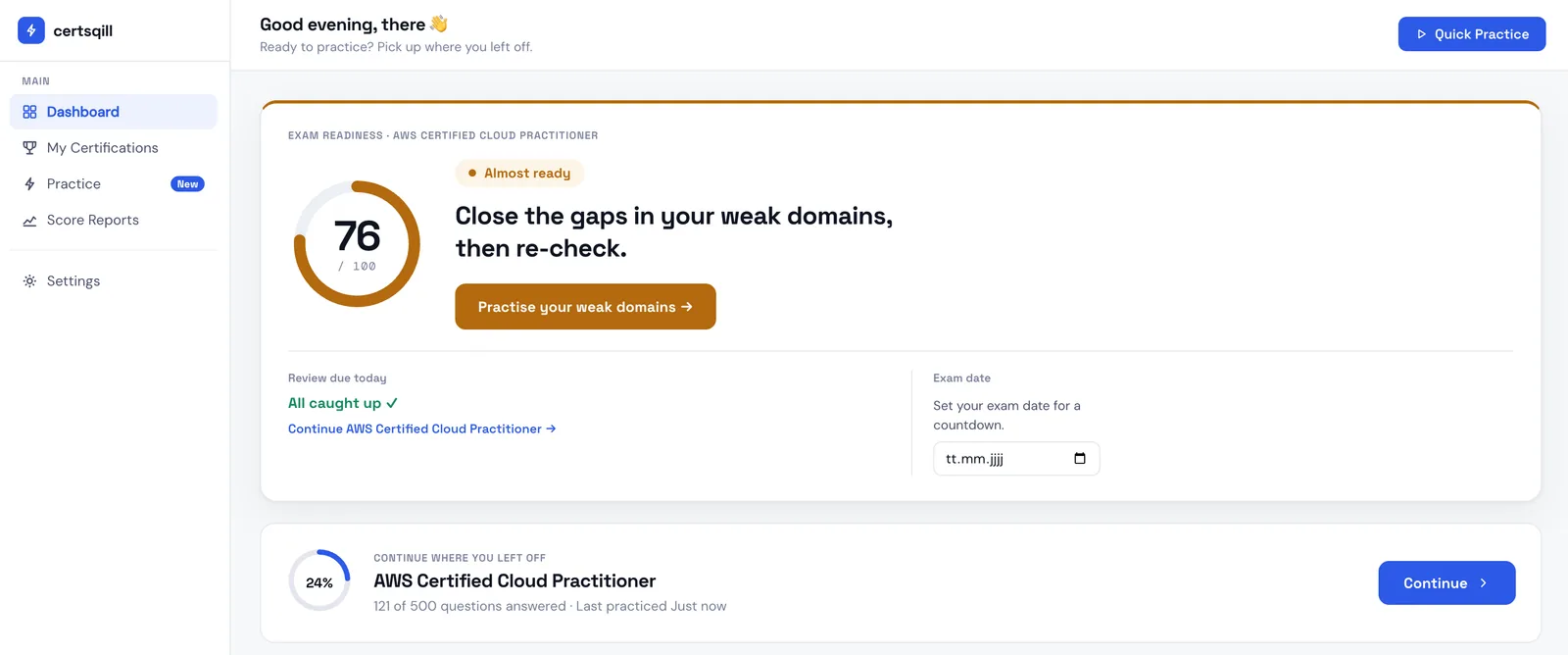
Know if you're ready for GDSA — before you book.
Certsqill measures your GDSA readiness across every official exam domain — one 0–100 score from coverage, accuracy and consistency that tells you whether to book, keep studying, or sit.
Why people switch to Certsqill
Everything you need to walk in ready
Know where you stand, understand every mistake, and study in your language — one payment, no subscription.
Your GDSA Readiness Score, not a guess
One number from three signals — coverage, accuracy, and consistency — tells you whether to book the exam or keep studying.
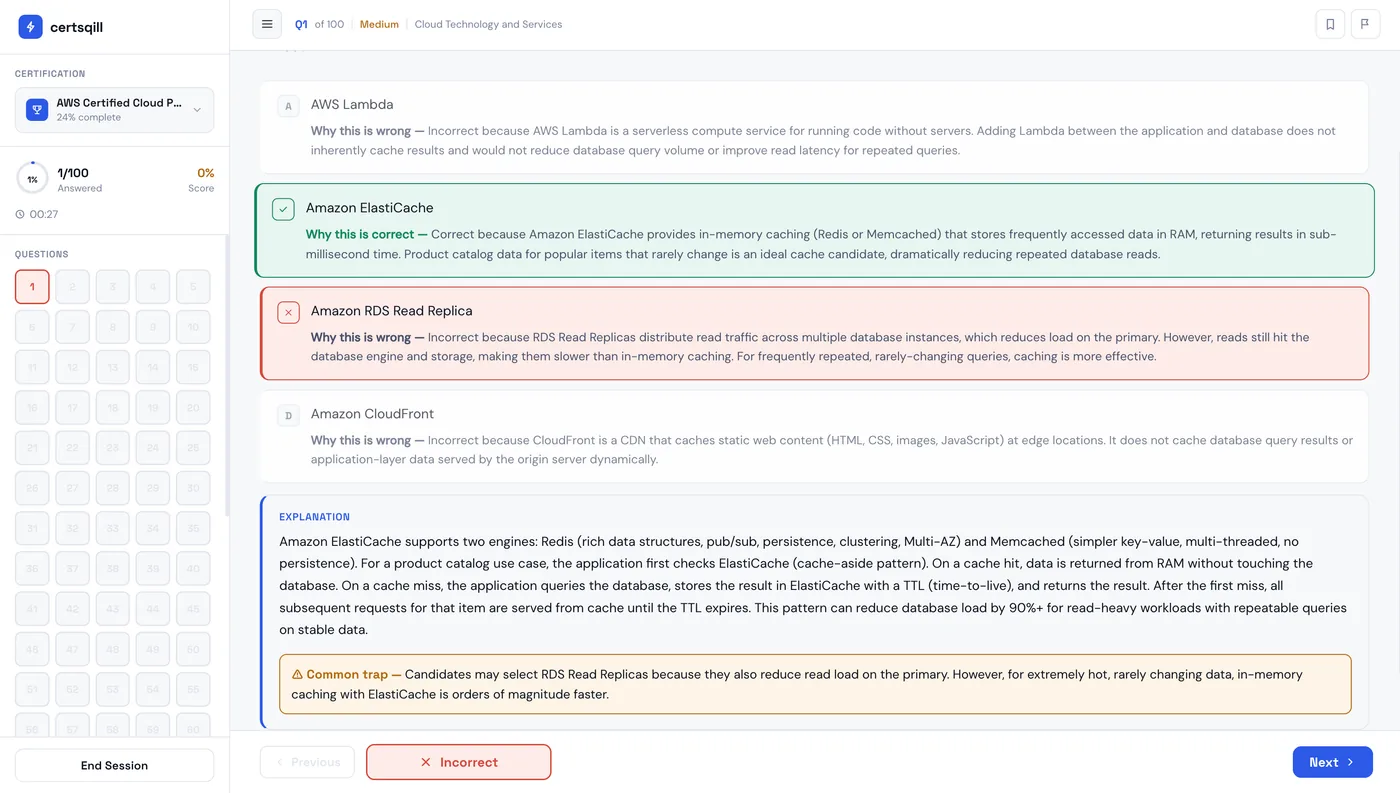
Understand every GDSA mistake
When you miss a question, it explains why — using your own answer history to catch the patterns you keep repeating. Included, no subscription.
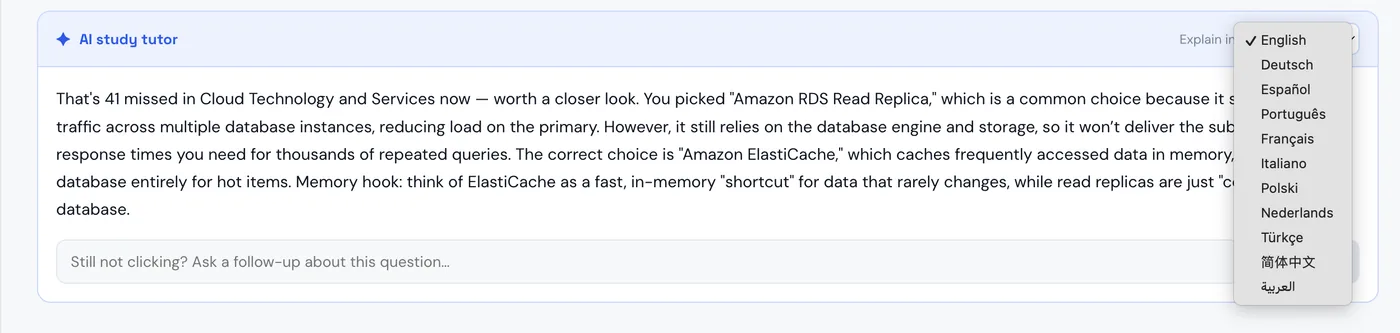
Explanations in your language, questions stay exam-accurate
Get every explanation in your language while the questions stay in exam-accurate English. Technical terms stay in English — the way the exam writes them.
Everything you need to pass
Why you can trust these GDSA questions
What is the GDSA certification?
GDSA is the GIAC Defensible Security Architect certification. GIAC’s pricing page and SANS list the same credential as GIAC Defensible Security Architecture; both names refer to the same GDSA exam.
GIAC says GDSA validates a practitioner’s ability to balance prevention, detection and response capabilities. Holders can design and implement network-centric and data-centric controls that add up to defense in depth, assess existing technology to improve those three capabilities, and apply Zero Trust principles.
The audience GIAC names is broad: security architects, network engineers and architects, security analysts, senior security engineers, system administrators, technical security managers, CND analysts, security monitoring specialists and cyber threat investigators. GIAC lists no prerequisites.
Source: GIAC — GIAC Defensible Security Architect (GDSA). Checked 14 October 2026.
How much does the GDSA certification cost?
GIAC’s pricing page lists a standalone GDSA certification attempt at US$999. A retake costs US$899, an attempt extension US$479, the renewal US$499 and an official practice exam US$399. GIAC sells no demo questions for GDSA.
Plan for two smaller fees as well: a missed proctored appointment costs a US$175 reseating fee (with a seven-day extension of your deadline), and additional renewals within two years of a full-price renewal cost US$249. All prices are in US dollars and exclude sales tax.
For training, SANS lists the OnDemand version of SEC530, the course linked to GDSA, at US$8,780.
Source: GIAC — Certification pricing and fees. Checked 14 October 2026.
GDSA exam format and passing score
The GDSA exam is one proctored exam with 75 questions and a 2-hour time limit — about 96 seconds per question.
GIAC has set the passing score at 63% for all candidates who receive the exam version released on or after 3 August 2019, based on a psychometric standard-setting study. GIAC asks candidates to confirm the passing score for their own attempt in their GIAC account.
GIAC offers two proctoring options: remotely with ProctorU or onsite at a Pearson VUE test center, and notes that both may not be available for every attempt. A standalone attempt gives you 120 days from activation to sit the exam.
Source: GIAC — GIAC Defensible Security Architect (GDSA). Checked 14 October 2026.
Is the GDSA exam open book?
Yes, in GIAC’s sense. You may bring hardcopy material: original course books from training you attended, handwritten or printed notes and an index. GIAC exams are not open internet or open computer, so no stored files, phones or other devices.
With 13 objectives in 120 minutes, an index is the real tool. A good one lets you look up a term like bogon filtering or single packet authentication in seconds; without one, the books cost more time than they save.
Source: GIAC — Proctor program overview. Checked 14 October 2026.
What is on the GDSA exam?
GIAC publishes 13 exam certification objectives for GDSA, without weightings. They run from the bottom of the stack to architecture models: Layer 1 and 2 attacks, routing and IPv6, proxies and firewalls, data-centric controls, cloud and containers, and three separate Zero Trust objectives.
- Cloud-Based Security Architecture — cloud security, on-premises hypervisors, segmentation, attack surface reduction, delivery models, container security
- Data Discovery, Governance, and Mobility Management — file classification, DLP, database governance, MDM
- Data-Centric Security — reverse proxies, web application firewalls, database firewalls, database activity monitoring
- Fundamental Layer 3 Defense — CIDR, routing attacks and mitigations, securing SNMP and NTP, bogon filtering
- Fundamental Security Architecture Concepts — presumption of compromise, Zero Trust model, Intrusion Kill Chain, Diamond Model, micro-segmentation
- IPv6 — addressing, dual-stack systems, tunneling, router advertisement attacks
- Layer 1/Layer 2 Defense — VLANs, CDP, MAC spoofing, ARP cache poisoning, DHCP starvation, VLAN hopping, 802.1X, NAC
- Network Defenses — NIDS, NIPS, network security monitoring, sandboxing, encryption, DDoS protection
- Network Encryption and Remote Access — secure remote access, dual-factor authentication for VPNs, jump boxes
- Network Proxies and Firewalls — web proxies, SMTP proxies, next-generation firewalls
- Zero Trust Endpoints — automated patching, privilege reduction, host hardening, host IDS/IPS, endpoint firewalls, log collection
- Zero Trust Fundamentals — Zero Trust architecture, credential rotation, pivoting adversaries, insider threats
- Zero Trust Networking — authenticating and encrypting endpoint traffic, domain isolation, single packet authentication, red herring defenses
Source: GIAC — GIAC Defensible Security Architect (GDSA). Checked 14 October 2026.
GDSA prerequisites
GIAC lists no formal prerequisites for GDSA, and training is not required to book the exam. GIAC itself names practical work experience, college-level courses and self-paced study as other ways to prepare.
The objectives do assume a working network background. SANS recommends the following before SEC530: a foundational understanding of security principles, knowledge of switches, routers and firewalls, some command-line experience on Linux and Windows, and experience with VMware and virtual machines. That is a fair benchmark for the exam as well.
Source: SANS Institute — SEC530 course page. Checked 14 October 2026.
GDSA training: SANS SEC530
The SANS course linked to GDSA is SEC530: Defensible Security Architecture and Engineering: Implementing Zero Trust for the Hybrid Enterprise. SANS offers it as six days instructor-led or 36 hours self-paced, worth 36 CPEs, and lists the OnDemand version at US$8,780.
Because GDSA is open book, the course books double as exam material, which is one reason many candidates take the course route. It remains optional: GIAC accepts candidates who prepare on their own from the published objectives.
Source: SANS Institute — SEC530 course page. Checked 14 October 2026.
GDSA practice test and exam dumps
GIAC sells an official GDSA practice exam for US$399. GIAC says practice tests simulate the real exam format and test engine, that they never include actual exam questions, and that the practice bank is limited, so you may see the same question on more than one test.
GIAC’s exam integrity policy lists any use of or reference to exam dump sites with actual or possible GIAC questions as a violation. Sanctions include revocation of previously issued GIAC certifications and bans from future GIAC certifications.
Source: GIAC — Exam integrity policy. Checked 14 October 2026.
GDSA renewal
GIAC certifications are kept active by collecting 36 credits over four years. The GDSA renewal fee is US$499; further renewals within two years of a full-price renewal cost US$249, which helps if you hold several GIAC certifications.
Source: GIAC — Certification renewal. Checked 14 October 2026.
GDSA vs GCED
GCED, the GIAC Certified Enterprise Defender, is the other defense-focused GIAC exam people weigh against GDSA. GCED is longer — 115 questions in 3 hours, with a 69% passing score for the version released on or after 1 October 2022 — and spans network defense, packet analysis, penetration testing, incident handling and malware removal.
GDSA is narrower and more design-oriented: 75 questions in 2 hours at 63%, centred on how to architect controls rather than how to respond once something has happened. GIAC publishes no salary data for either, so choose by whether your job is building the defenses or operating them.
Source: GIAC — GIAC Certified Enterprise Defender (GCED). Checked 14 October 2026.
GDSA practice questions
Certsqill’s GDSA practice questions are expert-developed and mapped to GIAC’s 13 exam objectives, from Layer 1/2 defense to Zero Trust networking.
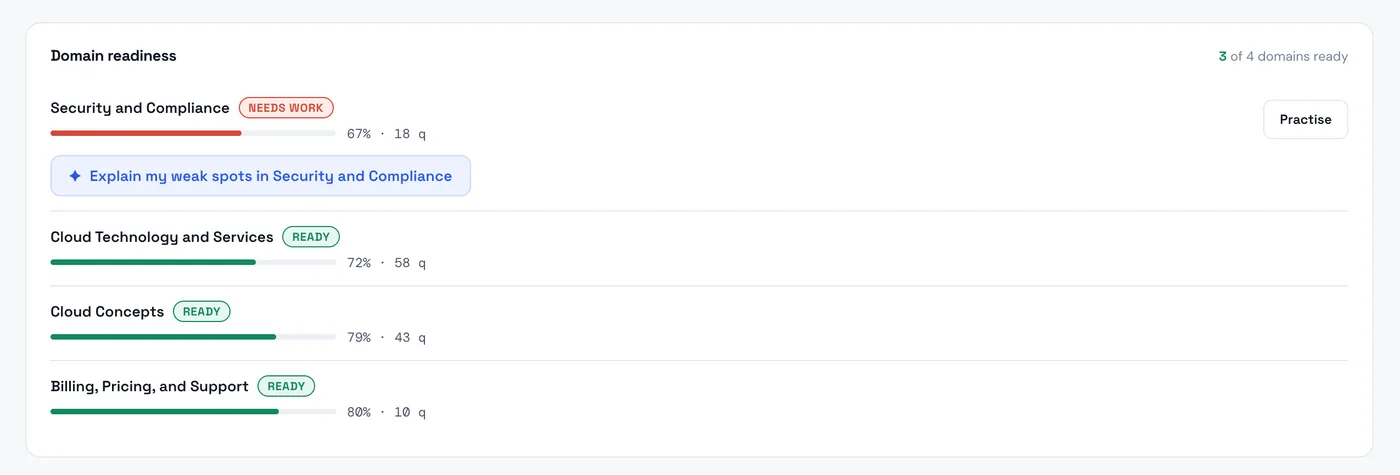
Every question comes with an explanation for each answer option, and your results build a readiness score per domain, so you can see whether IPv6, data-centric security or the Zero Trust objectives still need work before your 120-day window runs out. A 7-day money-back guarantee applies.
GDSA questions people ask
What is the GDSA certification?
The GIAC Defensible Security Architect certification, validating the ability to design network-centric and data-centric controls that balance prevention, detection and response. Source: GIAC, checked 14 October 2026.
How much does the GDSA exam cost?
US$999 for a standalone attempt; a retake costs US$899 and a practice exam US$399, excluding sales tax. Source: GIAC pricing, checked 14 October 2026.
How many questions are on the GDSA exam?
75 questions in one proctored exam with a 2-hour limit. Source: GIAC GDSA page, checked 14 October 2026.
What is the GDSA passing score?
63% for exam versions released on or after 3 August 2019. Source: GIAC GDSA page, checked 14 October 2026.
Is the GDSA exam open book?
Yes, for printed books and notes; no internet, stored files or devices. Source: GIAC proctor program overview, checked 14 October 2026.
Which SANS course prepares for GDSA?
SEC530: Defensible Security Architecture and Engineering — six days instructor-led or 36 hours self-paced. Optional for the exam. Source: SANS Institute, checked 14 October 2026.
Are there prerequisites for the GDSA certification?
GIAC lists none. SANS recommends networking, command-line and virtualization experience before SEC530. Source: GIAC and SANS, checked 14 October 2026.
Can I take the GDSA exam online?
Yes. GIAC offers remote proctoring through ProctorU as well as onsite testing at Pearson VUE, though both may not be available for every attempt. Source: GIAC, checked 14 October 2026.
How do I renew GDSA?
Collect 36 credits over four years and pay the US$499 renewal fee. Source: GIAC, checked 14 October 2026.

