LFCS certification: cost, hands-on exam format and passing score
The LFCS certification (Linux Foundation Certified System Administrator) is a hands-on Linux exam from the Linux Foundation. It costs $445, gives you 2 hours for 17–20 performance-based tasks in a Linux terminal, requires 67% to pass, has no prerequisites and is valid for 2 years.
- Certification
- Linux Foundation Certified System Administrator (LFCS)Linux Foundation LFCS page, checked 8 October 2026
- Exam fee
- $445 exam only · $645 with the LFS207 courseLinux Foundation LFCS page, checked 8 October 2026
- Format
- Online, proctored, performance-based — 17–20 tasks in a Linux terminalLinux Foundation LFCS page and LFCS instructions, checked 8 October 2026
- Duration
- 2 hoursLinux Foundation LFCS page, checked 8 October 2026
- Passing score
- 67% or aboveLinux Foundation LFCS instructions, checked 8 October 2026
- Prerequisites
- NoneLinux Foundation LFCS page, checked 8 October 2026
- Included
- 12-month exam eligibility, one retake, two simulator sessionsLinux Foundation LFCS page, checked 8 October 2026
- Validity
- 2 years; renewed by passing the same exam againLinux Foundation Candidate Handbook, checked 8 October 2026
- Languages
- English, German, Japanese, Simplified ChineseLinux Foundation Candidate Handbook, checked 8 October 2026
Know if you're ready for LFCS — before you book.
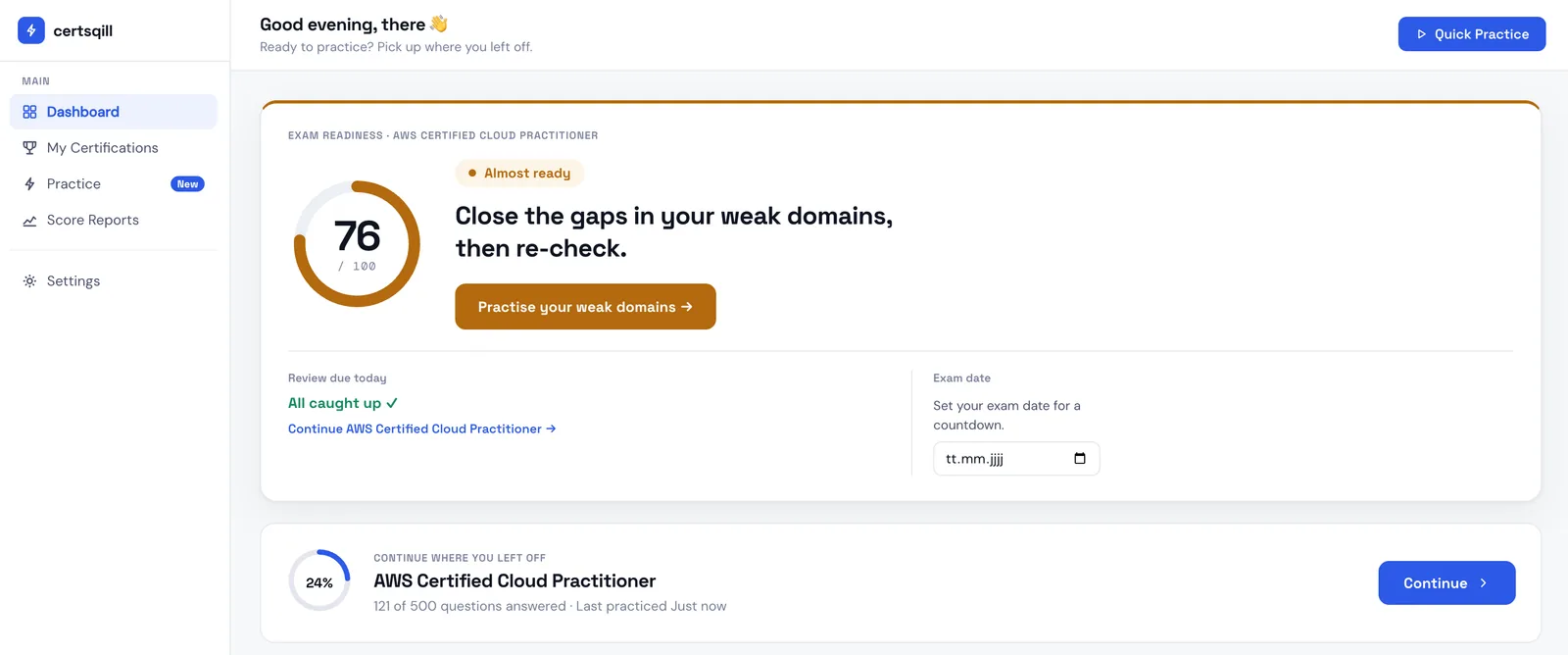
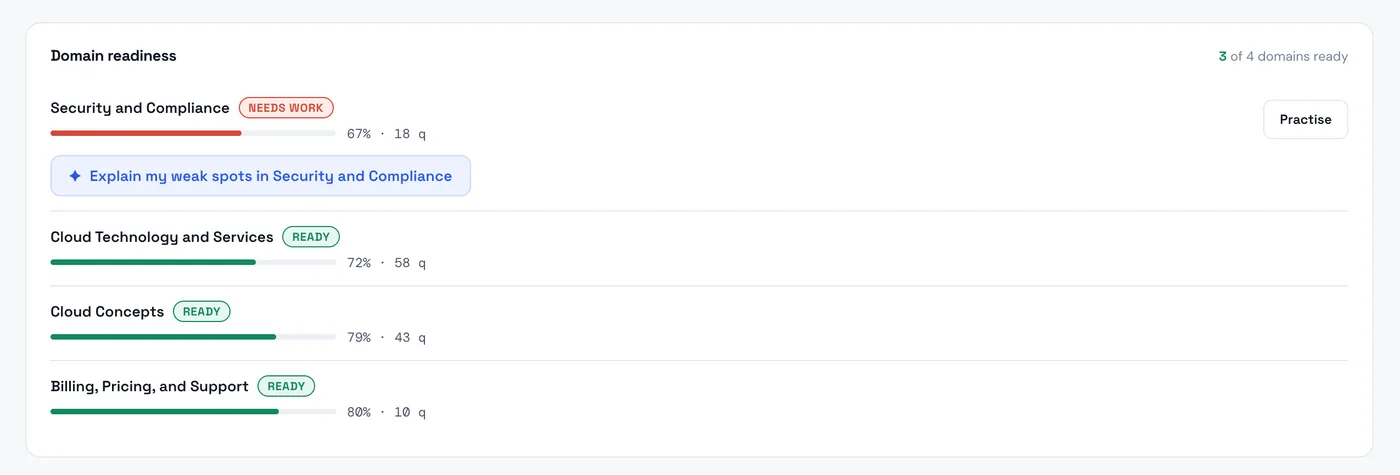
Certsqill measures your LFCS readiness across every official exam domain — one 0–100 score from coverage, accuracy and consistency that tells you whether to book, keep studying, or sit.
Why people switch to Certsqill
Everything you need to walk in ready
Know where you stand, understand every mistake, and study in your language — one payment, no subscription.
Your LFCS Readiness Score, not a guess
One number from three signals — coverage, accuracy, and consistency — tells you whether to book the exam or keep studying.
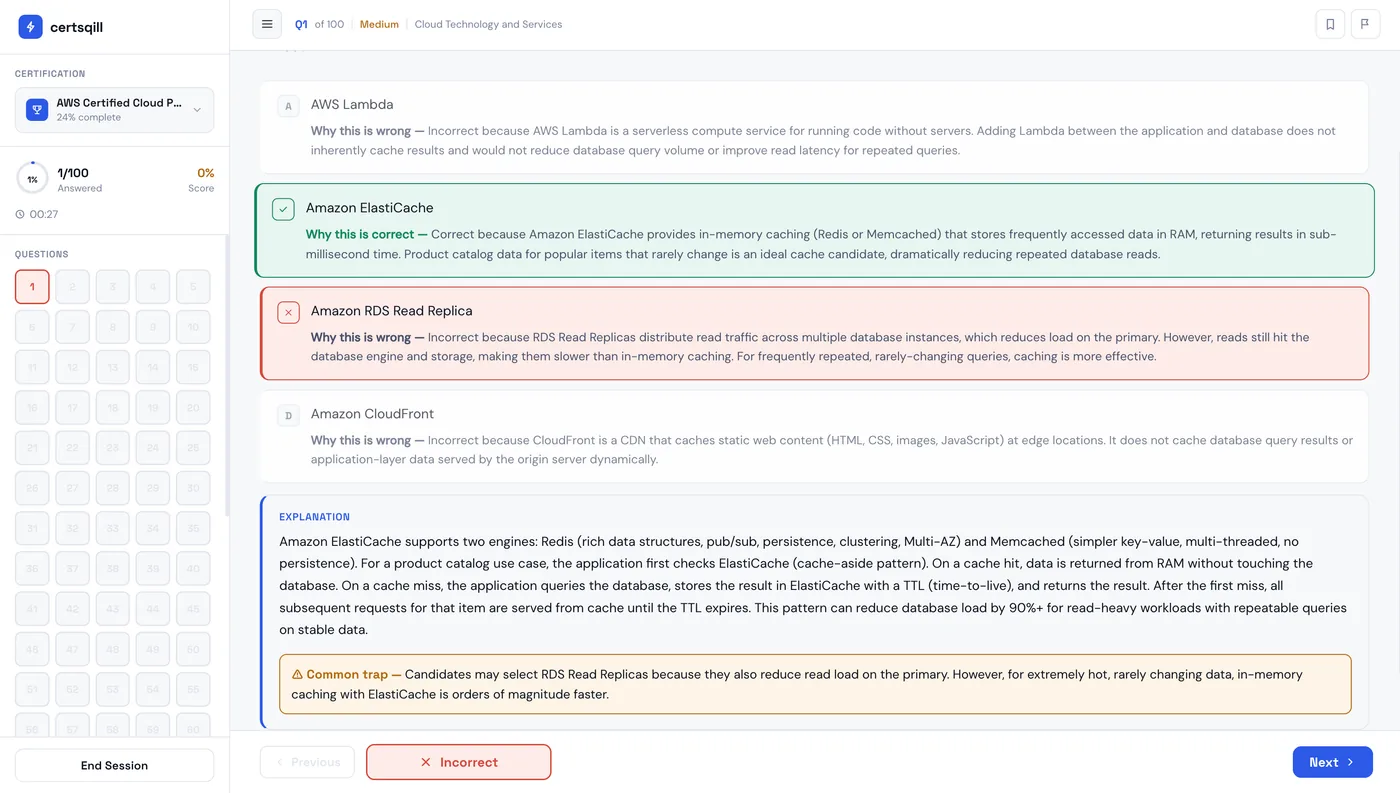
Understand every LFCS mistake
When you miss a question, it explains why — using your own answer history to catch the patterns you keep repeating. Included, no subscription.
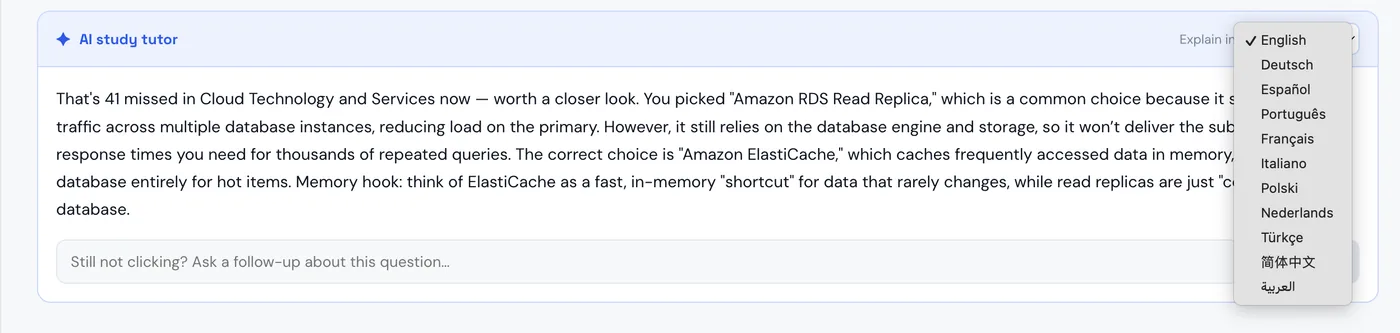
Explanations in your language, questions stay exam-accurate
Get every explanation in your language while the questions stay in exam-accurate English. Technical terms stay in English — the way the exam writes them.
Everything you need to pass
Why you can trust these LFCS questions
What is the LFCS certification?
LFCS stands for Linux Foundation Certified System Administrator. The Linux Foundation describes it as ideal for candidates looking to validate their Linux system administrator skills — running services, managing storage and networking, handling users and permissions, and keeping systems healthy.
Two things define it. First, it is performance-based: you do real administration work in a live Linux terminal instead of answering multiple-choice questions. Second, the Linux Foundation states that the exam is independent of distribution-specific tasks, so it tests Linux administration in general rather than one vendor’s distribution.
For many people LFCS sits underneath the Kubernetes certifications from the same issuer. CKA, CKAD and CKS are all solved in a Linux shell, so solid command-line administration is useful groundwork for them, although none of them formally requires LFCS.
Source: Linux Foundation — LFCS certification page. Checked 8 October 2026.
How much does the LFCS certification cost?
The Linux Foundation lists the LFCS exam at $445 for the exam only. Two bundles are offered: exam plus THRIVE-ONE subscription for $625, and exam plus its Linux System Administration Essentials course (LFS207) for $645.
The registration includes 12 months to schedule and take the exam, one retake and two simulator sessions, so the $445 is not tied to a single attempt.
Renewal works by retaking and passing the same exam before expiry, according to the Linux Foundation’s candidate handbook. Budget for another registration every two years if you need the credential to stay current.
Source: Linux Foundation — LFCS certification page. Checked 8 October 2026.
What is the LFCS exam format?
The LFCS is an online, proctored, performance-based test lasting 2 hours. The Linux Foundation’s instructions state that it consists of 17–20 performance-based tasks.
During the exam you are not on the open web. Allowed resources are man pages, documents installed by the distribution (such as /usr/share and its subdirectories) and packages that are part of the distribution — and they must be accessed from within the Linux terminal on which the exam is delivered. Knowing how to find answers with man and the local documentation is therefore part of the skill being tested.
The Linux Foundation does not name the distribution or version used in the exam environment on the pages checked; it only states that the exam is independent of distribution-specific tasks.
Source: Linux Foundation — Important Instructions: LFCS. Checked 8 October 2026.
LFCS passing score
The Linux Foundation states that a score of 67% or above must be earned to pass the LFCS.
Because the score comes from the end state of the systems you worked on, it rewards finished, correct work. A service configured but not enabled at boot, or a mount that does not survive a reboot, may count as not done. With 17–20 tasks in 2 hours, you have on average six to seven minutes per task.
In preparation, practise verifying your own work — checking status, rebooting test systems, re-reading the task — as deliberately as you practise the configuration itself.
Source: Linux Foundation — Important Instructions: LFCS. Checked 8 October 2026.
What is on the LFCS exam?
The Linux Foundation publishes five domains with weightings. Operations deployment and networking together account for half of the exam. Operations deployment covers areas such as kernel parameters, processes and services, scheduling, packages, virtual machines, containers and SELinux; networking reaches from IPv4/IPv6 and name resolution to firewalling, routing, bonding and reverse proxies.
The remaining half is split across storage (LVM, filesystems, swap, network and remote block storage, automounters), essential commands (including basic Git, service configuration, performance and disk-space troubleshooting, SSL certificates) and users and groups (local accounts, environment profiles, resource limits, ACLs and LDAP accounts).
- Operations Deployment — 25%
- Networking — 25%
- Storage — 20%
- Essential Commands — 20%
- Users and Groups — 10%
Source: Linux Foundation — LFCS certification page. Checked 8 October 2026.
LFCS prerequisites
There are none. The Linux Foundation states: “There are no prerequisites for this exam.” No prior certification, degree or documented experience is required.
Practically, the exam assumes you can work productively in a shell without a graphical interface, because every task is solved in a terminal and the only help available is local documentation.
Source: Linux Foundation — LFCS certification page. Checked 8 October 2026.
How long is the LFCS certification valid?
The LFCS is valid for 2 years. The Linux Foundation’s candidate handbook states that certifications become non-current 24 months after the date you pass, unless renewed.
You keep the certification current by retaking and passing the same exam before it expires; it then becomes current for another 2 years from the date of the new pass.
Source: Linux Foundation — Candidate Handbook: Certificates and Certification. Checked 8 October 2026.
LFCS study materials and training
The Linux Foundation’s course for this exam is Linux System Administration Essentials (LFS207), sold on its own or bundled with the exam for $645.
Each registration includes two simulator sessions with 36 hours of access each; the Linux Foundation states that the simulator includes 20–25 questions and provides graded results. Treat the first run as a diagnosis and the second as a dress rehearsal.
The rest of the official material is on your own machine: the man pages and installed documentation are exactly what you are allowed to use in the exam, so practising with them instead of a web search builds the habit you will need.
Source: Linux Foundation — LFCS certification page. Checked 8 October 2026.
LFCS vs RHCSA
Both are performance-based Linux administration exams, but they differ in scope. The Linux Foundation states that the LFCS is independent of distribution-specific tasks. Red Hat’s RHCSA exam (EX200), by contrast, is based on Red Hat Enterprise Linux 10, so it tests administration of one specific distribution.
They also differ in what is published. The Linux Foundation lists the LFCS price ($445), duration (2 hours) and passing score (67%). Red Hat’s RHCSA exam page does not state a price, a duration or a passing score on the pages checked.
The choice usually follows the environment you work in: Red Hat Enterprise Linux shops point to RHCSA; mixed or distribution-agnostic environments point to LFCS.
Source: Red Hat — RHCSA exam (EX200). Checked 8 October 2026.
LFCS practice questions
Because the LFCS is scored on work done in a live terminal, knowledge questions complement hands-on practice and do not replace it. They are useful for the layer beneath the commands — which file controls persistent mounts, what a given permission bit does, how routing decisions are made — so that terminal practice goes into execution rather than into looking things up.
Certsqill’s LFCS practice questions explain each option and follow the Linux Foundation’s published domain weightings.
LFCS questions people ask
How much does the LFCS exam cost?
$445 for the exam only, including one retake and two simulator sessions. With the LFS207 course it is $645. Source: Linux Foundation, checked 8 October 2026.
Is the LFCS exam hands-on?
Yes. It is an online, proctored, performance-based test of 17–20 tasks in a Linux terminal. Source: Linux Foundation, checked 8 October 2026.
How long is the LFCS exam?
2 hours. Source: Linux Foundation, checked 8 October 2026.
What is the LFCS passing score?
67% or above. Source: Linux Foundation LFCS instructions, checked 8 October 2026.
Which Linux distribution does the LFCS use?
The Linux Foundation does not name one; it states the exam is independent of distribution-specific tasks, checked 8 October 2026.
Can I use the internet during the LFCS exam?
No. Allowed resources are man pages, documentation installed by the distribution and distribution packages, used from within the exam terminal. Source: Linux Foundation, checked 8 October 2026.
How long is the LFCS valid?
2 years. You renew by retaking and passing the same exam before it expires. Source: Linux Foundation Candidate Handbook, checked 8 October 2026.
Is the LFCS available in German?
Yes. The LFCS is offered in English, German, Japanese and Simplified Chinese. Source: Linux Foundation Candidate Handbook, checked 8 October 2026.
Is the Linux Foundation Certified System Administrator (LFCS) certification worth it?
The Linux Foundation Certified System Administrator (LFCS) certification is worth it mainly for one reason: it is earned by doing the work, not by recognising answers. A pass shows that you configured services, storage, networking and users correctly in a live terminal under time pressure — which is closer to the job than any multiple-choice result.
It fits best if you administer Linux across more than one distribution, or if you are building towards the Kubernetes certifications from the same issuer, which are also solved in a shell. If your organisation standardises on Red Hat Enterprise Linux, compare it with RHCSA first, as covered above.
On cost, the $445 registration includes one retake and two simulator sessions, and renewal means passing the exam again every two years. The Linux Foundation publishes no salary data for LFCS holders, so we do not put a number on the return.
Source: Linux Foundation — LFCS certification page. Checked 8 October 2026.
How to prepare for a performance-based Linux exam
Because every task is checked on the end state of the system, the most useful preparation is repetition on real machines: set something up, reboot, and confirm it still works. A local virtual machine or two is enough to rehearse every domain, including storage tasks such as LVM and persistent mounts.
Practise finding answers the way the exam allows — with man pages and the documentation under /usr/share — rather than with a web search. Speed at locating the right option in a man page is a real advantage when you have roughly six to seven minutes per task.
Save both simulator sessions for the second half of your preparation. The first tells you which domains still slow you down; the second shows whether that has changed.
LFCS dumps: why they do not help, and what they cost
A performance-based exam leaves little for a dump to offer: knowing the wording of a task does not configure the system for you. But the bigger risk is the rulebook.
The Linux Foundation’s Global Certification and Confidentiality Agreement prohibits disclosing or transmitting any exam and related information, and names “using recollections of others or materials from previous administration of any Exam, a.k.a. braindump material” as misconduct. The sanctions it lists include revoking all certifications earned and a permanent ban from future Linux Foundation certifications.
Source: Linux Foundation — Global Certification and Confidentiality Agreement. Checked 9 October 2026.
More LFCS questions
Is the LFCS certification worth it?
It is a strong fit if you administer Linux across distributions or plan to take CKA, CKAD or CKS. It is earned with hands-on tasks, which is what makes it credible.
Are LFCS dumps allowed?
No. The Linux Foundation’s certification agreement names braindump material as misconduct and allows revocation of certifications and a permanent ban. Checked 9 October 2026.
What is the best way to practise for the LFCS?
Work through every domain on your own virtual machines, verify each result after a reboot, look things up only in man pages and local documentation, and use the two included simulator sessions late in your preparation.

