RBT certification: exam, cost and requirements
4.6/5 873 verified reviews
RBT certification is the BACB’s paraprofessional credential in behavior analysis. To get RBT certified you need to be 18, have a high school education, pass background checks, complete a 40-hour training and a competency assessment, then pass an 85-question, 90-minute exam at Pearson VUE. Fees: $65 application plus $45 exam.
- Certification
- Registered Behavior Technician (RBT), Behavior Analyst Certification Board (BACB)BACB, checked 12 November 2026
- Questions
- 85 multiple choice (75 scored, 10 unscored)RBT Handbook, checked 12 November 2026
- Duration
- 90 minutesRBT Handbook, checked 12 November 2026
- Passing score
- Pass/fail; cut score set by the modified Angoff methodRBT Handbook, checked 12 November 2026
- Delivery
- In person at Pearson VUE test centersRBT Handbook, checked 12 November 2026
- Requirement
- 18+, high school education, background checks, 40-hour training, competency assessmentRBT Handbook, checked 12 November 2026
- Price
- $65 application (BACB) + $45 exam (Pearson VUE)RBT Handbook, checked 12 November 2026
- Valid for
- Renewed yearly through 2026; then a 2-year cycle with 12 PDUsRBT Handbook, checked 12 November 2026
Know if you're ready for RBT — before you book.
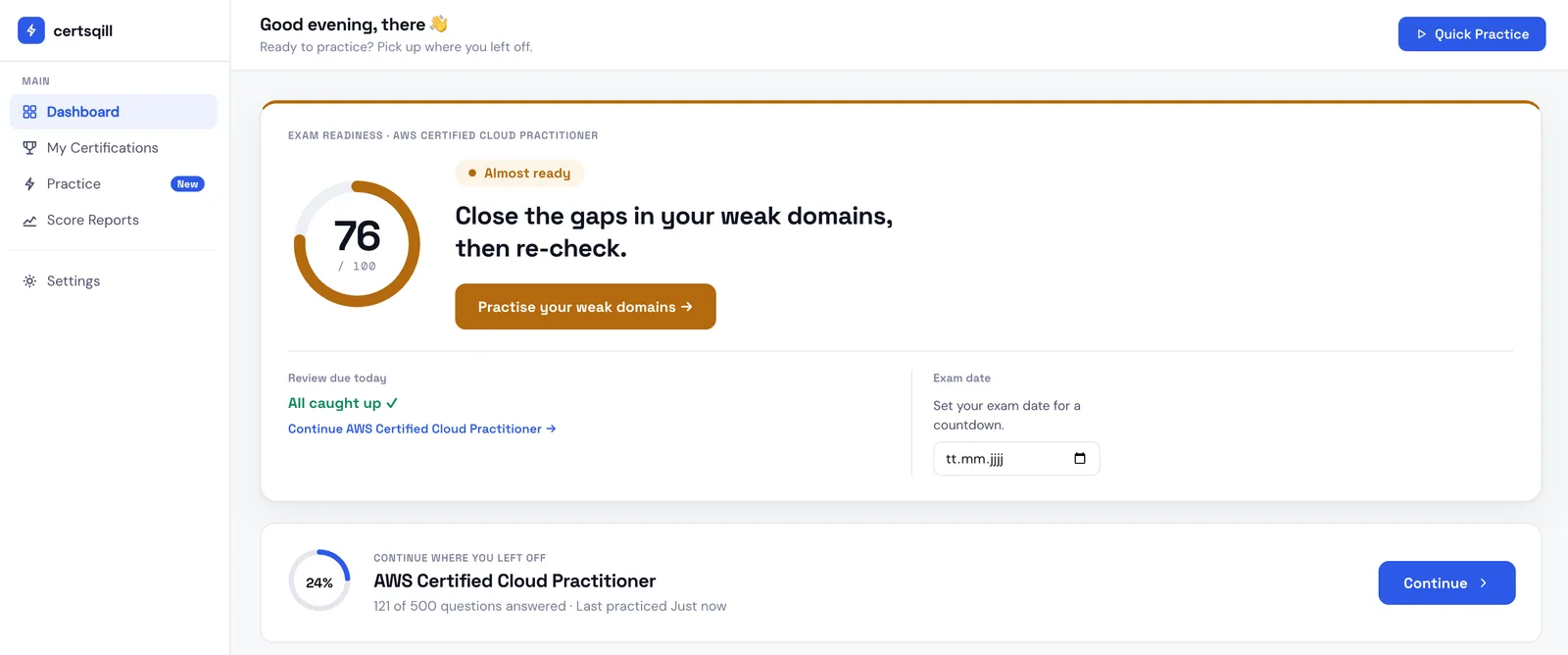
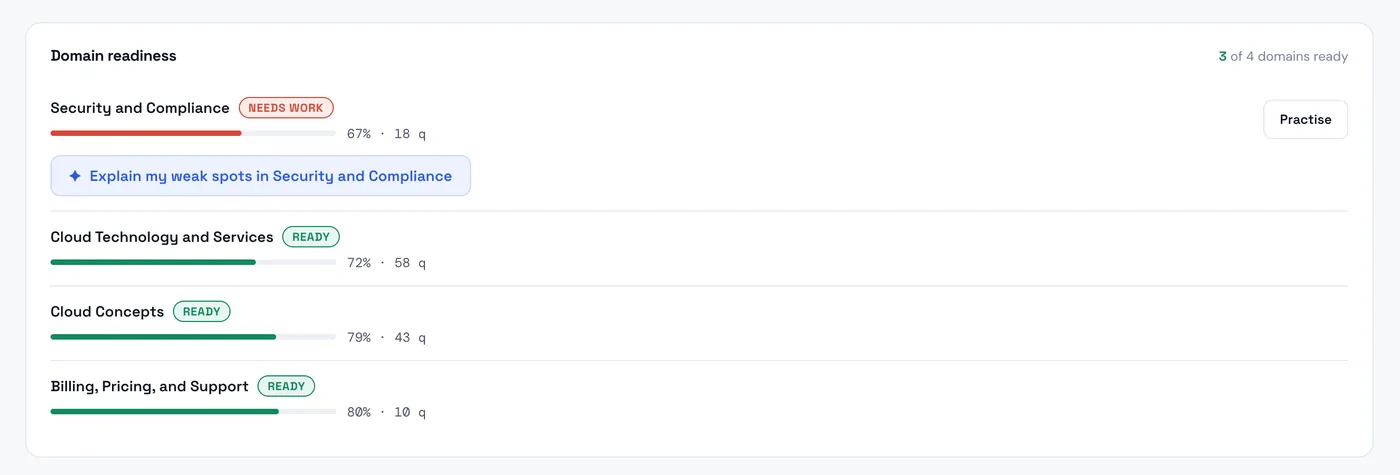
Certsqill measures your RBT readiness across every official exam domain — one 0–100 score built only from first-try answers and kept deliberately conservative, so a high number has to be earned. It tells you whether to book, keep studying, or sit.
Why people switch to Certsqill
Everything you need to walk in ready
Know where you stand, understand every mistake, and study in your language — one payment, no subscription.
Your RBT Readiness Score, not a guess
One conservative number from your first-try answers across every exam domain tells you whether to book the exam or keep studying.
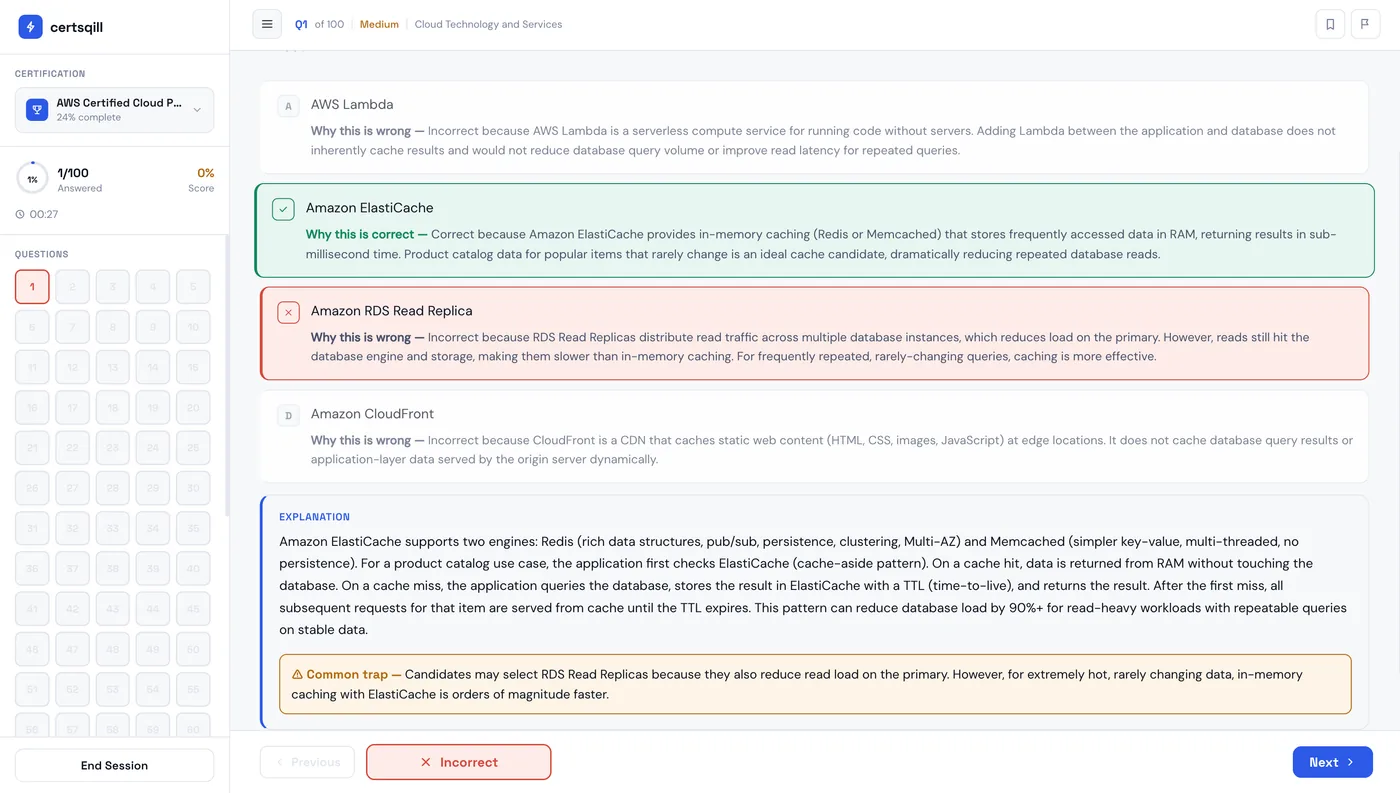
Understand every RBT mistake
When you miss a question, it explains why — using your own answer history to catch the patterns you keep repeating. Included, no subscription.
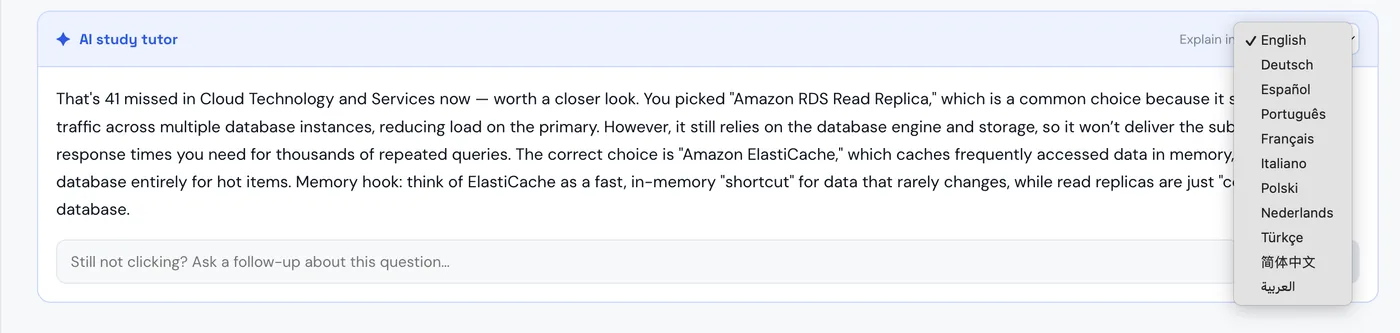
Explanations in your language, questions stay exam-accurate
Get every explanation in your language while the questions stay in exam-accurate English. Technical terms stay in English — the way the exam writes them.
Everything you need to pass
Why you can trust these RBT questions
What is RBT certification?
What is RBT certification? The Registered Behavior Technician (RBT) certification is a paraprofessional certification in behavior analysis, issued by the Behavior Analyst Certification Board (BACB). A registered behavior technician RBT certification holder delivers behavior-analytic services under the direction and close supervision of an RBT Supervisor or RBT Requirements Coordinator.
What is a certified RBT allowed to do on their own? Nothing without supervision: RBTs must obtain ongoing supervision for at least 5% of the hours they spend providing services each calendar month.
Source: BACB — Registered Behavior Technician (RBT). Checked 12 November 2026.
How much does RBT certification cost?
The RBT Handbook lists two fees: a $65 application processing fee paid to the BACB and $45 for the exam appointment paid to Pearson VUE. The 40-hour training, background checks and competency assessment are not BACB fees; their cost depends on the provider. There is no free RBT certification online.
Source: BACB — RBT Handbook (updated October 2026). Checked 12 November 2026.
What is the RBT exam format?
The RBT test is 90 minutes long and has 85 multiple-choice questions: 75 scored and 10 unscored. Each question has four options with one correct answer. It is delivered in person at Pearson VUE test centers, so there is no fully online RBT certification exam.
Source: BACB — RBT Handbook (updated October 2026). Checked 12 November 2026.
RBT passing score
The exam is pass/fail. The BACB sets the passing score with the modified Angoff method and does not state a percentage in the handbook. You can retake the exam up to 8 times within 12 months, with at least 7 days between attempts. More detail on the RBT exam page.
Source: BACB — RBT Handbook (updated October 2026). Checked 12 November 2026.
What is on the RBT exam?
The exam is based on the RBT Test Content Outline (3rd ed.): 43 tasks in six content areas.
- Data Collection and Graphing
- Behavior Assessment
- Behavior Acquisition
- Behavior Reduction
- Documentation and Reporting
- Ethics
Source: BACB — RBT Handbook (updated October 2026). Checked 12 November 2026.
RBT requirements
How to get RBT certification, step by step, according to the RBT Handbook:
- Be at least 18 when you apply and have at least a high school education or equivalent
- Pass criminal and abuse registry background checks completed within 180 days before you pay the application fee
- Complete a 40-hour training that meets the RBT 2026 40-Hour Training Requirements, spread over 5 to 180 days
- Pass the RBT Initial Competency Assessment, showing that you can competently perform the listed tasks
- Apply to the BACB ($65), then book and pass the RBT exam at Pearson VUE ($45)
Source: BACB — RBT Handbook (updated October 2026). Checked 12 November 2026.
How long is RBT certification valid?
Through December 31, 2026, RBT certification is renewed every year, with a renewal competency assessment completed no more than 45 days before your expiration date. After that, RBTs move to a two-year recertification cycle with 12 professional development units per cycle. Ongoing supervision of at least 5% of service hours per month is required throughout.
Source: BACB — RBT Handbook (updated October 2026). Checked 12 November 2026.
RBT study materials and training
The official study basis is the RBT Test Content Outline (3rd ed.) in the RBT Handbook, together with your 40-hour training. Searches for RBT certification online usually mean the 40-hour training: the BACB requires it to meet the RBT 2026 40-Hour Training Requirements and to span 5 to 180 days, whatever the format.
Source: BACB — RBT Handbook (updated October 2026). Checked 12 November 2026.
RBT certification vs the 40-hour training certificate
The certificate from a 40-hour training course is not the RBT certification. It shows that you completed one requirement. You still need the Initial Competency Assessment, the BACB application and a passed exam at Pearson VUE before you hold the RBT credential.
Source: BACB — RBT Handbook (updated October 2026). Checked 12 November 2026.
RBT practice questions
Good RBT practice questions and sample questions follow the 3rd-edition content outline and the real format: four options, one correct answer. An RBT mock exam should have 85 questions in 90 minutes to rehearse timing. When you look for an RBT practice exam 2026 or an RBT mock exam 2026, check that it was written for the 3rd-edition outline. For RBT quiz prep between full mock exams, work by content area.
Certsqill RBT practice is in preparation and not available yet. Join the waitlist on this page and we will email you when the first RBT practice questions are live.
Source: BACB — RBT Handbook (updated October 2026). Checked 12 November 2026.
RBT questions people ask
What are the RBT requirements?
Age 18+, high school education, background checks, a 40-hour training meeting the 2026 requirements, and the Initial Competency Assessment. Source: RBT Handbook, checked 12 November 2026.
How many questions are on the RBT exam?
85 multiple-choice questions, 75 scored and 10 unscored, in 90 minutes. Source: RBT Handbook, checked 12 November 2026.
How much does RBT certification cost?
$65 application fee to the BACB and $45 exam fee to Pearson VUE, plus the cost of your 40-hour training. Source: RBT Handbook, checked 12 November 2026.
Can I take the RBT exam online?
No. The BACB delivers the RBT exam in person at authorized Pearson VUE testing sites. Source: RBT Handbook, checked 12 November 2026.
How often can I retake the RBT exam?
Up to 8 attempts in 12 months, waiting at least 7 days between attempts. Source: RBT Handbook, checked 12 November 2026.
What is the RBT passing score?
The exam is pass/fail; the BACB sets the cut score with the modified Angoff method and does not state a percentage in the handbook. Checked 12 November 2026.