CDL permit test: knowledge tests, CLP rules and the road to a CDL license
The CDL permit test is the set of knowledge tests your state gives before it issues a commercial learner’s permit (CLP): a general knowledge test, plus tests such as air brakes, combination vehicles or endorsements depending on what you will drive. Federal rules require at least 80 percent correct on each knowledge test. You then hold the CLP for at least 14 days, complete entry-level driver training where it applies, and pass a three-part skills test. Fees, question counts and attempts are set by each state.
- Issued by
- Your state licensing agency (FMCSA sets the federal standards but does not issue CDLs)FMCSA, checked 19 October 2026
- Knowledge test pass mark
- At least 80% correct on each knowledge test49 CFR 383.135, checked 19 October 2026
- Number of questions
- Set by each state from an FMCSA-approved question pool; no federal number49 CFR 383.133, checked 19 October 2026
- Minimum age for a CLP
- 1849 CFR 383.25, checked 19 October 2026
- Wait before the skills test
- 14 days after the CLP is first issued49 CFR 383.25, checked 19 October 2026
- CLP validity
- No more than one year from first issuance (California: 180 days, renewable once)49 CFR 383.25 and California DMV, checked 19 October 2026
- Skills test
- Vehicle inspection, basic controls and road testFMCSA, checked 19 October 2026
- CDL classes
- Class A, Class B and Class CFMCSA, checked 19 October 2026
- Example fee
- Florida: $75 original or renewal CDL, $7 per endorsement, $10 knowledge retestFlorida FLHSMV fees, checked 19 October 2026
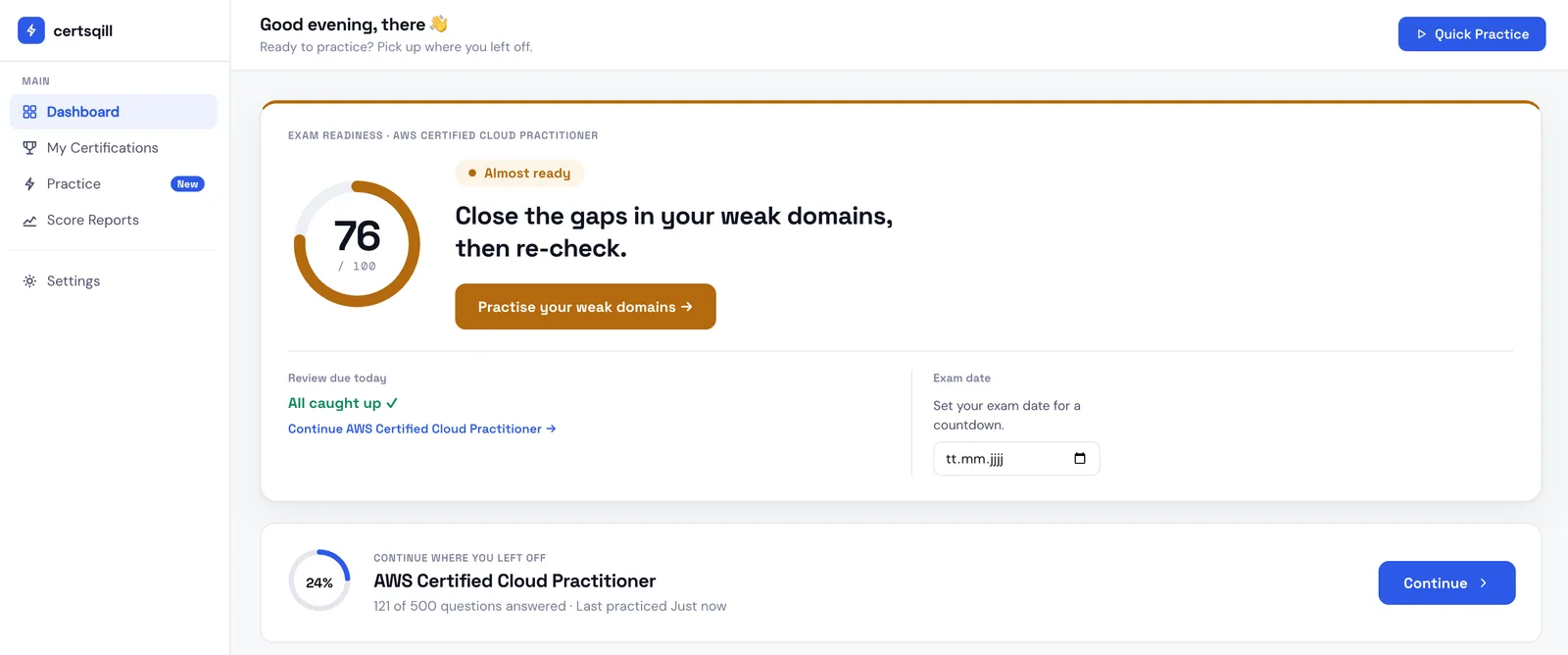
Know if you're ready for CDL — before you book.
Certsqill measures your CDL readiness across every official exam domain — one 0–100 score built only from first-try answers and kept deliberately conservative, so a high number has to be earned. It tells you whether to book, keep studying, or sit.
Why people switch to Certsqill
Everything you need to walk in ready
Know where you stand, understand every mistake, and study in your language — one payment, no subscription.
Your CDL Readiness Score, not a guess
One conservative number from your first-try answers across every exam domain tells you whether to book the exam or keep studying.
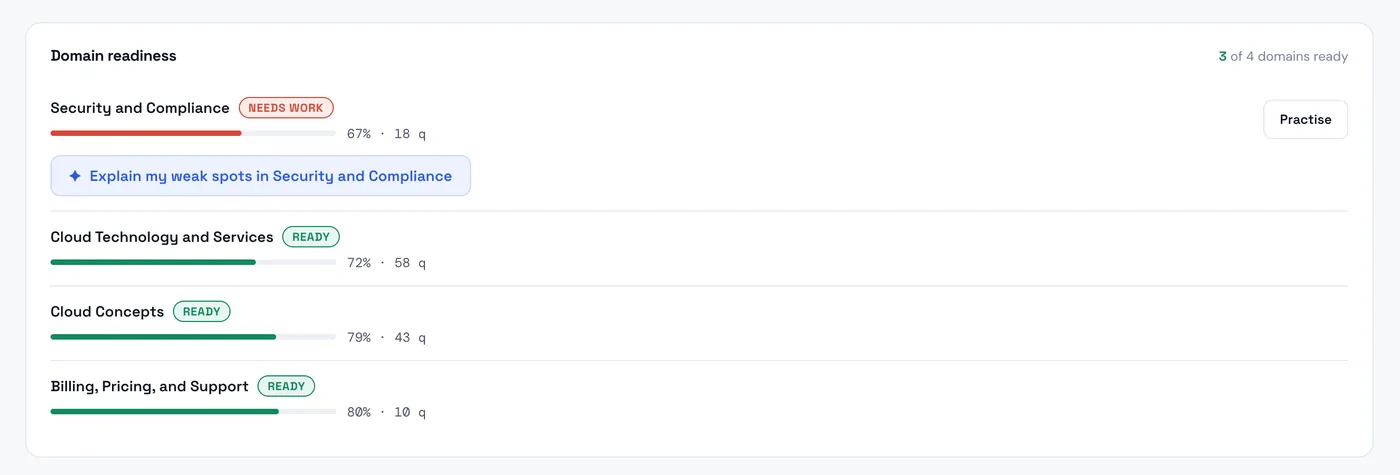
Understand every CDL mistake
When you miss a question, it explains why — using your own answer history to catch the patterns you keep repeating. Included, no subscription.
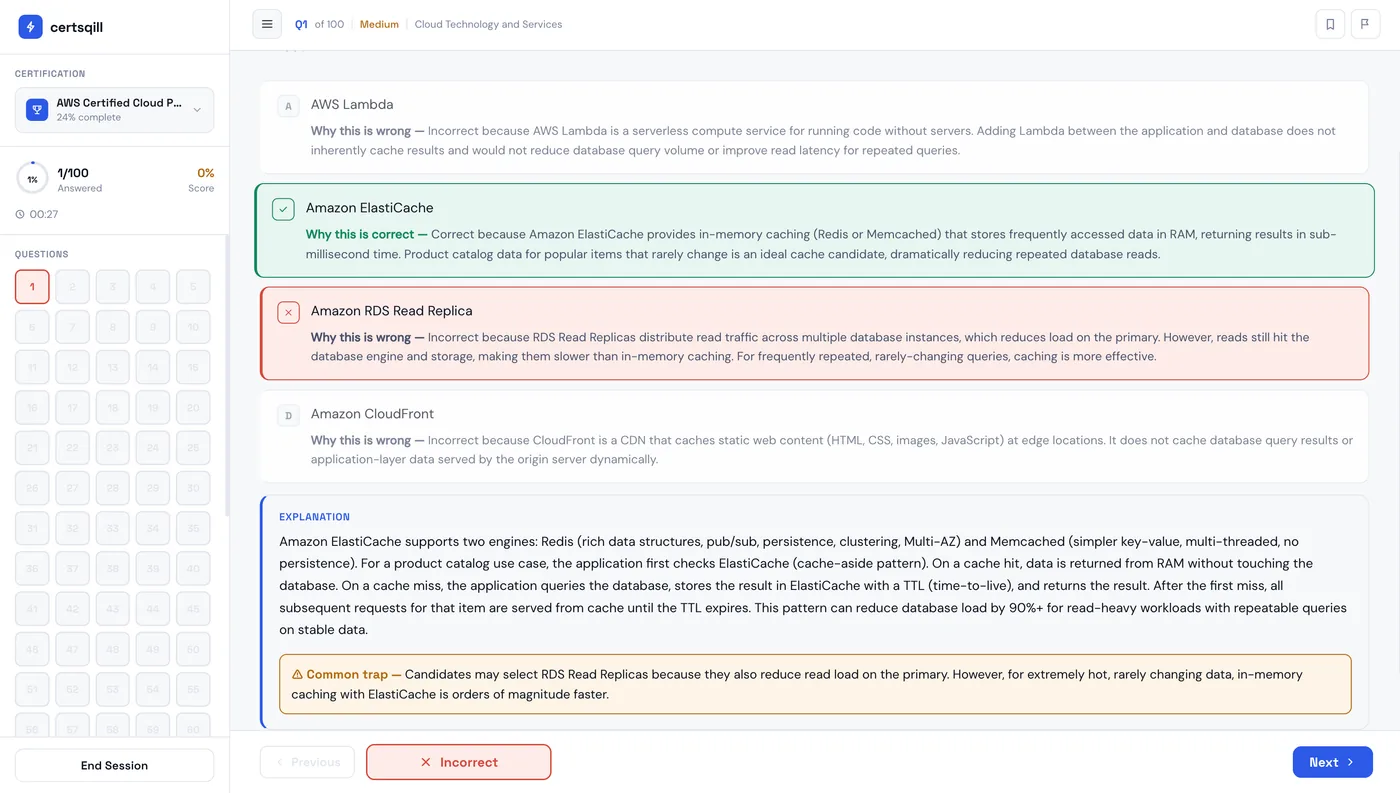
Explanations in your language, questions stay exam-accurate
Get every explanation in your language while the questions stay in exam-accurate English. Technical terms stay in English — the way the exam writes them.
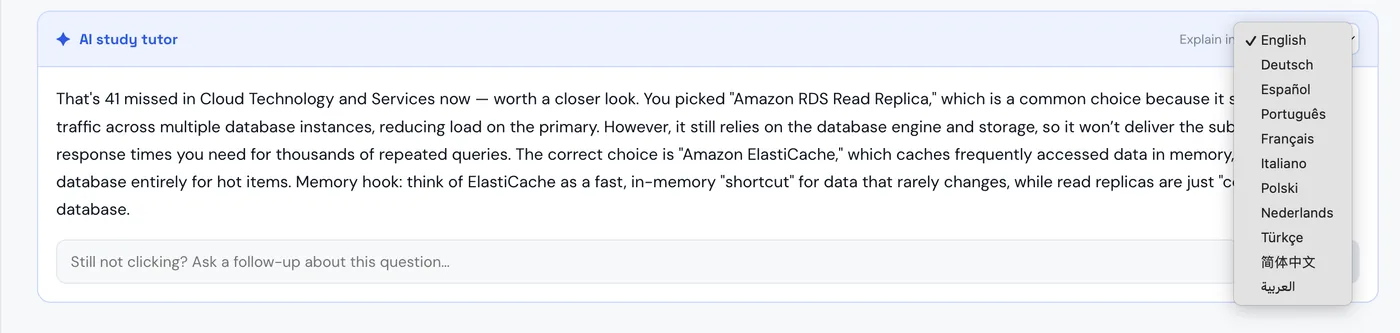
Everything you need to pass
Why you can trust these CDL questions
What is a CDL license?
A commercial driver’s license (CDL) is the license you need to drive a commercial motor vehicle. Federal rules define a commercial motor vehicle as a vehicle or combination used in commerce to transport passengers or property that falls into Group A, B or C: heavy combinations, heavy single vehicles, or smaller vehicles designed for 16 or more passengers including the driver or used to carry placarded hazardous materials.
CDL licensing is a state job. FMCSA writes the minimum standards, but it does not issue CDLs; your state licensing agency runs the tests and issues the license. That is why the CDL license process looks slightly different from state to state while the core rules stay the same.
Source: FMCSA — How do I get a Commercial Driver’s License?. Checked 19 October 2026.
CDL classes: CDL license A or B, and Class C
Whether you need a CDL license A or B depends on the vehicle. Class A covers any combination of vehicles with a gross combination weight rating or weight of 26,001 pounds or more. Class B covers any single vehicle with a gross vehicle weight rating or weight of 26,001 pounds or more. Class C covers vehicles that meet neither definition but still need a CDL, such as vehicles for 16 or more passengers or hazmat vehicles.
So what CDL A license holders can drive depends on the combination, while a CDL B license fits heavy straight trucks and buses. States may add more restrictive categories, and restrictions such as L or Z (no full air brake) and E (no manual transmission) depend on the vehicle you test in.
Source: FMCSA — Commercial Driver’s License: Drivers. Checked 19 October 2026.
CDL license endorsements
CDL license endorsements let you drive specific vehicles or loads. Most need only a knowledge test; passenger and school bus also need a skills test.
On a CLP, only the passenger (P), school bus (S) and tank vehicle (N) endorsements are allowed, each with limits: no passengers with P or S, and only empty, purged tank vehicles with N. A CLP holder may not drive a vehicle carrying hazardous materials.
- T: double/triple trailers (knowledge test only)
- P: passenger (knowledge and skills tests)
- N: tank vehicle (knowledge test only)
- H: hazardous materials (knowledge test only)
- X: combination of tank vehicle and hazardous materials (knowledge test only)
- S: school bus (knowledge and skills tests)
Source: FMCSA — Commercial Driver’s License: Drivers. Checked 19 October 2026.
What is on the CDL permit test?
Every CLP applicant must pass a general knowledge test that meets federal standards. The CDL general knowledge test is the core of the CDL permit test; states build it from an FMCSA pre-approved question pool, and each test has a set number of questions with a prescribed share from each knowledge area. The federal rules do not fix one number for all states, so the length of the CDL general knowledge exam depends on where you test.
Which other tests you take depends on your class and vehicle. California’s handbook, as one state example, lists the air brakes test for drivers of vehicles with air brakes, including air over hydraulic brakes, and the combination vehicles test for anyone who wants to drive combinations, which is why the CDL A permit test usually means more than one test. If you skip the CDL air brake test, expect an air brake restriction on your license.
Source: California DMV — California Commercial Driver Handbook (state example). Checked 19 October 2026.
How do I get a CDL license?
FMCSA describes three steps. If you are asking how do I get my CDL license from scratch, or how to get your CDL license in a new class, start with your state’s CDL manual, then decide which class and endorsements you need.
- Step 1, CDL license permit: pass the knowledge tests for a commercial learner’s permit. Your state checks your driving record for the last 10 years in all states and D.C., and you must show medical qualification.
- Step 2, entry-level driver training: for a first Class A or B CDL, a Class B to A upgrade or a first S, P or H endorsement, complete training with a provider on FMCSA’s Training Provider Registry before testing.
- Step 3, CDL: hold the CLP for at least 14 days, then pass all three parts of the skills test: vehicle inspection, basic controls and the road test.
Source: FMCSA — How do I get a Commercial Driver’s License?. Checked 19 October 2026.
DOT physical for CDL license applicants and the medical card
The DOT physical for CDL license applicants must be done by a medical examiner listed on FMCSA’s National Registry of Certified Medical Examiners. The resulting medical examiner’s certificate is often called your medical card. You also self-certify to your state which of four operating categories you fall into: interstate or intrastate, excepted or non-excepted.
The medical card for CDL license holders is not a one-time step: a driver who has not been examined and certified during the preceding 24 months needs a new exam, and you must send each new certificate to your state before the old one expires. If you do not keep your CDL license medical card up to date with the state, your commercial driving privileges are downgraded.
Source: FMCSA — Commercial Driver’s License: Medical. Checked 19 October 2026.
Passing score and retakes on the CDL test
On every knowledge test for CDL license applicants, federal rules require you to answer at least 80 percent of the questions correctly. If you fail and retake a test, the state must give you a different version, so memorising one set of CDL permit test questions does not help.
Attempts and retest fees are state rules. In California, for example, you have three attempts to pass each required knowledge test; after three fails on the same test the application is no longer valid and you reapply. The skills test segments are scored against the federal examiner manual, not a percentage.
Source: eCFR — 49 CFR 383.135 Passing knowledge and skills tests. Checked 19 October 2026.
The CDL license manual
FMCSA’s first step is to get your state’s CDL manual, either at a licensing office or as a download. The CDL license manual is the source the knowledge tests are written from, and it explains which sections you need for your class and endorsements.
California’s commercial handbook is a typical manual for CDL license applicants: driving safely, transporting cargo safely, transporting passengers, air brakes, combination vehicles, doubles and triples, tank vehicles, hazardous materials and school buses, followed by the vehicle inspection, basic control skills and road test sections.
Source: California DMV — California Commercial Driver Handbook (state example). Checked 19 October 2026.
CDL license schools and entry-level driver training
If you got your CLP on or after 7 February 2022 and are seeking a first Class A or B CDL, a Class B to A upgrade or a first S, P or H endorsement, you must complete entry-level driver training with a provider listed on FMCSA’s Training Provider Registry before testing. CDL license schools must be listed on the registry to deliver this training.
Training includes a theory assessment with a minimum overall score of 80 percent, and instructors document your proficiency in behind-the-wheel skills. Some states add their own requirements on top.
Source: FMCSA — How do I get a Commercial Driver’s License?. Checked 19 October 2026.
CDL test prep: how to prepare for the permit test
Good CDL prep starts with the manual sections for your class, then moves to timed questions. For CDL test preparation, work through the general knowledge section first, then air brakes and combination vehicles if you need them, then each endorsement. A CDL hazmat sample test is only useful once you have read the hazardous materials section, because the H test is knowledge-only and detailed.
Whether you use a CDL prep app, a printed manual or a browser, the goal of CDL test prep is the same: get comfortably above 80 percent in every area, not just on average. A CDL pre test is simply a practice run before the real knowledge test; the state test itself is the only one that counts.
Source: eCFR — 49 CFR 383.135 Passing knowledge and skills tests. Checked 19 October 2026.
Free CDL sample tests from state agencies
Some state agencies publish free practice material. California DMV, for example, offers two free commercial sample tests for Class A or B applicants alongside its commercial handbook, and adds new questions to its sample tests from time to time. Check your own state’s licensing agency for its manual and any official sample tests.
Source: California DMV — Sample Driver’s License Knowledge Tests (state example). Checked 19 October 2026.
CDL practice test questions
Certsqill’s CDL practice test questions are expert-developed and organised by knowledge area: CDL general knowledge practice tests, a CDL air brake section, combination vehicles and endorsement areas, including a hazmat CDL practice test and a CDL permit practice test for each class. A practice test for class B CDL drivers follows the same structure without combination vehicles.
Every question comes with an explanation for each answer option, and your results build a readiness score per area, so you can see where you are below the 80 percent mark before you book the real test. A 7-day money-back guarantee applies.
CDL questions people ask
What is a CDL licence?
Licence is the British spelling; in the US it is a commercial driver’s license, issued by your state to drive commercial motor vehicles. What is CDL licence and what is a CDL license are the same question. Source: FMCSA, checked 19 October 2026.
Do you need a CDL license to drive an RV?
The federal CDL rules cover vehicles used in commerce to transport passengers or property. Licensing for private RVs is set by each state: California, for example, requires a noncommercial Class A license to tow a fifth-wheel travel trailer over 15,000 pounds when not for compensation. Check your state. Sources: 49 CFR 383.5 and California DMV handbook, checked 19 October 2026.
How many questions are on the CDL permit test?
It depends on the state and the test. Federal rules require each test to have a set number of questions from an FMCSA-approved pool but do not fix one number. Source: 49 CFR 383.133, checked 19 October 2026.
What score do I need to pass the CDL permit test?
At least 80 percent correct on each knowledge test. Source: 49 CFR 383.135, checked 19 October 2026.
How long is a CDL permit valid?
Federally, no more than one year from first issuance. California issues it for 180 days, renewable for another 180 days within that year. Sources: 49 CFR 383.25 and California DMV, checked 19 October 2026.
Can I take the skills test right after the CDL permit test?
No. You must hold the CLP for 14 days before the skills test, and complete entry-level driver training first where it applies. Source: 49 CFR 383.25, checked 19 October 2026.
Is a practice test for CDL general knowledge enough?
It covers the test every applicant takes, but you also need the air brakes, combination vehicles or endorsement tests that match your vehicle. Your state manual lists which apply.
How much does a CDL license cost?
Fees are set by each state. Florida, for example, charges $75 for an original or renewal CDL, $7 per endorsement and $10 for a knowledge retest, plus a possible $6.25 service fee. Source: Florida FLHSMV, checked 19 October 2026.