The FE exam: what it is, what it costs and how to prepare
The FE exam (Fundamentals of Engineering) is the NCEES exam that is generally your first step toward a professional engineer (P.E.) license. It has 110 questions in 5 hours 20 minutes of exam time, costs US$225, and is computer-based, year-round, at NCEES-approved Pearson test centers. Results are pass or fail and usually arrive within 7 to 10 business days.
- Exam owner
- NCEES (National Council of Examiners for Engineering and Surveying)NCEES FE Exam page, checked 19 October 2026
- Questions
- 110NCEES FE Exam page, checked 19 October 2026
- Time
- 5 hours 20 minutes of exam time in an appointment of about 6 hoursNCEES FE Exam page and Examinee Guide, checked 19 October 2026
- Exam fee
- US$225, paid to NCEESNCEES FE Exam page, checked 19 October 2026
- Delivery
- Computer-based, year-round, at Pearson test centers onlyNCEES Examinee Guide, checked 19 October 2026
- Reference
- NCEES reference handbook supplied on screen as a searchable PDFNCEES Examinee Guide, checked 19 October 2026
- Passing score
- Not published by NCEES; results are pass or failNCEES Exam scoring page, checked 19 October 2026
- Retakes
- One attempt per testing window, at most three in 12 monthsNCEES FE Exam page, checked 19 October 2026
- Results
- Typically within 7 to 10 business daysNCEES FE Exam page, checked 19 October 2026
Know if you're ready for FE Exam — before you book.
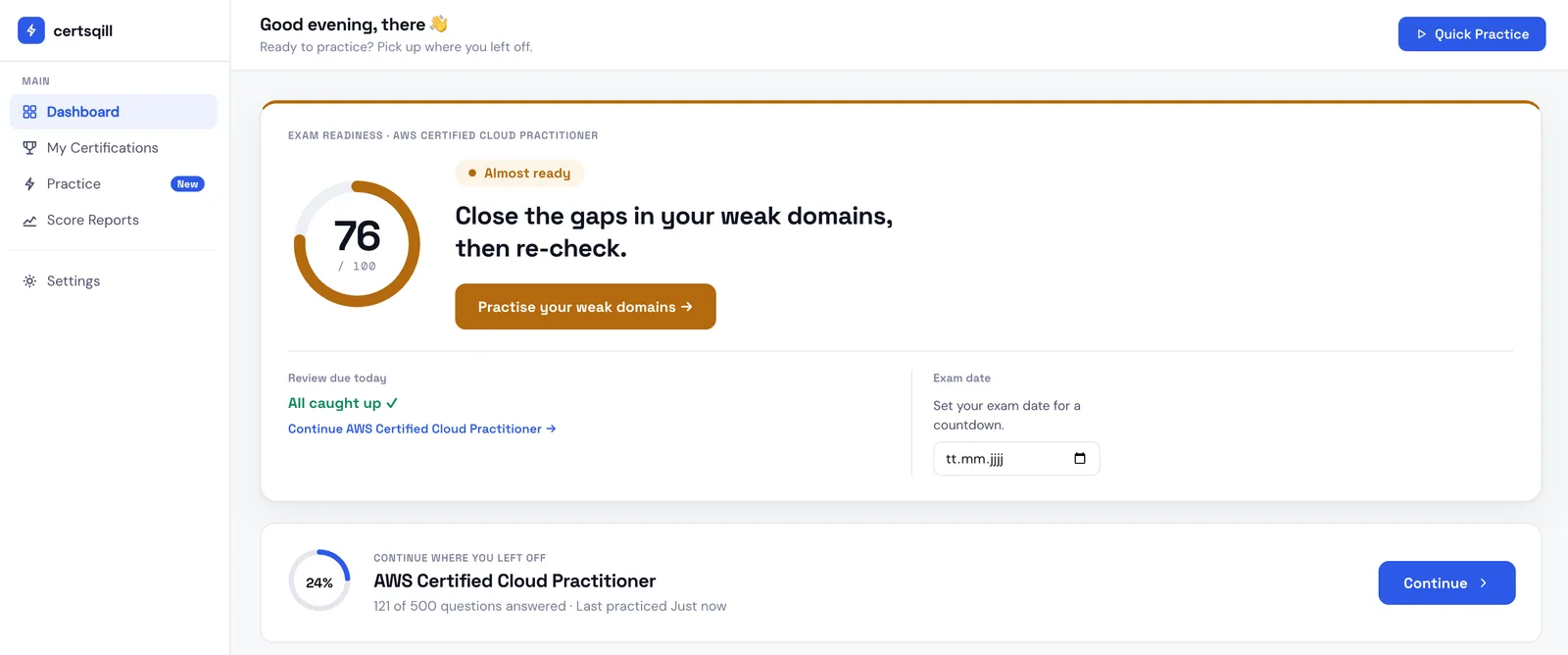
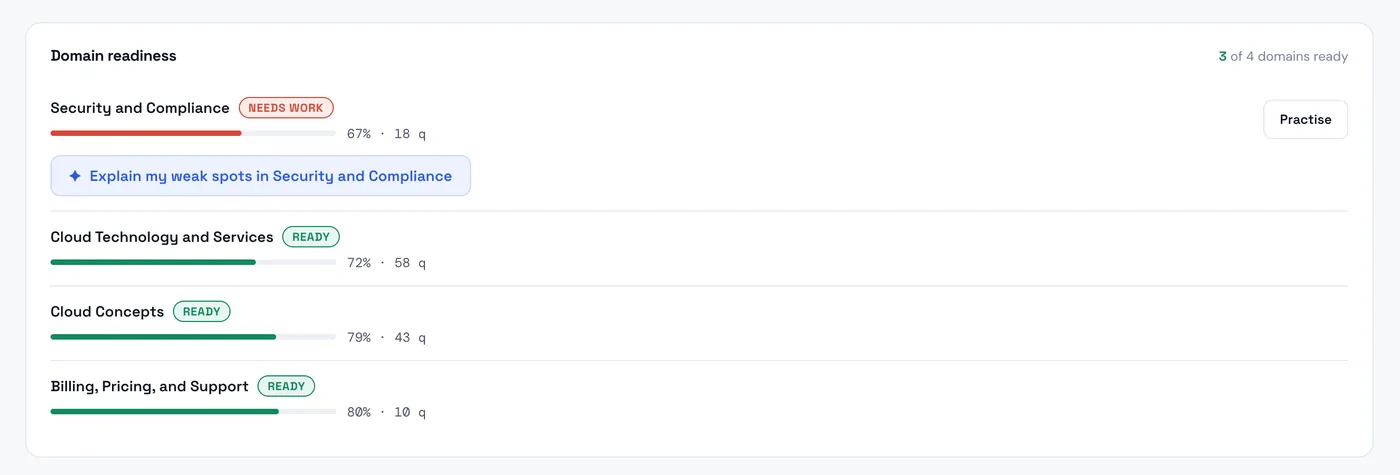
Certsqill measures your FE Exam readiness across every official exam domain — one 0–100 score built only from first-try answers and kept deliberately conservative, so a high number has to be earned. It tells you whether to book, keep studying, or sit.
Why people switch to Certsqill
Everything you need to walk in ready
Know where you stand, understand every mistake, and study in your language — one payment, no subscription.
Your FE Exam Readiness Score, not a guess
One conservative number from your first-try answers across every exam domain tells you whether to book the exam or keep studying.
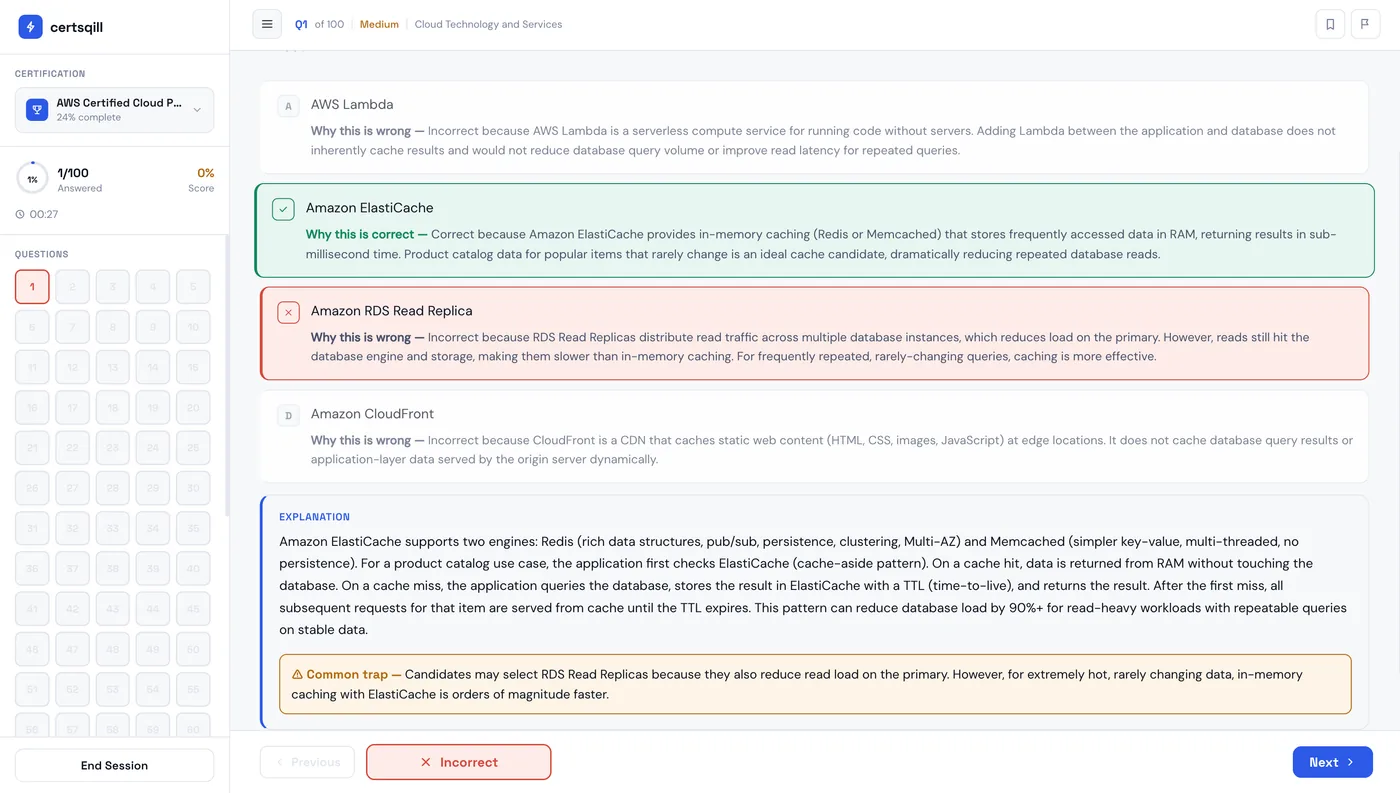
Understand every FE Exam mistake
When you miss a question, it explains why — using your own answer history to catch the patterns you keep repeating. Included, no subscription.
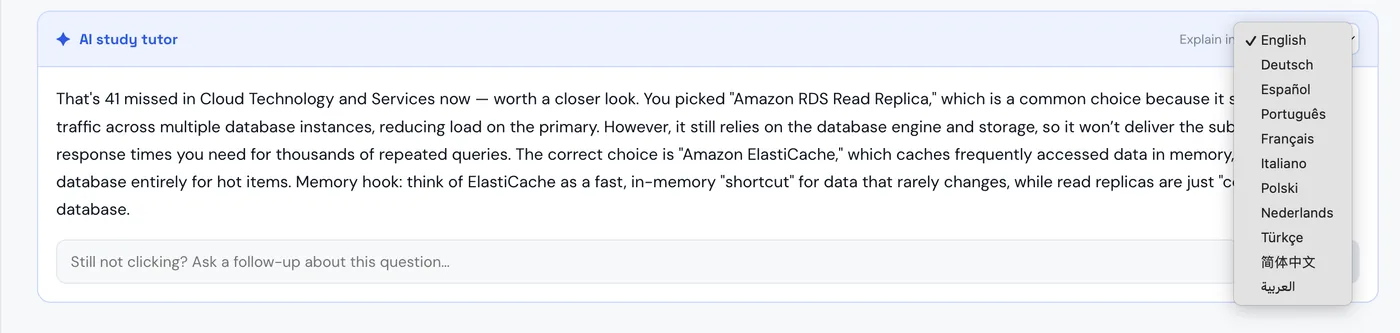
Explanations in your language, questions stay exam-accurate
Get every explanation in your language while the questions stay in exam-accurate English. Technical terms stay in English — the way the exam writes them.
Everything you need to pass
Why you can trust these FE Exam questions
What is the FE exam?
The FE fundamentals of engineering exam is written and scored by NCEES. NCEES describes it as generally your first step in the process of becoming a licensed professional engineer, designed for recent graduates and students who are close to finishing an undergraduate engineering degree. The FE exam for engineers is the same national NCEES exam in every state; what differs is the licensing board that decides who may take it.
Many candidates look for an EIT FE exam as if it were a separate test. It is not: EIT stands for engineer in training, a title used in connection with passing the FE. Whether your board issues an EIT or engineer intern certificate, and on what terms, is set by that board.
Source: NCEES — FE Exam. Checked 19 October 2026.
NCEES FE exam format
The NCEES FE exam has 110 questions. The appointment is about 6 hours: a 2-minute nondisclosure agreement, an 8-minute tutorial, 5 hours 20 minutes of exam time and a 25-minute scheduled break. You get the full exam time at the start, there are no individually timed sections, and there are no deductions for wrong answers.
The specifications describe the exam as closed book with an electronic reference, and it uses both SI and US customary units. Is there an online FE exam? No: NCEES states that its exams are administered exclusively at Pearson test centers. An FE exam online at home is not offered; what you can do online is register, schedule and take NCEES’s interactive practice exams.
Source: NCEES Examinee Guide (May 2026). Checked 19 October 2026.
What is on the FE exam? Seven disciplines
You choose one discipline. NCEES sells practice exams for seven FE disciplines, and the same seven appear in its annual report: Chemical, Civil, Electrical and Computer, Environmental, Industrial and Systems, Mechanical, and Other Disciplines. Each has its own specification with a range of questions per knowledge area.
All disciplines share some ground, such as mathematics, probability and statistics, ethics and professional practice, and engineering economics. The rest is discipline-specific. The FE exam topics page breaks down the civil and mechanical specifications in detail.
Source: NCEES — Exam prep. Checked 19 October 2026.
Civil, mechanical, electrical and chemical engineering FE exam versions
Mechanical FE exam: the NCEES specification (effective July 2020) has 14 knowledge areas. The heaviest are dynamics, kinematics and vibrations, fluid mechanics, thermodynamics and mechanical design and analysis, each with 10 to 15 questions; statics and mechanics of materials have 9 to 14 each. That makes it the FE exam for mechanical engineers who are strong in the thermal and fluids sciences as well as in mechanics.
Chemical engineering FE exam: the specification (effective July 2020) is led by material and energy balances with 10 to 15 questions, followed by fluid mechanics, thermodynamics, heat transfer, and mass transfer and separation at 8 to 12 each. The FE exam for chemical engineers also covers chemical reaction engineering, process design and process control.
The FE exam civil engineering version and the electrical FE exam have their own specifications as well. A civil engineer FE exam candidate faces areas such as geotechnical, transportation, hydraulics, structural and environmental engineering; the FE exam for electrical engineers covers circuits, power, electronics, signal processing, control systems and computer topics.
Source: NCEES — FE Mechanical CBT exam specifications. Checked 19 October 2026.
FE exam cost and FE exam price
The FE exam price is US$225, payable directly to NCEES. NCEES also sells optional interactive practice exams for US$50 each.
Changes cost extra. If you cancel your registration you can get a refund of the NCEES registration fee less a US$50 administrative fee. Rescheduling or cancelling a test appointment costs US$50, paid to Pearson, and must be done at least 48 hours before the appointment.
Source: NCEES Examinee Guide (May 2026). Checked 19 October 2026.
Who can take the FE exam? The MN FE exam and other states
NCEES says eligibility varies and is determined by each licensing board. Many boards require you to be approved before you can register and schedule. So the MN FE exam is the same NCEES test as in other states; the board in your state decides when you may sit for it and what happens after you pass.
Check your board’s rules before you register through your MyNCEES account. Some boards also have a stricter retake policy than NCEES’s own.
Source: NCEES Examinee Guide (May 2026). Checked 19 October 2026.
FE exam calculator: approved calculators for FE exam day
You may bring one NCEES-approved calculator into the testing room, and a TI-30XS is available on screen during the exam. NCEES lists the approved calculators for the FE exam as follows:
- Casio: all fx-115 and fx-991 models
- Hewlett Packard: the HP 33s and HP 35s models, but no others
- Texas Instruments: all TI-30X and TI-36X models
Source: NCEES — Exams (calculator policy). Checked 19 October 2026.
The FE exam handbook
You do not bring books. The current NCEES reference handbook for your exam is supplied on screen as a searchable PDF, and you can open the same version from the dashboard of your MyNCEES account to prepare with it. The keyboard shortcut Ctrl + F does not work in the exam, so learn where formulas sit in the FE exam handbook before test day.
Source: NCEES Examinee Guide (May 2026). Checked 19 October 2026.
How hard is the FE exam? Scoring and FE exam pass rates
NCEES converts the number of correct answers into a scaled score and compares it with a minimum ability level. It does not publish the passing score, and it scores each exam with no predetermined percentage of examinees who should pass. First-time and repeat takers are graded to the same standard.
NCEES publishes FE exam pass rates in its annual Squared report, broken down by discipline, first-time and repeat takers, and by degree background. Use those tables rather than figures quoted elsewhere. What makes the exam hard is mainly breadth and pace: 110 questions in 320 minutes is a little under 3 minutes per question.
Source: NCEES — Exam scoring. Checked 19 October 2026.
FE exam vs PE exam
The FE exam and PE exam are the two NCEES engineering exams on the path to licensure. The FE is for students and recent graduates, has 110 questions and costs US$225. The PE exam is designed for engineers with at least four years of post-college work experience and costs US$400 (PE Structural is priced per section).
In short, pass the FE early, gain experience, then take the PE. Your board sets the exact sequence and requirements.
Source: NCEES Examinee Guide (May 2026). Checked 19 October 2026.
FE exam prep and preparation for FE exam day
Good FE exam prep starts with the specification for your discipline and the reference handbook. Civil FE exam prep should cover every knowledge area in the civil specification, while mechanical FE exam prep and mechanical engineering FE exam prep should weight thermodynamics, fluids, dynamics and design, which carry the most questions. NCEES’s interactive practice exams are representative of the computer-based exam and include a timed mode and solution review, which makes them a useful sample FE exam.
Preparation for FE exam day itself: bring one physical, government-issued photo ID (digital and student IDs are not accepted), your approved calculator, and arrive at the Pearson test center 30 minutes early. Phones, computers and wearables stay outside the testing room.
Source: NCEES — Exam prep. Checked 19 October 2026.
FE exam practice questions
Certsqill’s FE exam practice questions are expert-developed and organized by the knowledge areas of the NCEES specifications. They cover civil FE exam practice and mechanical FE exam practice, plus the other disciplines, as a full FE exam practice test or by topic.
Every question comes with an explanation for each answer option, and your results build a readiness score per knowledge area, so you can see where you stand before you schedule. A 7-day money-back guarantee applies.
FE Exam questions people ask
What is the FE exam?
The Fundamentals of Engineering exam from NCEES, generally the first step toward a P.E. license. It has 110 questions and is taken on a computer at Pearson test centers. Source: NCEES, checked 19 October 2026.
How much is the FE exam cost?
US$225, paid to NCEES. Check your board for any fees of its own. Source: NCEES, checked 19 October 2026.
What calculators are allowed on FE exam day?
Calculators allowed on FE exam day are Casio fx-115 and fx-991 models, the HP 33s and HP 35s, and TI-30X and TI-36X models. A TI-30XS is also available on screen. Source: NCEES, checked 19 October 2026.
Can I take the FE exam online?
No. NCEES administers its exams exclusively at Pearson test centers. Source: NCEES Examinee Guide, checked 19 October 2026.
How difficult is FE exam timing?
You have 5 hours 20 minutes for 110 questions, a little under 3 minutes each, with no individually timed sections. NCEES does not publish the passing score.
Is the EIT FE exam a different test?
No. EIT means engineer in training; the exam is the NCEES FE. Your board decides how it certifies engineers in training after you pass.
Where can I find FE exam questions to practise with?
NCEES sells interactive practice exams (two volumes per discipline, US$50 each) that are representative of the computer-based exam. Source: NCEES, checked 19 October 2026.
How often can I retake the FE exam?
Once per testing window and no more than three times in 12 months; some boards are stricter. Source: NCEES, checked 19 October 2026.