The PE exam: requirements, format, cost and pass rates
The PE exam (Principles and Practice of Engineering) is the NCEES exam that tests minimum competency in one engineering discipline, and it is designed for engineers with at least four years of post-college work experience. Most versions cost US$400 and have 80 or 85 questions; PE Civil, for example, has 80 questions in a 9-hour appointment and is offered year-round at Pearson test centers.
- Exam owner
- NCEESNCEES PE Exam page, checked 19 October 2026
- Intended for
- Engineers with at least four years of post-college work experienceNCEES PE Exam page, checked 19 October 2026
- Exam fee
- US$400; PE Structural US$350 per breadth or depth sectionNCEES Examinee Guide and PE Structural page, checked 19 October 2026
- Questions
- 80 (PE Civil, Mechanical, Power, Chemical, Environmental) or 85 (most other disciplines)NCEES Examinee Guide, checked 19 October 2026
- PE Civil time
- 9-hour appointment with an 8-hour exam and a 50-minute breakNCEES PE Civil page, checked 19 October 2026
- Delivery
- Computer-based at Pearson test centers onlyNCEES Examinee Guide, checked 19 October 2026
- References
- Electronic reference handbook and design standards supplied in the examNCEES PE Civil page, checked 19 October 2026
- Passing score
- Not published by NCEES; results are pass or failNCEES Exam scoring page, checked 19 October 2026
- Eligibility
- Set by each state licensing boardNCEES Examinee Guide, checked 19 October 2026
Know if you're ready for PE Exam — before you book.
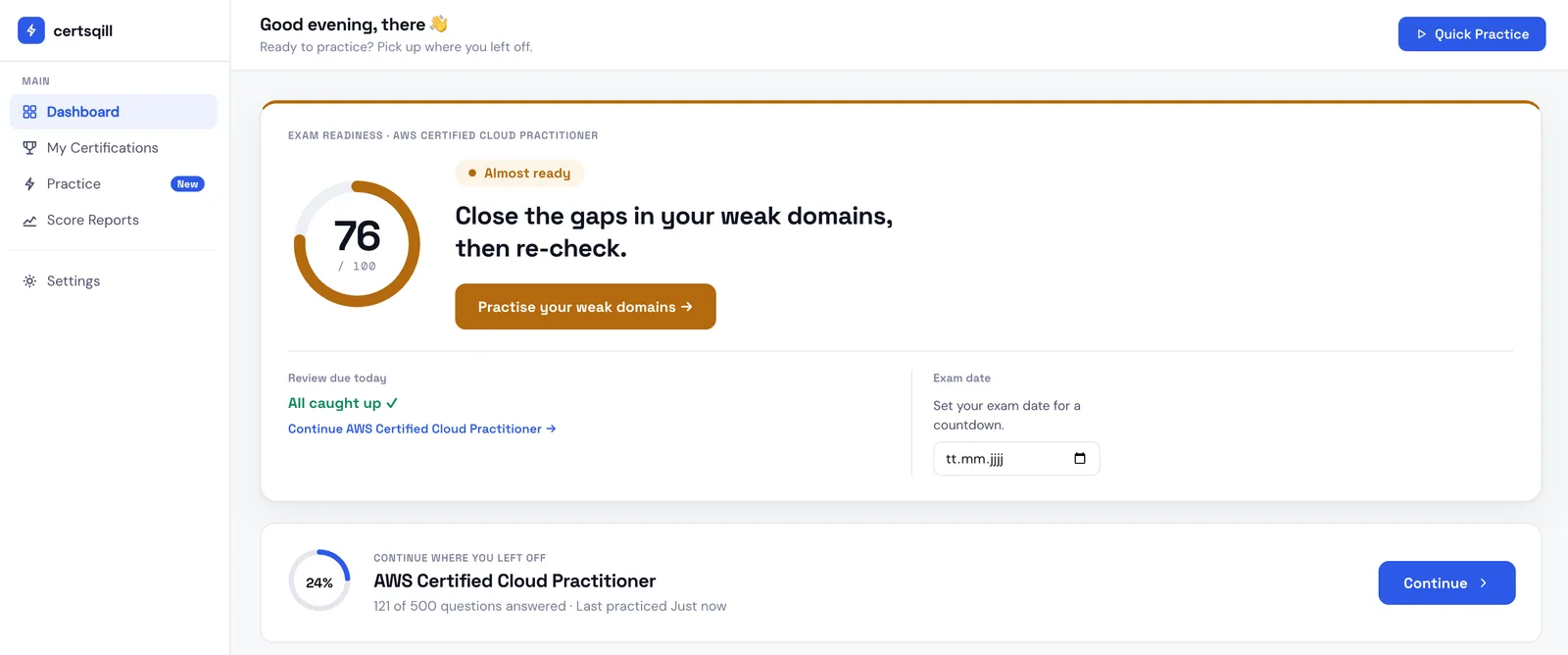
Certsqill measures your PE Exam readiness across every official exam domain — one 0–100 score built only from first-try answers and kept deliberately conservative, so a high number has to be earned. It tells you whether to book, keep studying, or sit.
Why people switch to Certsqill
Everything you need to walk in ready
Know where you stand, understand every mistake, and study in your language — one payment, no subscription.
Your PE Exam Readiness Score, not a guess
One conservative number from your first-try answers across every exam domain tells you whether to book the exam or keep studying.
Understand every PE Exam mistake
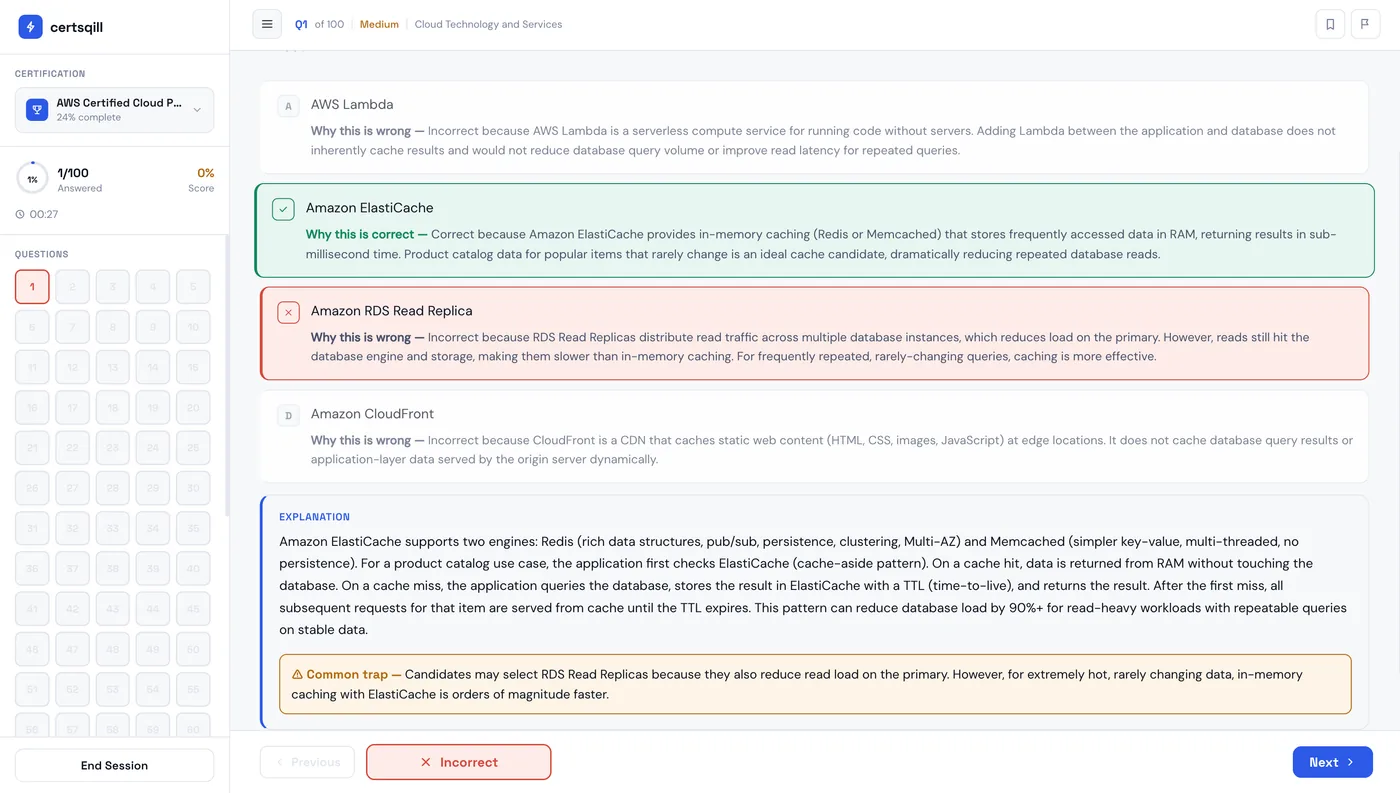
When you miss a question, it explains why — using your own answer history to catch the patterns you keep repeating. Included, no subscription.
Explanations in your language, questions stay exam-accurate
Get every explanation in your language while the questions stay in exam-accurate English. Technical terms stay in English — the way the exam writes them.

Everything you need to pass
Why you can trust these PE Exam questions
What is the PE exam?
The Principles and Practice of Engineering (PE) exam is the NCEES exam that tests for a minimum level of competency in a particular engineering discipline. NCEES designs it for engineers who have gained a minimum of four years of post-college work experience, which makes it the later of the two NCEES PE exam and FE exam steps on the way to a professional engineer license.
The PE exam for engineers is computer-based and taken only at Pearson test centers. Results usually come within 7 to 10 business days for most disciplines.
Source: NCEES — PE Exam. Checked 19 October 2026.
PE exam engineering disciplines
You take the PE in one discipline. Five are offered year-round with 80 questions: PE Civil, PE Mechanical, PE Electrical and Computer: Power, PE Chemical and PE Environmental. Most other disciplines have 85 questions in a 9-hour-30-minute appointment and are given on only one or two days a year, for example on 27 or 28 October 2026 for several of them.
PE Civil is split into five exams: Civil: Construction, Civil: Geotechnical, Civil: Structural, Civil: Transportation and Civil: Water Resources and Environmental. PE Mechanical is listed in three areas: HVAC and Refrigeration, Machine Design and Materials, and Thermal and Fluids Systems. PE Structural is a separate exam with its own format.
Source: NCEES Examinee Guide (May 2026). Checked 19 October 2026.
Civil PE exam: construction, transportation and structural
The civil PE exam has 80 questions, a 9-hour appointment with an 8-hour exam and a 50-minute break, and is offered year-round. NCEES supplies an electronic reference handbook and all specified design standards during the exam; they are the only references allowed.
Each civil engineer PE exam has its own specification. The construction PE exam (effective April 2024) gives the most questions to design for construction loads (10 to 15) and construction operations and methods (9 to 14). The transportation PE exam and the civil structural PE exam follow the same 80-question format with their own knowledge areas and design standards.
Source: NCEES — PE Civil. Checked 19 October 2026.
Structural PE exam
The structural PE exam (PE Structural) is different from PE Civil: Structural. It has a vertical and a lateral component, each with a breadth and a depth section. Breadth sections have 55 questions (45 scored, 10 pretest) and are offered year-round. Depth sections from April 2026 have 60 questions (40 scored, 20 pretest) and are offered twice a year: lateral depth on 27 October 2026 and 13 April 2027, vertical depth on 28 October 2026 and 14 April 2027. From April 2027 depth sections have 48 questions.
Each breadth and depth section costs US$350. NCEES supplies the reference handbook and design standards in the exam but does not sell printed handbooks or provide the standards for study; those come from their publishers. For structural PE exam study materials, start from the specification that lists those standards.
Source: NCEES — PE Structural. Checked 19 October 2026.
Mechanical PE exam and the power PE exam
The mechanical PE exam is offered year-round with 80 questions, in one of three areas: HVAC and Refrigeration, Machine Design and Materials, or Thermal and Fluids Systems. Choose the PE exam for mechanical engineers whose area matches your daily work.
The PE exam for electrical engineers who work in power systems is PE Electrical and Computer: Power, also year-round with 80 questions. Other PE exam for electrical engineering options, Computer Engineering and Electronics, Controls, and Communications, have 85 questions and are given on fixed dates.
Source: NCEES Examinee Guide (May 2026). Checked 19 October 2026.
PE exam requirements: FE and PE exam requirements
NCEES does not set PE exam requirements itself: eligibility to sit for an NCEES exam is determined by each licensing board. NCEES describes the FE as generally the first step toward licensure and designs the PE for engineers with at least four years of post-college work experience.
So FE and PE exam requirements usually come in sequence: the FE first, then work experience, then board approval for the PE, with the details set by your board. Check your state board for its exact rules before you register in MyNCEES.
Source: NCEES Examinee Guide (May 2026). Checked 19 October 2026.
PE exam cost
The PE exam cost is US$400, payable directly to NCEES, for every discipline except PE Structural, which costs US$350 per breadth or depth section. Some licensing boards charge a separate application fee on top. Rescheduling or cancelling an appointment at Pearson costs US$50 and must be done at least 48 hours ahead.
Source: NCEES — PE Civil. Checked 19 October 2026.
How long is the PE exam?
PE Civil takes a 9-hour appointment: a nondisclosure agreement, a tutorial, an 8-hour exam and a 50-minute break. The other year-round 80-question exams also have a 9-hour appointment. The 85-question disciplines take 9 hours 30 minutes, with 8 hours 30 minutes of exam time. PE Structural breadth sections take 6 hours, depth sections 6 hours 30 minutes.
Source: NCEES Examinee Guide (May 2026). Checked 19 October 2026.
PE exam pass rates and how hard the PE exam is
NCEES publishes pass rates per discipline. On the PE Civil page (last updated July 2026, covering a half-year population), first-time pass rates were 60% for Construction, 63% for Geotechnical, 62% for Structural, 61% for Transportation and 71% for Water Resources and Environmental. Repeat takers passed at 38% to 49%.
For PE Structural breadth sections the first-time pass rate for the same update was 45% for lateral and 44% for vertical. NCEES does not publish the passing score, and first-time and repeat takers are graded to the same standard. A pass rate for PE exam disciplines not shown here was not on the pages we checked.
Source: NCEES — PE Civil. Checked 19 October 2026.
FE vs PE exam
The FE exam has 110 questions, costs US$225 and is meant for students and recent graduates; NCEES calls it generally the first step toward a P.E. license. The PE exam comes after you have gained experience, costs US$400 and goes deep into one discipline with design standards in the exam. Taking the FE and PE exam in that order is the usual path; your board decides the details.
Source: NCEES — FE Exam. Checked 19 October 2026.
PE exam prep: study materials, reference manual and courses
NCEES says prep materials for the PE exams, including a practice exam, are in the NCEES portal. That NCEES PE exam practice exam is the closest thing to a sample PE exam or real PE exam examples, because it comes from the exam owner. Your other core PE exam study materials are the specification for your discipline and the design standards it lists.
There is no separate official PE exam reference manual to bring: NCEES supplies its reference handbook, for civil the PE Civil Reference Handbook, inside the exam. A PE exam prep course, PE exam review course or PE exam preparation course from a third party can help structure your study; check that it follows the current NCEES specification and uses the same handbook and standards. PE exam prep classes are optional, timed practice is not.
Source: NCEES — PE Civil: Construction exam specifications. Checked 19 October 2026.
PE exam practice questions
Certsqill’s PE exam practice questions are expert-developed and mapped to the NCEES knowledge areas of each discipline, from civil construction and transportation to mechanical and power. They work as PE exam example questions you can take by topic or as a timed set, close to the style of real PE exam questions.
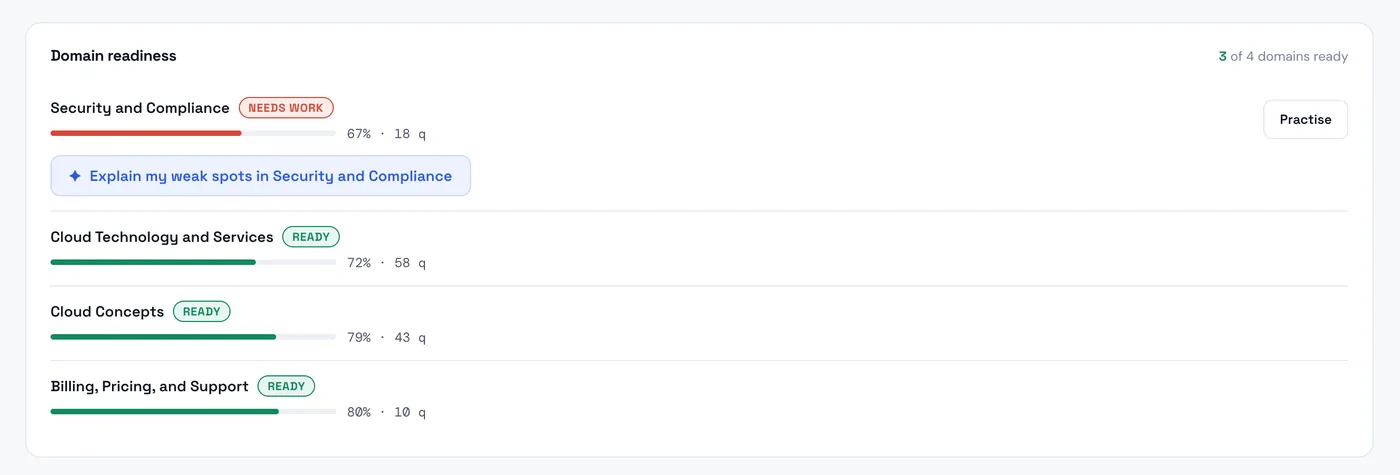
Every question has an explanation for each answer option, and your results build a readiness score per knowledge area, so you know where you stand before you schedule. A 7-day money-back guarantee applies.
PE Exam questions people ask
What is on the PE exam?
Discipline-specific knowledge areas set out in an NCEES specification for each exam; for example PE Civil: Construction covers areas such as construction loads, operations and methods, and scheduling. Source: NCEES, checked 19 October 2026.
How much is the PE exam cost?
US$400, paid to NCEES; PE Structural costs US$350 per section. Source: NCEES, checked 19 October 2026.
How hard is the PE exam?
On the July 2026 update, first-time pass rates for the five PE Civil exams ranged from 60% to 71%. NCEES does not publish the passing score. Source: NCEES PE Civil page, checked 19 October 2026.
How hard is PE exam Structural compared with Civil?
First-time pass rates for the PE Structural breadth sections were 45% (lateral) and 44% (vertical) on the July 2026 update, below the PE Civil range. Source: NCEES, checked 19 October 2026.
What are the PE exam requirements?
Each state board sets them. NCEES designs the PE for engineers with at least four years of post-college experience. Source: NCEES, checked 19 October 2026.
What is the pass rate for PE exam civil disciplines?
First-time: Construction 60%, Geotechnical 63%, Structural 62%, Transportation 61%, Water Resources and Environmental 71% (NCEES, last updated July 2026).
Can I take the PE exam online?
No. NCEES exams are administered exclusively at Pearson test centers. Source: NCEES Examinee Guide, checked 19 October 2026.
What calculator can I use on the PE exam?
One NCEES-approved calculator: Casio fx-115 or fx-991 models, HP 33s or HP 35s, or TI-30X or TI-36X models. Source: NCEES, checked 19 October 2026.