CBAP certification: cost, requirements and exam format
CBAP — Certified Business Analysis Professional — is IIBA’s senior business analysis certification. You need 7,500 hours of business analysis work in the last 10 years, 35 hours of professional development and two references. The exam has 120 case-study and scenario-based questions in 210 minutes and costs US$505, or US$350 for IIBA members, plus a US$145 application fee. IIBA publishes no passing score.
- Certification
- Certified Business Analysis Professional (CBAP), issued by IIBAIIBA CBAP page, checked 10 October 2026
- Exam fee
- US$505 — US$350 for IIBA members; IIBA says the first year of membership is includedIIBA CBAP page, checked 10 October 2026
- Application fee
- US$145, non-refundable, expires 12 months after purchaseIIBA CBAP page, checked 10 October 2026
- Questions
- 120 case-study and scenario-based multiple-choice questionsIIBA CBAP page and CBAP Handbook, checked 10 October 2026
- Duration
- 210 minutesIIBA CBAP page, checked 10 October 2026
- Passing score
- Not published by IIBAThe CBAP Handbook says only that you receive a pass or fail result on screen, checked 10 October 2026
- Delivery
- Online remote proctored or at a PSI test centreIIBA CBAP Handbook, checked 10 October 2026
- Eligibility
- 7,500 hours (5+ years) of BA work in the last 10 years, 900 hours in 4 of 6 knowledge areas, 35 PD hours, 2 referencesIIBA CBAP page and Handbook, checked 10 October 2026
- Renewal
- 60 CDUs every three years; fee US$85 for members, US$120 for non-membersIIBA CBAP Handbook and CBAP page, checked 10 October 2026
Know if you're ready for CBAP — before you book.
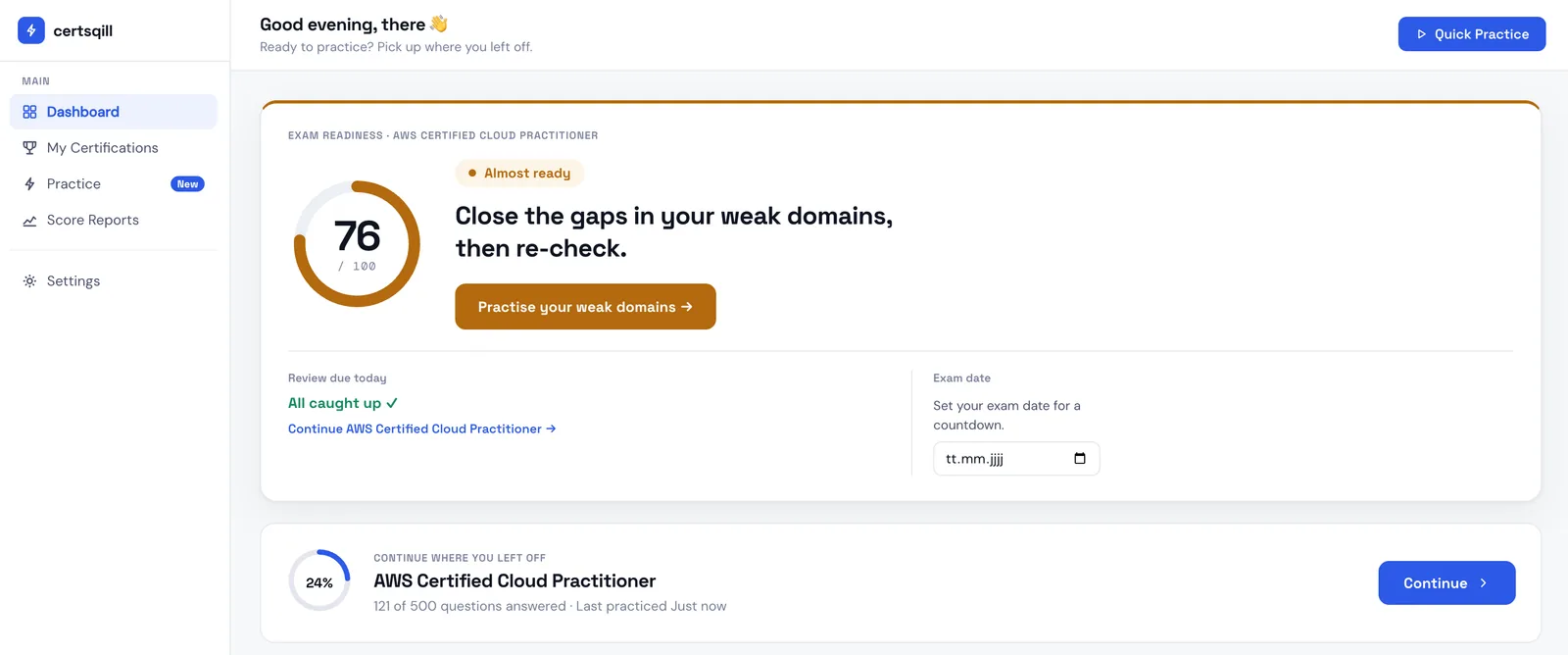
Certsqill measures your CBAP readiness across every official exam domain — one 0–100 score from coverage, accuracy and consistency that tells you whether to book, keep studying, or sit.
Why people switch to Certsqill
Everything you need to walk in ready
Know where you stand, understand every mistake, and study in your language — one payment, no subscription.
Your CBAP Readiness Score, not a guess
One number from three signals — coverage, accuracy, and consistency — tells you whether to book the exam or keep studying.
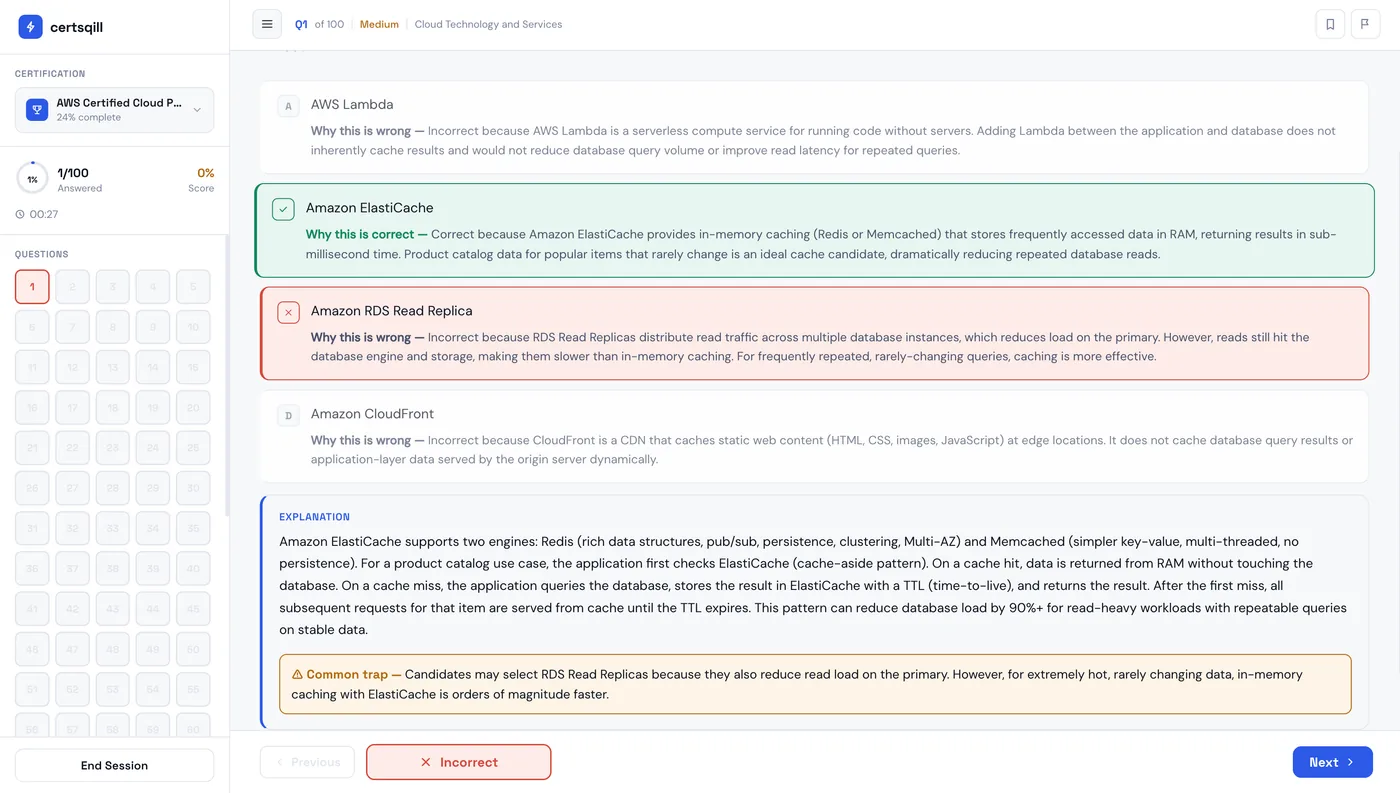
Understand every CBAP mistake
When you miss a question, it explains why — using your own answer history to catch the patterns you keep repeating. Included, no subscription.
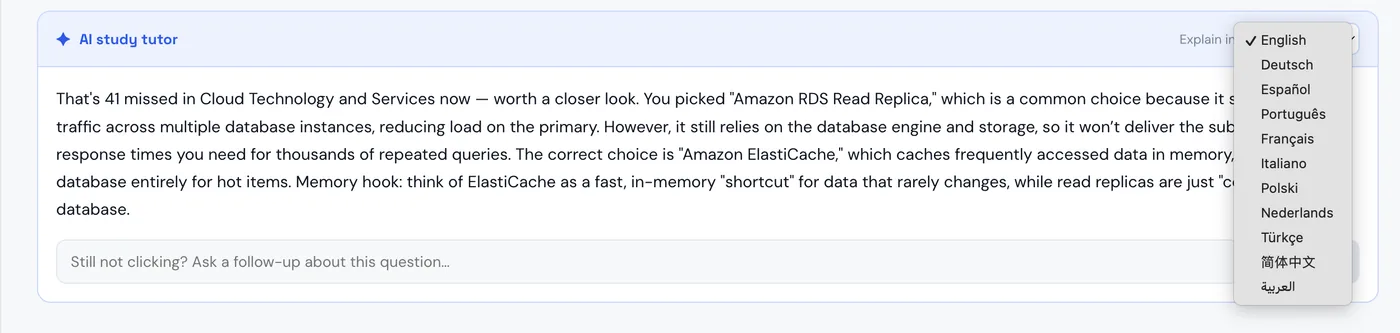
Explanations in your language, questions stay exam-accurate
Get every explanation in your language while the questions stay in exam-accurate English. Technical terms stay in English — the way the exam writes them.
Everything you need to pass
Why you can trust these CBAP questions
What is CBAP certification?
CBAP stands for Certified Business Analysis Professional. It is issued by IIBA, the International Institute of Business Analysis, and IIBA calls it the industry’s premier business analysis certification, tailored for experienced professionals ready to lead.
So what is a CBAP certification in practice? It is proof, checked by IIBA before you may sit the exam, that you have years of documented business analysis work, and then proof by examination that you can apply the BABOK Guide’s knowledge areas to realistic cases. The IIBA CBAP certification is not an entry-level credential: the experience requirement comes first.
IIBA lists the roles it has in mind: senior, lead, principal and enterprise business analysts, business analysis managers, business architects, product managers, digital transformation analysts, senior consultants and holders of the CCBA. A CBAP certificate is meant to signal that seniority.
Source: IIBA — Certified Business Analysis Professional (CBAP). Checked 10 October 2026.
CBAP certification cost
IIBA publishes its CBAP fees in US dollars, and they come in stages. First the application fee of US$145, which is non-refundable, non-transferable and expires 12 months after purchase. IIBA labels it the member rate and lists no other application figure.
Then the exam fee: US$505, or US$350 for IIBA members. IIBA notes that the first year of membership is included with the exam fee. If you need another attempt, the exam rewrite fee is US$295 for members and US$450 for non-members. Every three years, recertification costs US$85 for members and US$120 for non-members.
So the cost of CBAP certification for a first-time pass is the application fee plus one exam fee; training to meet the 35 professional development hours is a separate expense set by whoever delivers it. IIBA states that all prices are subject to change without notice.
- Application: US$145
- Exam: US$505 standard, US$350 for members
- Exam rewrite: US$295 members, US$450 non-members
- Recertification every three years: US$85 members, US$120 non-members
Source: IIBA — Certified Business Analysis Professional (CBAP). Checked 10 October 2026.
CBAP certification requirements and prerequisites
The CBAP certification requirements are about experience, not about a degree. IIBA asks for five or more years of business analysis work in the last 10 years, totalling 7,500 hours. Within that, the CBAP Handbook requires at least 900 hours in each of 4 of the 6 knowledge areas, so a career spent in only one or two areas does not qualify.
The other CBAP certification prerequisites: 35 hours of professional development within the last four years, and two professional references who have known you for at least six months. The Handbook adds that references must give a work email address, not a personal one.
IIBA reviews your application before you can buy the exam. Refer to the CBAP Handbook and IIBA’s step-by-step application guide when you document your hours; the application, not the exam, is where many candidates spend the most time.
- 7,500 hours of business analysis work (5+ years) in the last 10 years
- At least 900 hours in 4 of the 6 knowledge areas
- 35 professional development hours in the last 4 years
- Two professional references
Source: IIBA — CBAP Handbook (May 2026). Checked 10 October 2026.
CBAP exam format and passing score
The CBAP exam is 210 minutes long and has 120 multiple-choice questions, all case-study or scenario-based. That is 1 minute 45 seconds per question if you use the full time, and the case studies take reading time, so pace matters more than on a short-answer test.
The CBAP test is computer-based and IIBA’s exam partner PSI delivers it in two ways: online with a remote proctor, or at a PSI test centre.
IIBA does not publish a CBAP passing score. The Handbook says only that you receive a pass or fail result on the screen. Any percentage quoted elsewhere does not come from IIBA, so aim for consistent strength across all six knowledge areas rather than a number.
After approval you have a one-year term with up to three exam attempts. Each attempt you buy is valid for six months or until the one-year term ends, whichever comes first.
Source: IIBA — CBAP Handbook (May 2026). Checked 10 October 2026.
What is on the CBAP exam? The knowledge areas
The CBAP syllabus is the set of six knowledge areas from IIBA’s BABOK Guide, and IIBA publishes the exam blueprint with their weights. One area dominates: requirements analysis and design definition carries 30%, twice as much as any other.
- Requirements analysis and design definition — 30%
- Requirements life cycle management — 15%
- Strategy analysis — 15%
- Business analysis planning and monitoring — 14%
- Solution evaluation — 14%
- Elicitation and collaboration — 12%
Source: IIBA — Certified Business Analysis Professional (CBAP). Checked 10 October 2026.
CBAP training and courses
You need 35 professional development hours in the last four years before you can apply, so CBAP training is part of the route for most candidates, not an optional extra. IIBA points to two official sources: IIBA Training Partners, which offer exam prep and professional development courses aligned with IIBA standards, and its directory of endorsed education and training, including upcoming certification exam preparation courses.
CBAP courses come in several formats. CBAP online training can be self-paced or live with an instructor; classroom courses and intensive boot camp formats exist too. Whatever the label — a CBAP course online, a weekend workshop or a bootcamp — check two things before you pay: that the hours will count towards your 35, and that the course is built on the six knowledge areas and their weights.
Choosing CBAP training online over a classroom course changes the delivery, not the requirement. IIBA sets no single training price; it depends on the provider you choose.
Source: IIBA — Certified Business Analysis Professional (CBAP). Checked 10 October 2026.
CBAP sample questions, practice tests and mock exams
IIBA publishes CBAP exam sample questions on its CBAP page, with answers. They are the best guide to the question style: short business scenarios — a stakeholder disagreeing with project objectives, a regulatory change affecting records — followed by four options about which technique or output the business analyst should use.
Treat the official CBAP sample questions as a style reference, not as a CBAP sample exam: there are only a handful. For volume, CBAP practice tests and full CBAP mock exams have to come from elsewhere. A useful CBAP practice exam mirrors the real one: case-based questions, weighted towards requirements analysis and design definition, under the 210-minute limit. Take at least one full CBAP mock exam under time pressure before you book, and a shorter CBAP practice test after each knowledge area.
CBAP test questions and CBAP exam questions shared as copies of the live exam are a different matter. IIBA’s Code of Ethical Conduct requires candidates to keep the contents of the exam — including questions, scenarios and cases — confidential and calls disclosure strictly prohibited. Violations can lead to rejection of the application, denial to sit the exam and revocation. An exam dump built from such content puts your certification at risk.
Source: IIBA — Code of Ethical Conduct and Professional Standards. Checked 10 October 2026.
How do you renew CBAP?
CBAP is renewed every three years. The CBAP Handbook requires credential holders to earn and record 60 Continuing Development Units (CDUs) in each three-year period in IIBA’s BA Development Log, and the recertification fee is US$85 for members or US$120 for non-members.
Sixty CDUs over three years means about 20 a year. Record them as you earn them rather than at the end of the cycle.
Source: IIBA — CBAP Handbook (May 2026). Checked 10 October 2026.
CBAP vs CCBA
Both are IIBA certifications built on the same knowledge areas, but they gate on different amounts of experience. CCBA, the Certification of Capability in Business Analysis, asks for two to three years of work in the last seven (3,750 hours) and 21 professional development hours. CBAP asks for twice the hours — 7,500 over the last 10 years — and 35 professional development hours.
The exams differ too. CCBA has 130 scenario-based questions in 180 minutes; CBAP has 120 case-study and scenario-based questions in 210 minutes. The CCBA exam fee is US$405, or US$250 for members, compared with US$505 and US$350 for CBAP. If your hours do not yet reach 7,500, CCBA is the IIBA certification with the lower experience bar, and IIBA lists CCBA holders among the people CBAP is aimed at.
Source: IIBA — Certification of Capability in Business Analysis (CCBA). Checked 10 October 2026.
CBAP practice questions
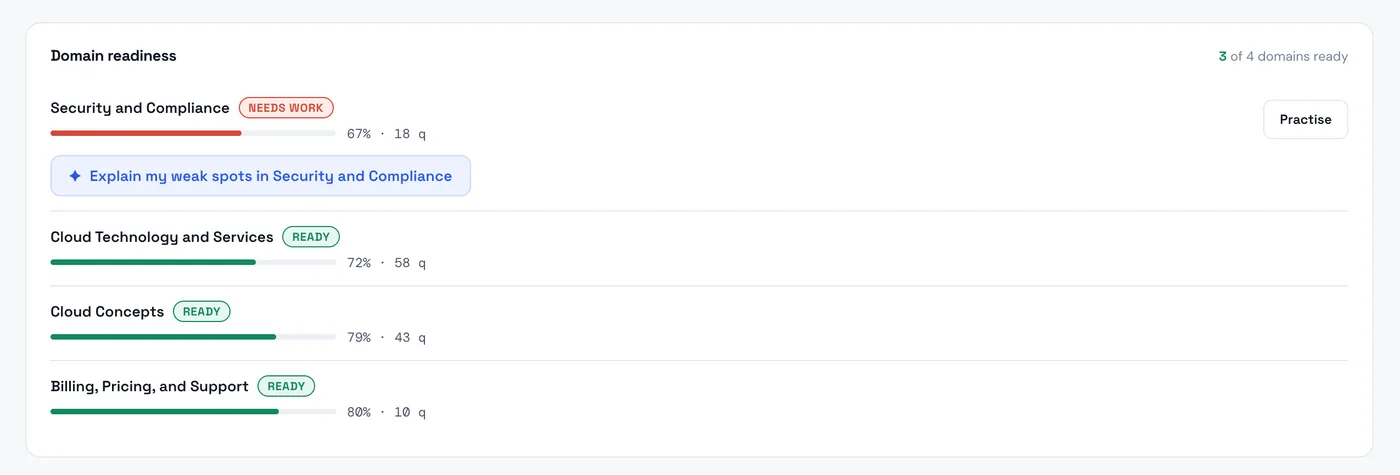
Certsqill’s CBAP practice questions are expert-developed and case-based: every question explains each answer option, and a readiness score for each of the six knowledge areas shows whether requirements analysis and design definition, at 30% of the exam, is ready before you spend an attempt.
CBAP questions people ask
What is CBAP certification?
The Certified Business Analysis Professional from IIBA, its senior business analysis certification. It requires 7,500 hours of documented experience before you can sit the exam. Source: IIBA, checked 10 October 2026.
How much does CBAP certification cost?
A US$145 application fee plus a US$505 exam fee, or US$350 for IIBA members. Retakes cost US$295 or US$450. Source: IIBA CBAP page, checked 10 October 2026.
What are the CBAP requirements?
7,500 hours of business analysis work in the last 10 years, at least 900 hours in 4 of 6 knowledge areas, 35 professional development hours in the last four years and two references. Source: IIBA, checked 10 October 2026.
How many questions are on the CBAP exam?
120 case-study and scenario-based multiple-choice questions in 210 minutes. Source: IIBA CBAP page, checked 10 October 2026.
What is the CBAP passing score?
IIBA does not publish one. The Handbook says only that you see a pass or fail result on screen, checked 10 October 2026.
Can I take the CBAP exam online?
Yes. It is offered as an online remote proctored exam or at PSI test centres. Source: IIBA CBAP Handbook, checked 10 October 2026.
How many times can I take the CBAP exam?
Up to three attempts within the one-year term after your application is approved. Source: IIBA CBAP Handbook, checked 10 October 2026.
How do I renew CBAP?
Earn and record 60 CDUs every three years and pay the recertification fee of US$85 for members or US$120 for non-members. Source: IIBA, checked 10 October 2026.
Is CBAP worth it, and what about salary?
IIBA states on its CBAP page that certified professionals earn up to 19% more than non-certified peers, without giving a method there. Treat it as IIBA’s own claim; whether CBAP is worth it depends on whether you meet the 7,500-hour bar and want a senior BA role.

