CAMS certification: cost, requirements and exam format
CAMS — Certified Anti-Money Laundering Specialist — is the anti-money laundering certification of ACAMS. You need ACAMS membership and 40 eligibility credits to apply. The exam has 120 multiple-choice and multiple-selection questions in 3.5 hours, the passing score is 75, and the standard package with the exam costs US$2,095 in the private sector or US$1,595 in the public sector. You recertify with 60 credits every three years.
- Certification
- Certified Anti-Money Laundering Specialist (CAMS), issued by ACAMSACAMS CAMS page and Candidate Handbook, checked 10 October 2026
- Cost
- Standard package with exam: US$2,095 private sector, US$1,595 public sectorACAMS CAMS Candidate Handbook, checked 10 October 2026
- Questions
- 120 multiple-choice and multiple-selection questionsACAMS CAMS Candidate Handbook, checked 10 October 2026
- Duration
- 3.5 hoursACAMS CAMS Candidate Handbook, checked 10 October 2026
- Passing score
- 75 — ACAMS does not state the scaleACAMS CAMS Candidate Handbook, checked 10 October 2026
- Delivery
- Pearson VUE test centre or online proctoringACAMS CAMS page and Candidate Handbook, checked 10 October 2026
- Eligibility
- Active ACAMS membership and 40 eligibility credits from education, experience and trainingACAMS CAMS Candidate Handbook, checked 10 October 2026
- Retake
- US$299 private sector, US$199 public sector; wait 30, 60 or 90 daysACAMS CAMS Candidate Handbook, checked 10 October 2026
- Recertification
- 60 credits every three years, at least 12 from ACAMS; fee US$200–300ACAMS CAMS Candidate Handbook, checked 10 October 2026
Know if you're ready for CAMS — before you book.
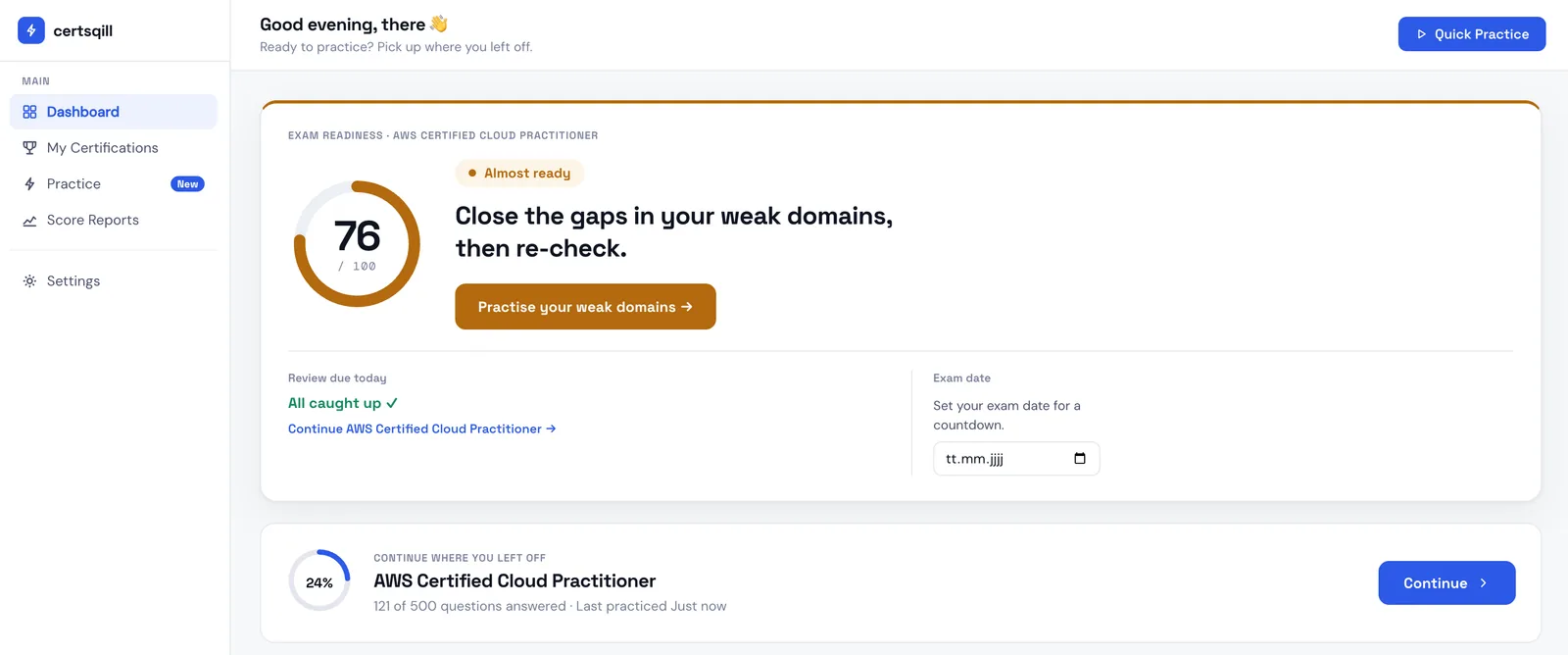
Certsqill measures your CAMS readiness across every official exam domain — one 0–100 score from coverage, accuracy and consistency that tells you whether to book, keep studying, or sit.
Why people switch to Certsqill
Everything you need to walk in ready
Know where you stand, understand every mistake, and study in your language — one payment, no subscription.
Your CAMS Readiness Score, not a guess
One number from three signals — coverage, accuracy, and consistency — tells you whether to book the exam or keep studying.
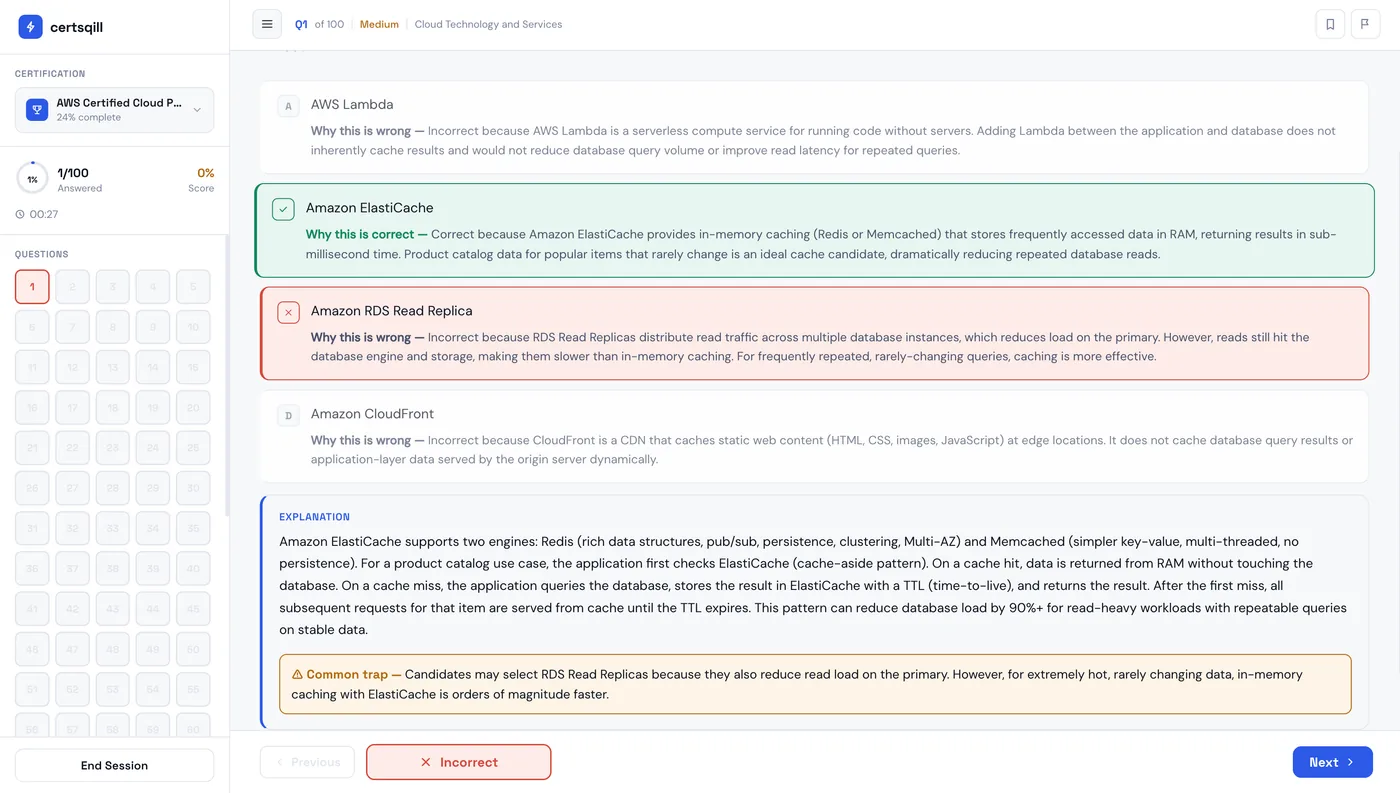
Understand every CAMS mistake
When you miss a question, it explains why — using your own answer history to catch the patterns you keep repeating. Included, no subscription.
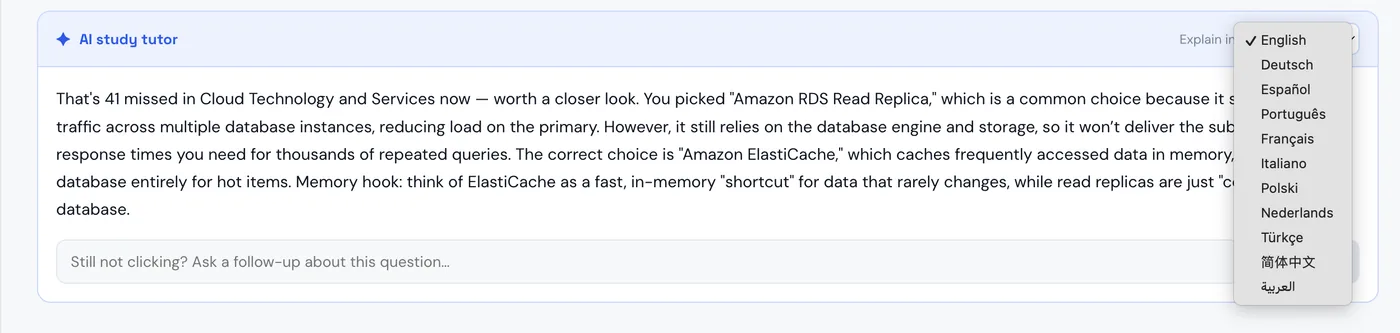
Explanations in your language, questions stay exam-accurate
Get every explanation in your language while the questions stay in exam-accurate English. Technical terms stay in English — the way the exam writes them.
Everything you need to pass
Why you can trust these CAMS questions
What is CAMS certification?
CAMS stands for Certified Anti-Money Laundering Specialist. It is issued by ACAMS (Association of Certified Anti-Money Laundering Specialists), which describes the CAMS designation as the preeminent anti-money laundering certification. When people talk about “the” ACAMS certification or the ACAMS AML certification, this is usually the one they mean.
The ACAMS Certified Anti-Money Laundering Specialist title is a specialist-level credential, not an entry test: before you can sit the exam you must be an ACAMS member and collect 40 eligibility credits from education, work experience and training. The exam then tests how financial crime works, the global frameworks that regulate it, how a compliance programme is built and which tools are used to fight it.
ACAMS offers the CAMS exam in 13 languages, from English, Spanish and French to Japanese, Korean, Polish and both forms of Chinese. ACAMS says you can get certified in as little as four months, depending on whether you choose self-study or one of its enhanced learning paths.
Source: ACAMS — CAMS certification. Checked 10 October 2026.
How much does CAMS certification cost?
ACAMS does not sell the CAMS exam as a standalone voucher. The fee table in the CAMS Candidate Handbook lists packages, and the exam is part of each one, so the ACAMS test cost is included in the package price. The standard package costs US$2,095 in the private sector and US$1,595 in the public sector. The package with the Virtual Classroom costs US$2,495 in the private sector and US$2,095 in the public sector.
So the ACAMS certification cost for a first attempt is one package — plus ACAMS membership, which is required to apply and to keep the certification. ACAMS’s membership page shows one-year and three-year terms and says public-sector members get preferential rates, but it displayed no membership amounts when we checked.
If you fail, a retake authorization costs US$299 in the private sector or US$199 in the public sector. Every three years, recertification costs US$200 if you file early (by 1 October), US$250 at the regular deadline (15 December) or US$300 late (by 31 March).
- Standard package with exam: US$2,095 private sector, US$1,595 public sector
- Package with Virtual Classroom: US$2,495 private sector, US$2,095 public sector
- Retake authorization: US$299 private sector, US$199 public sector
- Recertification: US$200 early, US$250 regular, US$300 late
- ACAMS membership: required; no amount shown on ACAMS’s membership page
Source: ACAMS — CAMS Candidate Handbook (VCB26.16). Checked 10 October 2026.
ACAMS certification requirements: how to get ACAMS certified
The ACAMS certification requirements have two parts. First, active ACAMS membership: the Handbook says membership is required to apply and to maintain the certification. Second, 40 eligibility credits, which you can combine from three sources.
Education counts once, by your highest degree. Work experience in the field earns 10 credits per year, with no upper limit, and financial-crime training earns one credit per hour, also without a limit. A master’s degree plus one year of experience therefore reaches 40, as does four years of experience on its own.
Once your application is approved, ACAMS emails instructions for scheduling your exam with Pearson VUE. That is how to get ACAMS certification in practice: join, document your 40 credits, apply, prepare, pass the exam.
- Associate degree: 10 credits
- Bachelor’s degree: 20 credits
- Master’s degree: 30 credits
- JD or PhD: 40 credits
- Work experience: 10 credits per year
- Financial-crime training: 1 credit per hour
Source: ACAMS — CAMS Candidate Handbook (VCB26.16). Checked 10 October 2026.
CAMS exam format and passing score
The CAMS exam has 120 multiple-choice and multiple-selection questions, and every candidate has 3.5 hours. That is 1 minute 45 seconds per question. Multiple-selection items ask for more than one correct answer, so read each stem for how many options it wants. There is no penalty for guessing, so leave nothing blank.
The passing score is 75. ACAMS does not say in the Handbook whether that is a scaled score or what the maximum is, so do not read it as “75%” without that caveat. You receive a pass or fail result immediately at the end of the test.
The exam is delivered by Pearson VUE, at a test centre or through online proctoring at home or in the office; the Handbook notes that online proctoring depends on your location. If you fail, you wait 30 days before the second attempt, 60 days before the third and 90 days before any later attempt.
Source: ACAMS — CAMS Candidate Handbook (VCB26.16). Checked 10 October 2026.
What is on the CAMS exam? The syllabus
The CAMS syllabus has four content domains, and the Handbook gives their weights. Two domains carry 30% each: how financial crime works, and how a compliance programme is built. Together they account for 60% of the exam, so these are where your preparation should start.
- Understanding the risks and methods of financial crime — 30%
- Building an anti-financial crime compliance program — 30%
- Global AFC frameworks, governance, and regulations — 20%
- Tools and technologies to fight financial crime — 20%
Source: ACAMS — CAMS Candidate Handbook (VCB26.16). Checked 10 October 2026.
CAMS study materials, training and exam prep
ACAMS bundles its exam prep into the package. The standard package lists an electronic study guide in PDF, online flashcards, review questions, a practice exam and the exam itself. The Virtual Classroom bundle adds six two-hour live online classes. The Handbook also mentions two elective courses that sit outside the exam blueprint.
Count the hours you spend in financial-crime training: they also earn eligibility credits, one per hour. For a structured plan, start with the two 30% domains, then cover frameworks and tools, and use the practice exam once you have been through the whole study guide.
Brain dumps are not a shortcut. Candidates agree not to discuss the content of an examination with anyone and may not record, copy or disclose questions or answers. ACAMS says violations can lead to cancelled scores and the suspension or revocation of certifications and memberships, as well as legal action.
Source: ACAMS — CAMS certification. Checked 10 October 2026.
ACAMS recertification requirements and credits
ACAMS recertification runs on a three-year cycle. You need a total of 60 recertification credits within the cycle, and at least 12 of them must come from ACAMS-provided training. Membership must stay active as well, because the Handbook makes it a condition of holding the certification.
ACAMS recertification credits come in two kinds. ACAMS credits come from ACAMS-hosted activities such as virtual classrooms, webinars and events, and are tracked automatically. Credits from other providers need proof of participation. Most activities earn one credit per hour, but they must be live: the Handbook requires at least one hour of continuous synchronous learning and does not accept asynchronous activities.
Plan the renew step around the fee deadlines: US$200 by 1 October, US$250 by 15 December, US$300 by 31 March. An extension request costs US$100.
Source: ACAMS — CAMS Candidate Handbook (VCB26.16). Checked 10 October 2026.
Other ACAMS certificates and certifications
Beyond CAMS, the Association of Certified Anti-Money Laundering Specialists (ACAMS) separates certificates — shorter courses with an assessment — from certifications. If you are comparing ACAMS certificates, these are the ones searchers most often ask about.
The ACAMS AML Foundations certificate is a learning path for people in banks, credit unions and asset managers, though ACAMS says it is relevant to any industry. You earn the certificate by passing a short assessment. Some people call it the ACAMS AML Foundations certification, but ACAMS itself calls it a certificate, and its page shows member and non-member pricing without amounts.
The ACAMS Fraud Foundations certificate covers fraud detection and prevention: online and self-paced, about four hours of coursework, to be completed within four weeks, with a 20-question final assessment. It costs US$595 for members and US$795 for non-members. If you are searching for an ACAMS fraud certification, this certificate is the fraud course ACAMS lists.
Two specialist certifications sit alongside CAMS. The ACAMS crypto certification is CCAS, the Certified Cryptoasset Anti-Financial Crime Specialist, which also requires membership and 40 eligibility credits. The ACAMS sanctions certification is CGSS, the Certified Global Sanctions Specialist.
Source: ACAMS — Fraud Foundations Certificate. Checked 10 October 2026.
Is ACAMS certification worth it?
ACAMS publishes no salary figures for CAMS holders on its CAMS page or in the Handbook, and this page does not quote anyone else’s. What can be weighed is the commitment: membership, 40 eligibility credits, a package of US$1,595 to US$2,095, and 60 credits every three years to keep the title.
It tends to make most sense if you work in, or are moving into, anti-financial crime compliance, where the domains — financial crime methods, frameworks, programme design and tools — are the daily work rather than background reading.
Source: ACAMS — CAMS Candidate Handbook (VCB26.16). Checked 10 October 2026.
CAMS practice questions
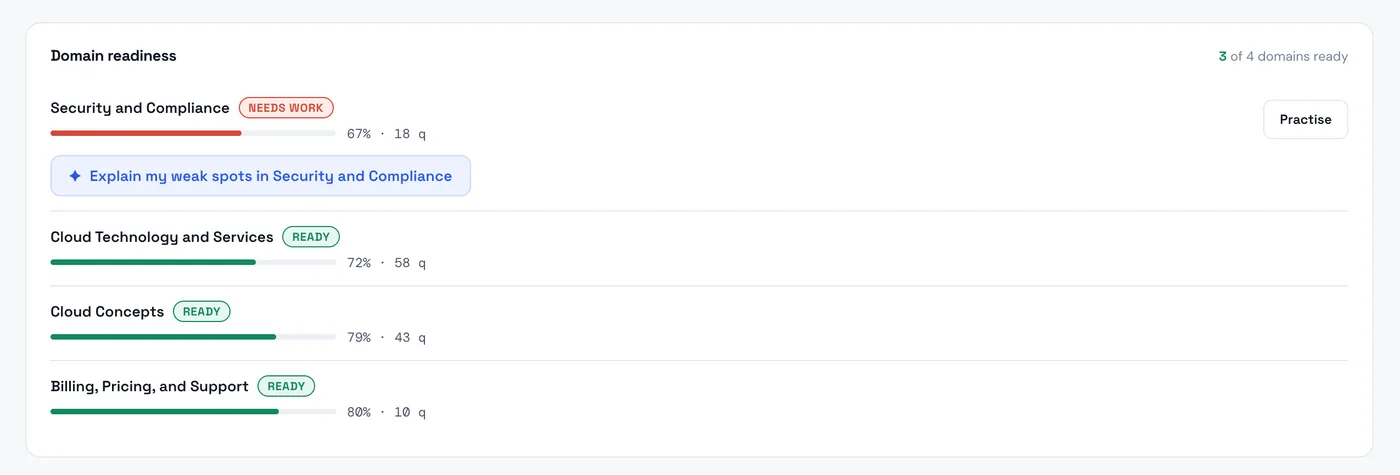
Certsqill’s CAMS practice questions are expert-developed: every question explains each answer option, and a readiness score for each of the four domains shows whether the two 30% domains are ready before you spend an attempt.
CAMS questions people ask
What is ACAMS certification?
ACAMS offers several certifications; the best known is CAMS, the Certified Anti-Money Laundering Specialist. It requires ACAMS membership and 40 eligibility credits. Source: ACAMS, checked 10 October 2026.
How much does the CAMS certification cost?
The standard package with the exam costs US$2,095 in the private sector or US$1,595 in the public sector; ACAMS membership is required on top. Source: ACAMS CAMS Candidate Handbook, checked 10 October 2026.
What is the ACAMS exam cost if I need a retake?
A retake authorization costs US$299 in the private sector or US$199 in the public sector. Source: ACAMS CAMS Candidate Handbook, checked 10 October 2026.
How many questions are on the CAMS exam?
120 multiple-choice and multiple-selection questions in 3.5 hours. Source: ACAMS CAMS Candidate Handbook, checked 10 October 2026.
What is the CAMS passing score?
75. ACAMS does not state the scale in the Handbook, checked 10 October 2026.
What are the ACAMS certification requirements?
Active ACAMS membership and 40 eligibility credits from education, work experience (10 per year) and training (1 per hour). Source: ACAMS CAMS Candidate Handbook, checked 10 October 2026.
How do I get ACAMS certification?
Join ACAMS, document 40 eligibility credits, apply, then schedule the exam with Pearson VUE once your application is approved and pass it.
What are the ACAMS recertification requirements?
60 recertification credits every three years, at least 12 from ACAMS training, plus a fee of US$200 to US$300 depending on when you file. Source: ACAMS CAMS Candidate Handbook, checked 10 October 2026.
Is ACAMS certification worth it?
ACAMS publishes no salary data for CAMS. It is most useful if anti-financial crime compliance is your field; weigh that against membership, the package price and the three-year recertification.

