CKAD certification: cost, hands-on exam format and passing score
The CKAD certification (Certified Kubernetes Application Developer) comes from the Linux Foundation and the CNCF. The exam costs $445, gives you 2 hours for 15–20 performance-based tasks in live Kubernetes clusters, requires 66% to pass, has no prerequisites and is valid for 2 years.
- Certification
- Certified Kubernetes Application Developer (CKAD) — Linux Foundation and CNCFLinux Foundation CKAD page, checked 8 October 2026
- Exam fee
- $445 exam only · $645 with the LFD259 courseLinux Foundation CKAD page, checked 8 October 2026
- Format
- Online, proctored, performance-based — 15–20 tasks on the command lineLinux Foundation CKAD page and CKA/CKAD instructions, checked 8 October 2026
- Duration
- 2 hoursLinux Foundation CKAD page, checked 8 October 2026
- Passing score
- 66% or aboveLinux Foundation FAQ, checked 8 October 2026
- Prerequisites
- NoneLinux Foundation CKAD page, checked 8 October 2026
- Kubernetes version
- v1.37Linux Foundation CKAD page, checked 8 October 2026
- Included
- 12-month exam eligibility, one retake, two simulator sessionsLinux Foundation CKAD page, checked 8 October 2026
- Validity
- 2 years; renewed by passing the exam againLinux Foundation FAQ, checked 8 October 2026
Know if you're ready for CKAD — before you book.
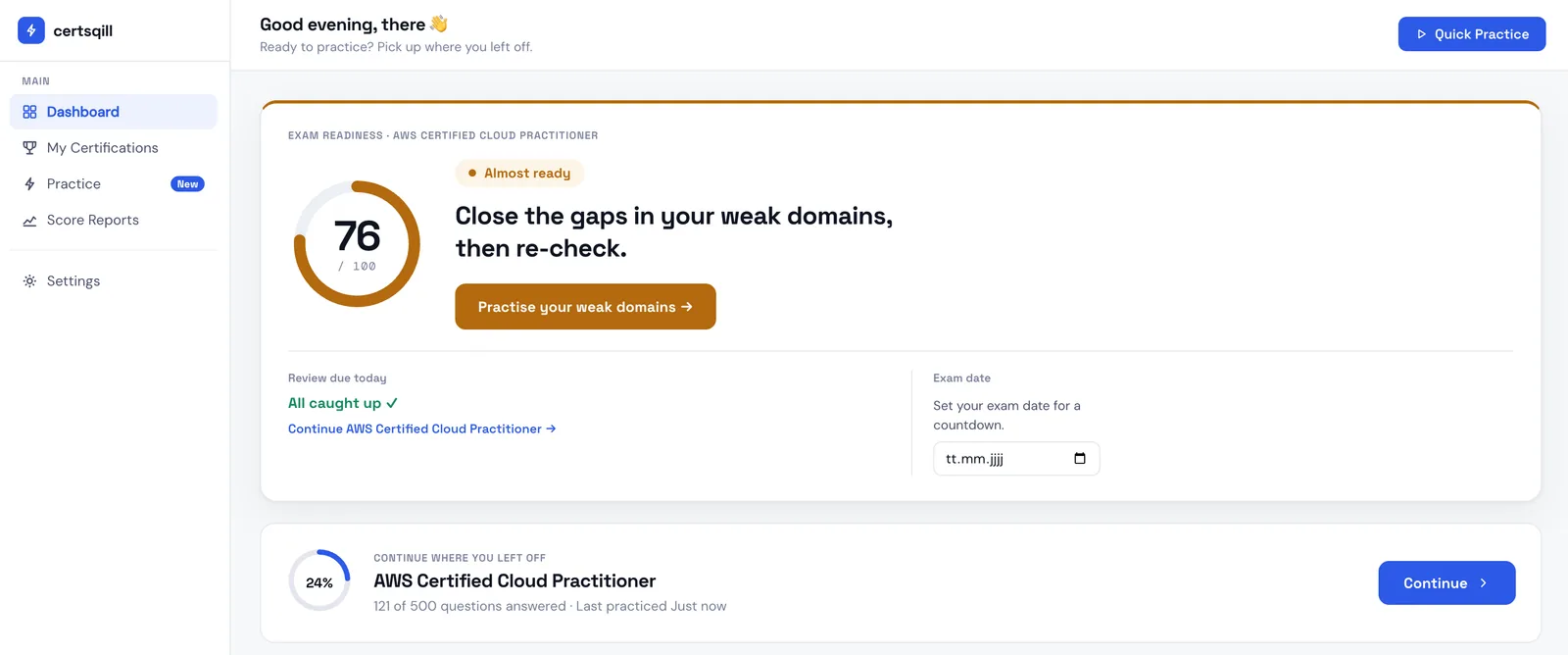
Certsqill measures your CKAD readiness across every official exam domain — one 0–100 score from coverage, accuracy and consistency that tells you whether to book, keep studying, or sit.
Why people switch to Certsqill
Everything you need to walk in ready
Know where you stand, understand every mistake, and study in your language — one payment, no subscription.
Your CKAD Readiness Score, not a guess
One number from three signals — coverage, accuracy, and consistency — tells you whether to book the exam or keep studying.
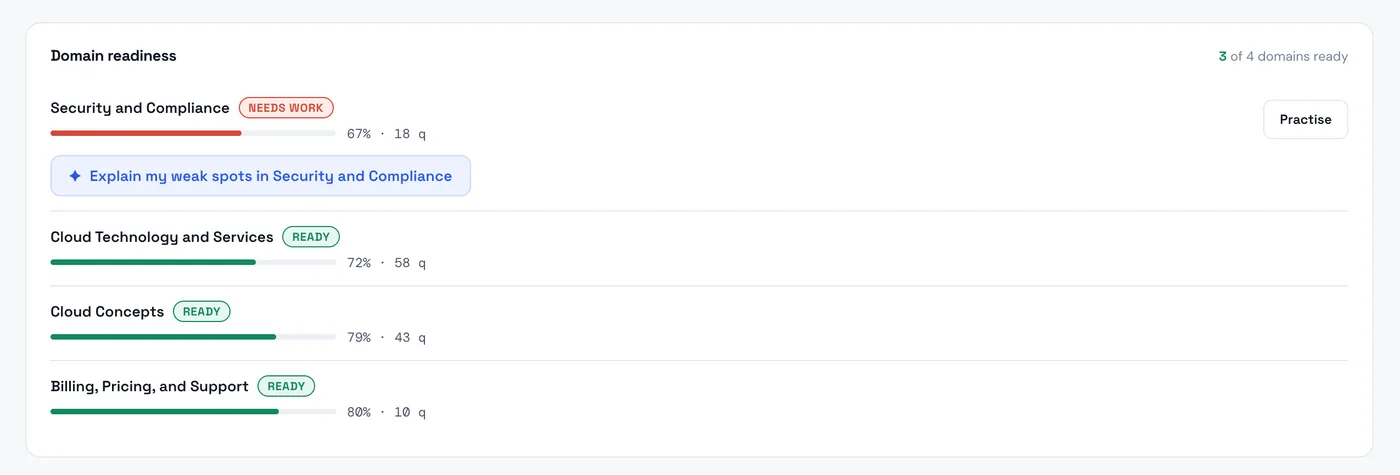
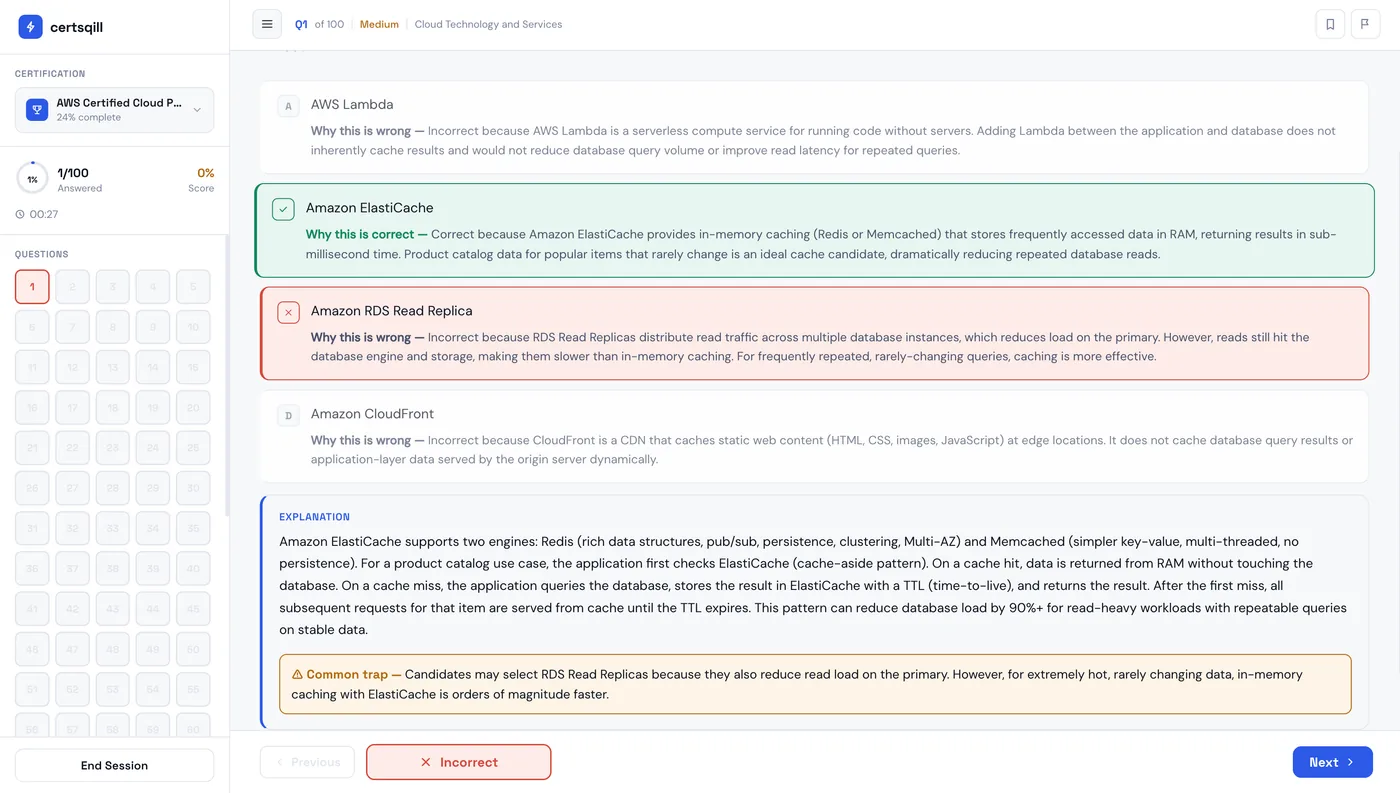
Understand every CKAD mistake
When you miss a question, it explains why — using your own answer history to catch the patterns you keep repeating. Included, no subscription.
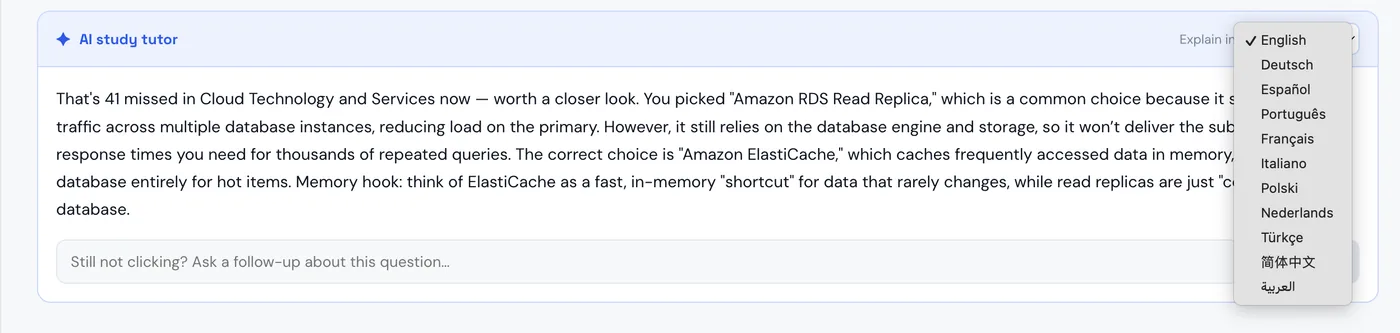
Explanations in your language, questions stay exam-accurate
Get every explanation in your language while the questions stay in exam-accurate English. Technical terms stay in English — the way the exam writes them.
Everything you need to pass
Why you can trust these CKAD questions
What is the CKAD certification?
CKAD stands for Certified Kubernetes Application Developer. In the Linux Foundation’s words, it focuses on the skills required to be a successful Kubernetes application developer — designing, building, configuring and exposing applications that run on Kubernetes, rather than building and operating the cluster underneath.
It is one of three Kubernetes certifications run by the Linux Foundation together with the Cloud Native Computing Foundation (CNCF). CKA is the administrator counterpart, and CKS is the security specialisation that requires a passed CKA. CKAD itself has no prerequisite, so it can be your first Kubernetes credential.
Like its siblings, CKAD is a hands-on exam. You work in live clusters from a terminal, and you are scored on what the cluster looks like when you are done — not on picking an answer.
Source: Linux Foundation — CKAD certification page. Checked 8 October 2026.
How much does the CKAD certification cost?
The Linux Foundation lists the CKAD exam at $445 for the exam only. It also offers the exam bundled with a THRIVE-ONE annual subscription for $625, and with its Kubernetes for Developers course (LFD259) for $645.
The purchase includes 12 months to schedule and take the exam, one retake and two simulator sessions. So a single $445 registration already covers a second attempt if the first one does not go to plan.
Renewal is done by retaking and passing the exam before expiry. The Linux Foundation does not list a separate renewal product, so budget for another registration every two years if you need the credential to stay current.
Source: Linux Foundation — CKAD certification page. Checked 8 October 2026.
What is the CKAD exam format?
The CKAD is an online, proctored, performance-based test. The Linux Foundation’s instructions state that it consists of 15–20 performance-based tasks, each completed on a designated host, and candidates have 2 hours.
You take it remotely on PSI’s proctoring platform “Bridge” using your own computer, with audio, video and screen sharing streamed to the proctor. The CKAD environment currently runs Kubernetes v1.37 — a newer minor version than the CKA and CKS environments, which run v1.35 — and the Linux Foundation states that it tracks new minor releases within roughly 4 to 8 weeks.
Allowed references are the Kubernetes documentation, the Kubernetes blog and the Helm documentation. You may search within them but must not open external search results. Results arrive by email within 24 hours.
Source: Linux Foundation — Important Instructions: CKA and CKAD. Checked 8 October 2026.
CKAD passing score
The Linux Foundation states that a score of 66% or above must be earned to pass the CKAD.
That percentage refers to task outcomes, not to multiple-choice answers. A task left half-done may earn nothing, so the real challenge is finishing correct work fast: with 15–20 tasks in 2 hours you have on average six to eight minutes each.
For preparation, that means drilling the routine moves — creating and editing manifests, generating YAML with kubectl, switching contexts and namespaces — until they are automatic, so the thinking time goes to the parts of a task that are actually new.
Source: Linux Foundation — FAQ: CKA, CKAD & CKS. Checked 8 October 2026.
What is on the CKAD exam?
The Linux Foundation publishes five domains with weightings. The largest is Application Environment, Configuration and Security at 25%; the other four sit at 20% or 15%, so no single area can be skipped.
The exam is currently based on Kubernetes v1.37, and the environment follows new minor releases within roughly 4 to 8 weeks, according to the Linux Foundation. Re-check the curriculum on the CKAD page close to your exam date, because study material written for an older version may describe APIs or defaults that have since changed.
- Application Environment, Configuration and Security — 25%
- Application Design and Build — 20%
- Application Deployment — 20%
- Services and Networking — 20%
- Application Observability and Maintenance — 15%
Source: Linux Foundation — CKAD certification page. Checked 8 October 2026.
CKAD prerequisites
There are none. The Linux Foundation states: “There are no pre-requisites for this exam.” You do not need CKA or any other certification first.
The Linux Foundation rates the experience level as intermediate. Because the exam happens entirely in a Linux terminal, working comfort with the shell, a terminal editor and kubectl is the practical starting point even though nothing formal is required.
Source: Linux Foundation — CKAD certification page. Checked 8 October 2026.
How long is the CKAD certification valid?
CKAD certifications are valid for 2 years. CKAD certifications achieved before 1 April 2024 keep their original 3-year validity.
To renew, you retake and pass the exam before the expiration date. The renewed certification stays current for a further 2 years from the date you pass.
Source: Linux Foundation — FAQ: CKA, CKAD & CKS. Checked 8 October 2026.
CKAD study materials and training
The Linux Foundation’s own course for this exam is Kubernetes for Developers (LFD259), available on its own or bundled with the exam for $645.
Every exam registration includes two simulator sessions, each with 36 hours of access and a different set of 17 questions, with graded results. They are the closest thing to the real exam environment you get from the issuer, so use one to find your gaps early and keep the other for the end.
Since kubernetes.io/docs is open during the exam, the documentation is also study material: practise finding the right page and the right YAML example quickly, because that is exactly what you will be doing under time pressure.
Source: Linux Foundation — CKAD certification page. Checked 8 October 2026.
CKAD vs CKA
CKAD and CKA match on the logistics: $445, 2 hours, 15–20 hands-on tasks, 66% to pass, 2-year validity. The difference is the job. CKA weights troubleshooting at 30% and cluster architecture, installation and configuration at 25%; CKAD weights application environment, configuration and security at 25% and spreads the rest across design, deployment, networking and observability.
Neither is a prerequisite for the other. If your work is shipping and running applications on a cluster someone else operates, CKAD is the closer fit; if you build or operate the clusters, CKA is. Only CKS has a prerequisite, and it is CKA, not CKAD.
Source: Linux Foundation — FAQ: CKA, CKAD & CKS. Checked 8 October 2026.
CKAD practice questions
Certsqill’s CKAD practice questions explain each option and follow the Linux Foundation’s published domain weightings.
An honest note on what questions do for this exam: CKAD is scored on work you do in a live cluster, so knowledge questions complement hands-on practice and never replace it. Their job is to make sure you know which object, field or probe a task needs before you start typing — so lab time goes into speed, not into looking up concepts.
CKAD questions people ask
How much does the CKAD exam cost?
$445 for the exam only, including one retake and two simulator sessions. With the LFD259 course it is $645. Source: Linux Foundation, checked 8 October 2026.
Is the CKAD exam hands-on?
Yes. It is an online, proctored, performance-based test of 15–20 tasks solved on the command line. Source: Linux Foundation, checked 8 October 2026.
How long is the CKAD exam?
2 hours. Source: Linux Foundation, checked 8 October 2026.
What is the CKAD passing score?
66% or above. Source: Linux Foundation FAQ, checked 8 October 2026.
Does CKAD have prerequisites?
No. The Linux Foundation states there are no prerequisites for this exam, checked 8 October 2026.
Which Kubernetes version is the CKAD based on?
Kubernetes v1.37. Source: Linux Foundation, checked 8 October 2026.
How long is the CKAD valid?
2 years (3 years for CKAD certifications achieved before 1 April 2024). Renew by retaking and passing the exam. Source: Linux Foundation FAQ, checked 8 October 2026.
In which languages can I take the CKAD?
English, Simplified Chinese and Japanese. Source: Linux Foundation FAQ, checked 8 October 2026.
The Certified Kubernetes Application Developer (CKAD) exam in practice
Most people searching for a Kubernetes application developer certification want proof that they can ship workloads on a cluster, not that they can recite definitions. That is what the certified Kubernetes application developer CKAD exam is built to test: every task is checked against the state of a live cluster when time runs out.
In practice that changes how you study. Reading about Deployments, ConfigMaps or NetworkPolicies is the first step; the second is creating, editing and debugging them from a terminal until you no longer need to think about the syntax. A CKAD cert earned this way says something concrete to an employer: you have done the work under time pressure.
What CKAD exam questions actually look like
There are no multiple-choice CKAD exam questions. Each item is a task: a short scenario on a named host, with something to build, fix or expose. You are graded on the result, so a task that is nearly right can still score nothing.
The best way to see the format before exam day is the official simulator included with your registration. Use the published curriculum — effectively the CKAD syllabus — to decide what to drill between the two simulator sessions.
Source: Linux Foundation — CKAD certification page. Checked 8 October 2026.
Choosing a CKAD course
The Linux Foundation’s own option is LFD259, Kubernetes for Developers. Whatever CKAD course you consider, check three things: does it follow the current curriculum and Kubernetes version, does it include hands-on labs in real clusters, and does it train speed — not just understanding. A course that only explains concepts leaves out the part of the exam that fails most candidates: finishing correct work in time.
Source: Linux Foundation — CKAD certification page. Checked 8 October 2026.
Vouchers, discounts and what your registration includes
Whether you buy the exam yourself or receive a CKAD voucher from an employer or a promotion, the registration is the same product: 12 months to schedule the exam, one retake and two simulator sessions. Before buying from anyone other than the Linux Foundation, make sure you are getting exactly that.
Source: Linux Foundation — CKAD certification page. Checked 8 October 2026.
CKAD dumps break the certification agreement
CKAD dumps are collections of tasks recalled from the live exam. The Linux Foundation’s certification agreement names this “braindump material” explicitly, prohibits seeking or obtaining unauthorized access to exam materials, and states that violators can have their certifications revoked and be barred from taking any other Linux Foundation exam.
They also miss the point of a performance-based test. Knowing a recalled task does not help if you cannot type the solution in a few minutes — and the environment is updated as Kubernetes moves on.
Source: Linux Foundation — Global Certification and Confidentiality Agreement. Checked 9 October 2026.
Is the CKAD certified Kubernetes application developer credential worth it?
Whether CKAD is worth it depends on your work. If you deploy and run applications on Kubernetes, the preparation itself makes you faster and more confident in day-to-day work, and the hands-on format makes the credential hard to fake. If you rarely touch a cluster, the two-year validity means you would be paying again to keep a credential you do not use.
The Linux Foundation does not publish salary or pass-rate data for the CKAD, so be wary of anyone who quotes exact figures.
More CKAD questions
Are there sample CKAD exam questions from the Linux Foundation?
Yes, in the form of the exam simulator: two sessions with a different set of 17 questions each, included with your registration. Source: Linux Foundation, checked 8 October 2026.
Can I lose my CKAD cert for using dumps?
Yes. The Linux Foundation’s certification agreement allows it to revoke certifications and bar candidates from further exams for obtaining unauthorized exam material. Source: Linux Foundation, checked 9 October 2026.

