KCNA certification: exam format, cost and passing score
KCNA — Kubernetes and Cloud Native Associate — is the Linux Foundation’s entry-level Kubernetes certification. The exam is online, proctored and multiple choice: 60 questions in 90 minutes, and you need 75% to pass. It costs $250 for the exam alone, includes one retake, has no prerequisites and is valid for two years.
- Certification
- Kubernetes and Cloud Native Associate (KCNA), from the Linux FoundationLinux Foundation KCNA page, checked 10 October 2026
- Exam cost
- $250 exam only; $299 with the LFS250 course; $495 with a THRIVE-ONE annual subscriptionLinux Foundation KCNA page, checked 10 October 2026
- Questions
- 60 multiple-choice questionsLinux Foundation Docs, Multiple Choice Exams instructions, checked 10 October 2026
- Duration
- 90 minutesLinux Foundation KCNA page and Multiple Choice Exams FAQ, checked 10 October 2026
- Passing score
- 75%Linux Foundation Docs, Multiple Choice Exams FAQ, checked 10 October 2026
- Delivery
- Online, remotely proctoredLinux Foundation KCNA page, checked 10 October 2026
- Prerequisites
- None; listed as beginner levelLinux Foundation KCNA page, checked 10 October 2026
- Attempts
- Two — the first attempt plus one retake, within 12 months of purchaseLinux Foundation KCNA page, checked 10 October 2026
- Validity
- 2 years; renewed by retaking KCNA or by passing CKA or CKADLinux Foundation Docs, Multiple Choice Exams FAQ, checked 10 October 2026
Know if you're ready for KCNA — before you book.
Certsqill measures your KCNA readiness across every official exam domain — one 0–100 score from coverage, accuracy and consistency that tells you whether to book, keep studying, or sit.
Why people switch to Certsqill
Everything you need to walk in ready
Know where you stand, understand every mistake, and study in your language — one payment, no subscription.
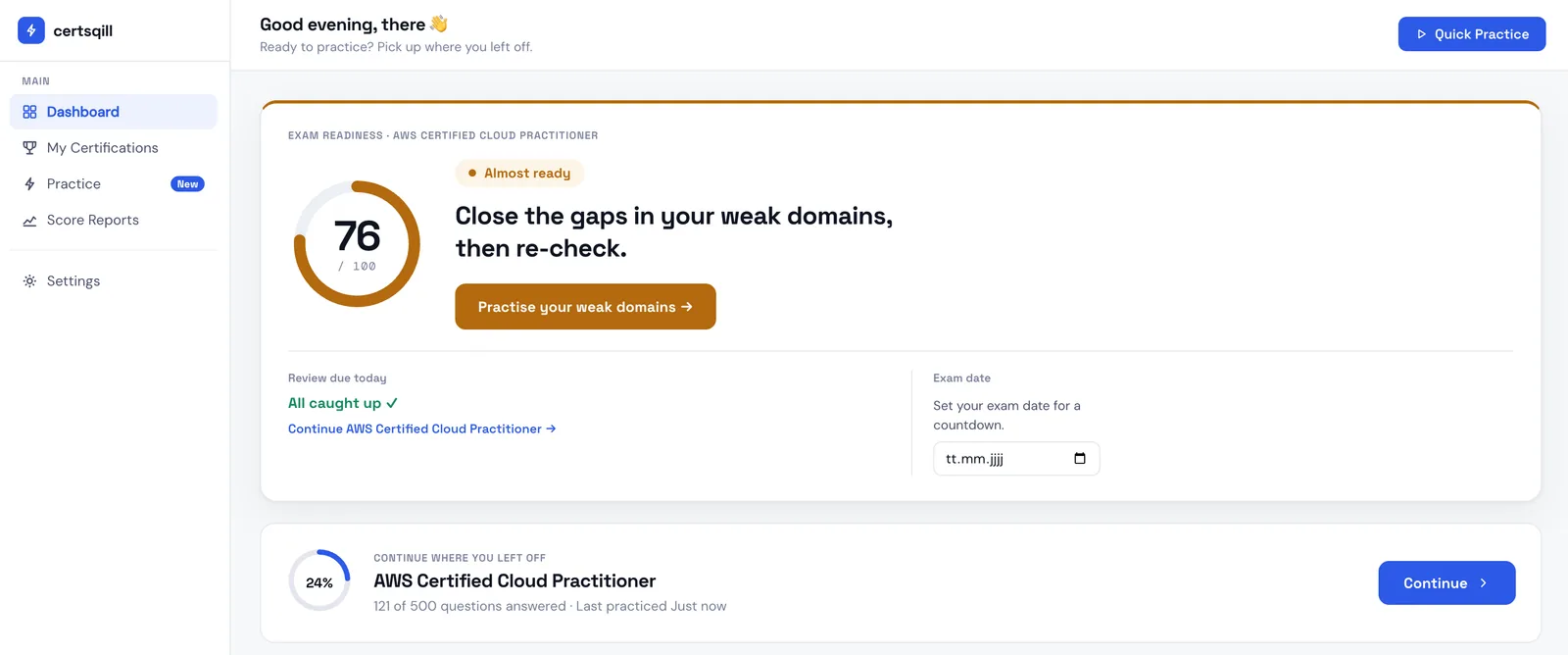
Your KCNA Readiness Score, not a guess
One number from three signals — coverage, accuracy, and consistency — tells you whether to book the exam or keep studying.
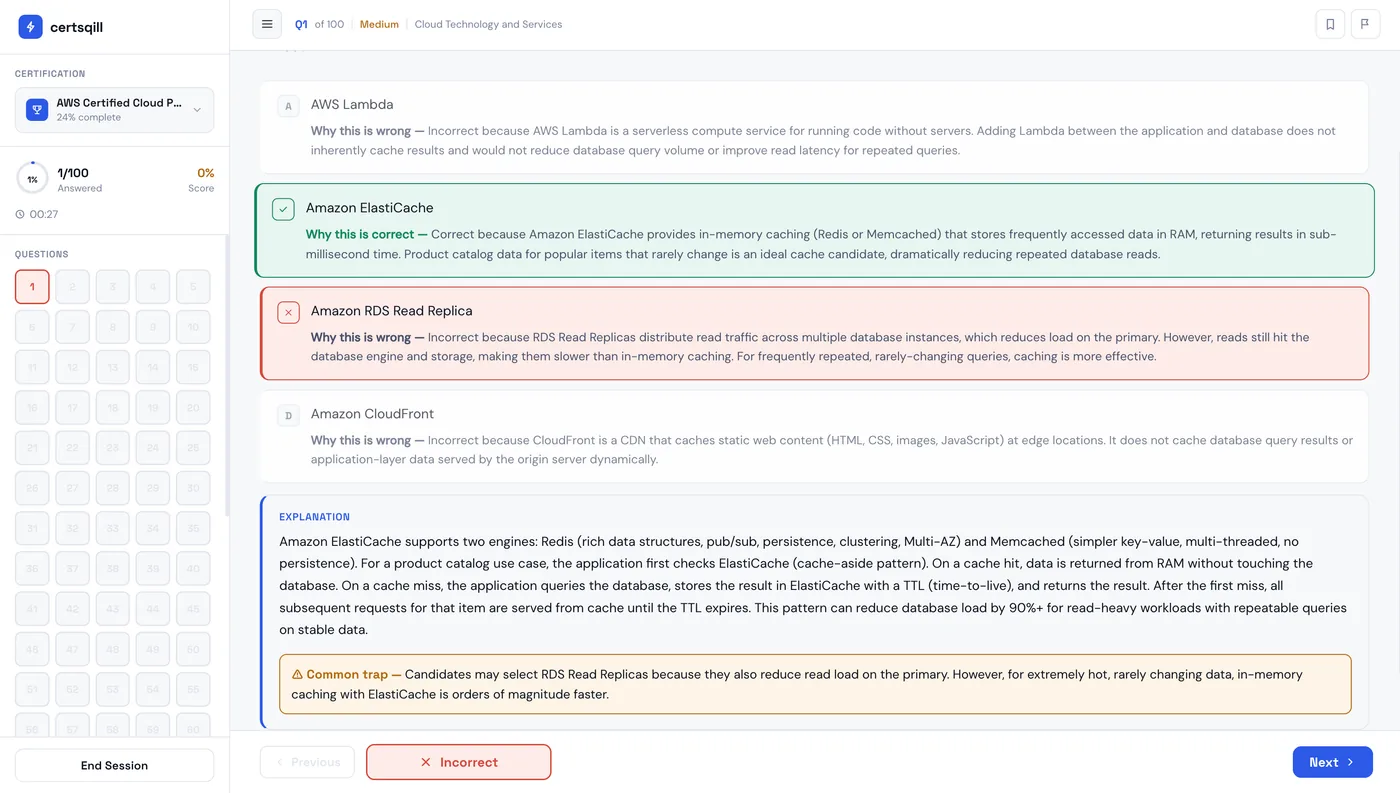
Understand every KCNA mistake
When you miss a question, it explains why — using your own answer history to catch the patterns you keep repeating. Included, no subscription.
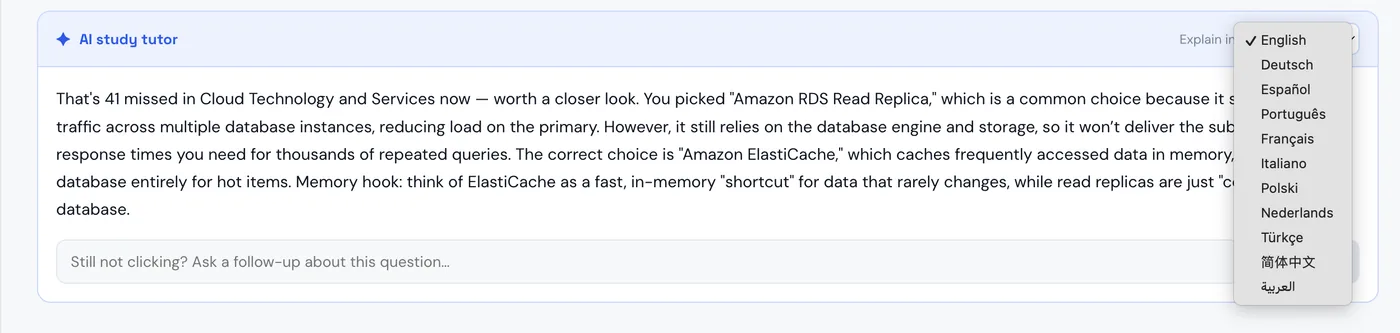
Explanations in your language, questions stay exam-accurate
Get every explanation in your language while the questions stay in exam-accurate English. Technical terms stay in English — the way the exam writes them.
Everything you need to pass
Why you can trust these KCNA questions
What is the KCNA certification?
KCNA stands for Kubernetes and Cloud Native Associate. The exam is run by the Linux Foundation, which describes it as a demonstration of a user’s foundational knowledge and skills in Kubernetes; its domains also cover the wider cloud native ecosystem.
It is the entry point of the Kubernetes certification track. The Linux Foundation lists it as beginner level with no prerequisites, and the exam is multiple choice — unlike CKA, a performance-based test solved from the Kubernetes command line. A KCNA cert therefore proves that you understand the concepts and the vocabulary, not that you can operate a cluster from the command line.
That makes the KCNA certification a sensible first step for people who work around Kubernetes rather than inside it every day — developers new to containers, operations staff moving to cloud native platforms, technical project managers — and for anyone planning to take CKA later. The Linux Foundation itself points KCNA holders to CKA as the next level.
Source: Linux Foundation — KCNA certification page. Checked 10 October 2026.
How much does the KCNA exam cost?
The KCNA exam costs $250 on its own. The Linux Foundation also sells two bundles: the exam plus its LFS250 course, Kubernetes and Cloud Native Essentials, for $299, and the exam plus a THRIVE-ONE annual subscription for $495.
The price includes two attempts: the Linux Foundation lists one retake as part of the purchase, and you have 12 months from purchase to schedule and take the exam. It does not say that a retake costs extra, so plan on the two attempts that the price covers rather than on any additional ones.
- Exam only: $250
- Exam + LFS250 Kubernetes and Cloud Native Essentials: $299
- Exam + THRIVE-ONE annual subscription: $495
Source: Linux Foundation — KCNA certification page. Checked 10 October 2026.
KCNA exam format and passing score
The KCNA exam consists of 60 multiple-choice questions, and you have 90 minutes to answer them — an average of 90 seconds per question. It is delivered online and proctored remotely through audio, video and screen sharing, so you take it from home or the office rather than at a test centre. The Linux Foundation requires a private, well-lit, clutter-free room and a single active monitor.
To pass you need a score of 75% or above. The exam is scored automatically, and the Linux Foundation says the score report is emailed within 24 hours of finishing, barring technical problems.
The Linux Foundation’s instructions for its multiple-choice exams state that no other applications or browser windows may be running during the exam, so plan to answer from what you know rather than from reference material.
Source: Linux Foundation Docs — Multiple Choice Exams: Important Instructions. Checked 10 October 2026.
KCNA exam syllabus: the four domains
The Linux Foundation publishes the KCNA syllabus as four domains with fixed weights. Kubernetes fundamentals alone carries 44% of the exam — almost half — so the core objects, the control plane and scheduling deserve the most study time.
Container orchestration follows at 28%, covering networking, security, troubleshooting and storage. The remaining 28% is split between application delivery and architecture: how cloud native applications are shipped and debugged, and the ecosystem around them, including observability, cloud native principles and the community that maintains the projects.
- Kubernetes Fundamentals — 44% (core concepts, administration, scheduling, containerization)
- Container Orchestration — 28% (networking, security, troubleshooting, storage)
- Cloud Native Application Delivery — 16% (application delivery, debugging)
- Cloud Native Architecture — 12% (observability, cloud native ecosystem and principles, community and collaboration)
Source: Linux Foundation — KCNA certification page. Checked 10 October 2026.
KCNA prerequisites
There are none. The Linux Foundation lists no prerequisites for KCNA and rates the exam as beginner level. You do not need another certification, a degree or documented experience to buy it.
In practice, the exam assumes you are comfortable with basic Linux and container ideas — what an image is, what a container runtime does — because the questions build on them. If those are new, start with the free Introduction to Kubernetes course that the Linux Foundation lists on the KCNA page before moving to exam-focused study.
Source: Linux Foundation — KCNA certification page. Checked 10 October 2026.
How long is the KCNA certification valid?
KCNA is valid for two years. The Linux Foundation states that renewal must be completed before the expiry date, either by retaking and passing the KCNA exam, after which the certification stays current for a further two years from the date you pass, or through its CARE programme.
Under CARE, passing the Certified Kubernetes Administrator (CKA) or Certified Kubernetes Application Developer (CKAD) exam automatically renews your KCNA. If you are planning to move up anyway, that is the more useful way to keep it current.
Source: Linux Foundation Docs — Multiple Choice Exams FAQ. Checked 10 October 2026.
KCNA study guide: official training and courses
The authoritative scope for any KCNA study plan is the domain list above. Check every KCNA course, book or video against it: if a resource spends most of its time on topics outside the four domains, it is not preparing you for this exam.
The Linux Foundation’s own KCNA training is LFS250, Kubernetes and Cloud Native Essentials, which it sells bundled with the exam for $299. It also lists free introductory courses on Kubernetes and on clouds and containers. Training is optional — there is no course requirement for KCNA — so the choice between a paid course, the free material and self-study is a matter of how much structure you need.
A practical order: work through Kubernetes fundamentals first, because it is 44% of the exam, then orchestration, then delivery and architecture. Run a small local cluster while you study; even on a multiple-choice exam, questions about objects and commands are easier when you have seen them in action.
Source: Linux Foundation — KCNA certification page. Checked 10 October 2026.
KCNA exam questions, practice exams and dumps
KCNA exam questions are all multiple choice, and they test recognition and understanding: which Kubernetes object fits a scenario, what a component does, which cloud native project addresses a need. A good KCNA practice exam copies that format — 60 questions, 90 minutes, weighted towards fundamentals — so you can see whether you clear 75% with a margin.
The Linux Foundation does not list an official KCNA practice exam or simulator on its KCNA page. Practice KCNA questions therefore have to come from elsewhere; judge them by whether they explain why each answer is right or wrong, not just by how many there are.
KCNA dumps are a different matter. The Linux Foundation’s Global Certification and Confidentiality Agreement treats the contents of the exam as confidential and explicitly prohibits using recollections of others or materials from previous exams — what it calls braindump material. Sanctions include cancelling your score, revoking any certifications you hold and barring you from other Linux Foundation exams. KCNA exam dumps put the certification itself at risk, and they tell you nothing about whether you understand Kubernetes.
Source: Linux Foundation — Global Certification and Confidentiality Agreement. Checked 10 October 2026.
KCNA vs CKA
KCNA and CKA are both Linux Foundation certifications, but they test different things. KCNA is a 90-minute multiple-choice exam for $250 that checks conceptual knowledge. CKA, the Certified Kubernetes Administrator, is a two-hour, performance-based exam for $445 in which you solve tasks on real clusters from the command line.
Neither has prerequisites, so you can go straight to CKA if you already administer clusters. KCNA is the gentler start if Kubernetes is new to you, and a passed CKA later automatically renews your KCNA.
Source: Linux Foundation — CKA certification page. Checked 10 October 2026.
KCNA practice questions on Certsqill
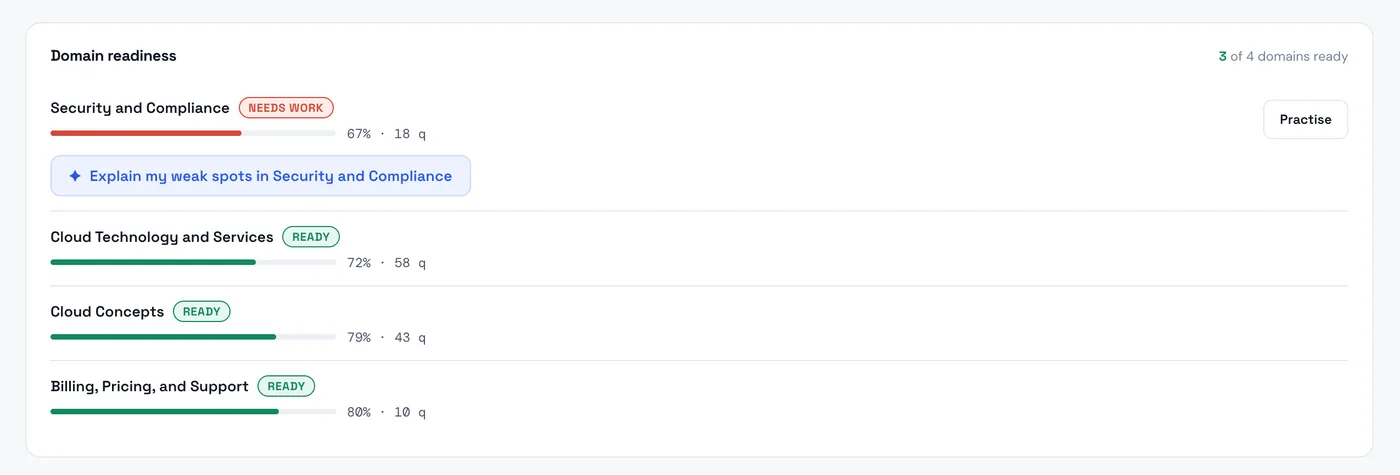
Certsqill’s KCNA practice questions are expert-developed: every question explains each answer option, and a readiness score for each of the four domains shows whether Kubernetes fundamentals, at 44% of the exam, is ready before you use one of your two attempts.
KCNA questions people ask
What is the KCNA certification?
The Kubernetes and Cloud Native Associate from the Linux Foundation, an entry-level, multiple-choice certification on Kubernetes and the cloud native ecosystem. Source: Linux Foundation, checked 10 October 2026.
How much does the KCNA exam cost?
$250 for the exam only, including one retake. Bundles cost $299 with the LFS250 course and $495 with a THRIVE-ONE subscription. Source: Linux Foundation KCNA page, checked 10 October 2026.
How many questions are on the KCNA exam?
60 multiple-choice questions in 90 minutes. Source: Linux Foundation Docs, checked 10 October 2026.
What is the KCNA passing score?
75% or above. Source: Linux Foundation Docs, Multiple Choice Exams FAQ, checked 10 October 2026.
Is the KCNA exam hard?
The Linux Foundation rates it as beginner level and publishes no pass rate. The challenge is breadth: Kubernetes fundamentals is 44% of the exam, and you need 75% overall.
Are there prerequisites for KCNA?
No. The Linux Foundation lists no prerequisites. Source: Linux Foundation KCNA page, checked 10 October 2026.
How long is the KCNA cert valid?
Two years. You can renew by passing KCNA again, or automatically by passing CKA or CKAD. Source: Linux Foundation Docs, checked 10 October 2026.
Is there an official KCNA practice exam?
The Linux Foundation does not list one on its KCNA page. It sells the LFS250 course and lists free introductory courses. Checked 10 October 2026.
Are there KCNA exam dumps free to download, and should I use them?
Do not use them. The Linux Foundation’s certification agreement prohibits braindump material and allows it to cancel scores and revoke certifications. Source: Linux Foundation, checked 10 October 2026.

