PMI-SP certification: exam, requirements and training
PMI-SP is PMI’s Scheduling Professional certification for specialists who build and run project schedules. The exam has 170 multiple-choice questions (150 scored, 20 unscored pretest) in 210 minutes at a Pearson VUE testing center. To apply you need 12 to 40 months of scheduling experience, depending on your degree, and 30 to 40 hours of scheduling education. You keep it with 30 PDUs every three years. PMI publishes no exam price on the PMI-SP page and no passing score.
- Certification
- PMI Scheduling Professional (PMI-SP), issued by PMIPMI PMI-SP page, checked 10 October 2026
- Exam cost
- Not published on the PMI-SP page — PMI says prices vary by membership status and regionPMI PMI-SP page and Certification Handbook, checked 10 October 2026
- Questions
- 170 multiple-choice — 150 scored, 20 unscored pretestPMI PMI-SP page, checked 10 October 2026
- Duration
- 210 minutesPMI PMI-SP page, checked 10 October 2026
- Passing score
- Not published by PMIThe Certification Handbook says only that it is set by psychometric analysis, checked 10 October 2026
- Delivery
- Pearson VUE testing center, in EnglishPMI PMI-SP page, checked 10 October 2026
- Eligibility
- 40, 24 or 12 months of scheduling experience (by degree) plus 40 or 30 hours of scheduling educationPMI PMI-SP page, checked 10 October 2026
- Attempts
- Up to 3 within a one-year eligibility periodPMI PMI-SP page and Certification Handbook, checked 10 October 2026
- Renewal
- 30 PDUs in each 3-year cyclePMI PMI-SP page, checked 10 October 2026
Know if you're ready for PMI-SP — before you book.
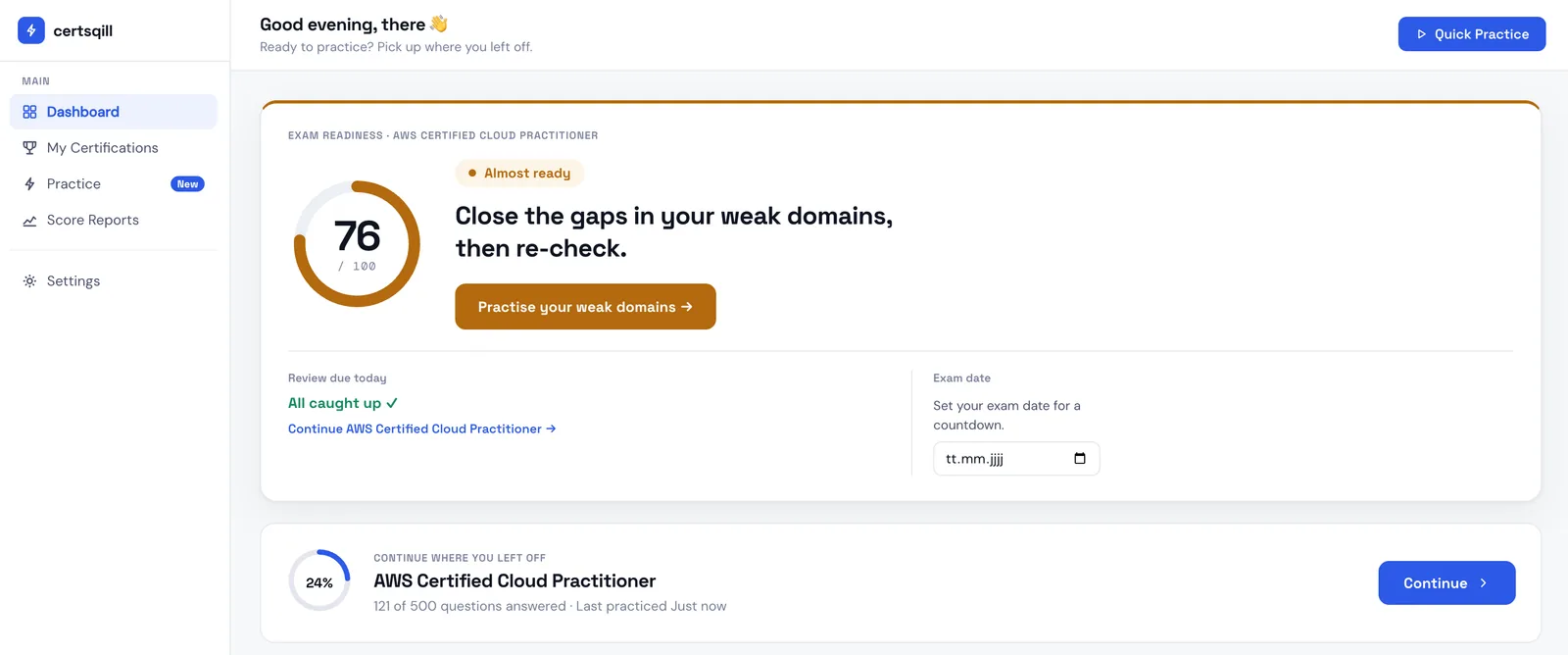
Certsqill measures your PMI-SP readiness across every official exam domain — one 0–100 score from coverage, accuracy and consistency that tells you whether to book, keep studying, or sit.
Why people switch to Certsqill
Everything you need to walk in ready
Know where you stand, understand every mistake, and study in your language — one payment, no subscription.
Your PMI-SP Readiness Score, not a guess
One number from three signals — coverage, accuracy, and consistency — tells you whether to book the exam or keep studying.
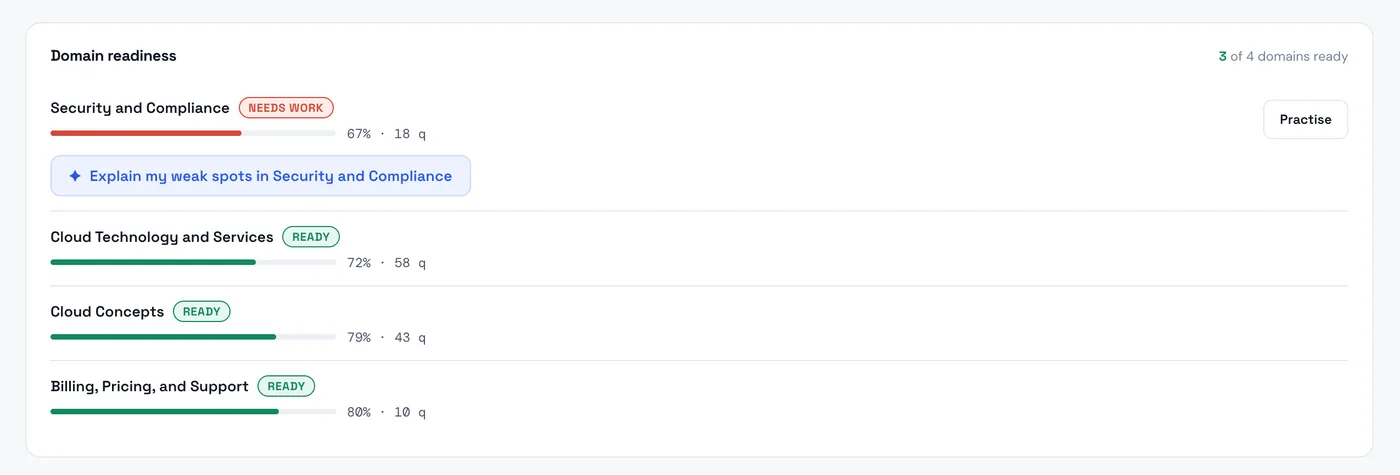
Understand every PMI-SP mistake
When you miss a question, it explains why — using your own answer history to catch the patterns you keep repeating. Included, no subscription.
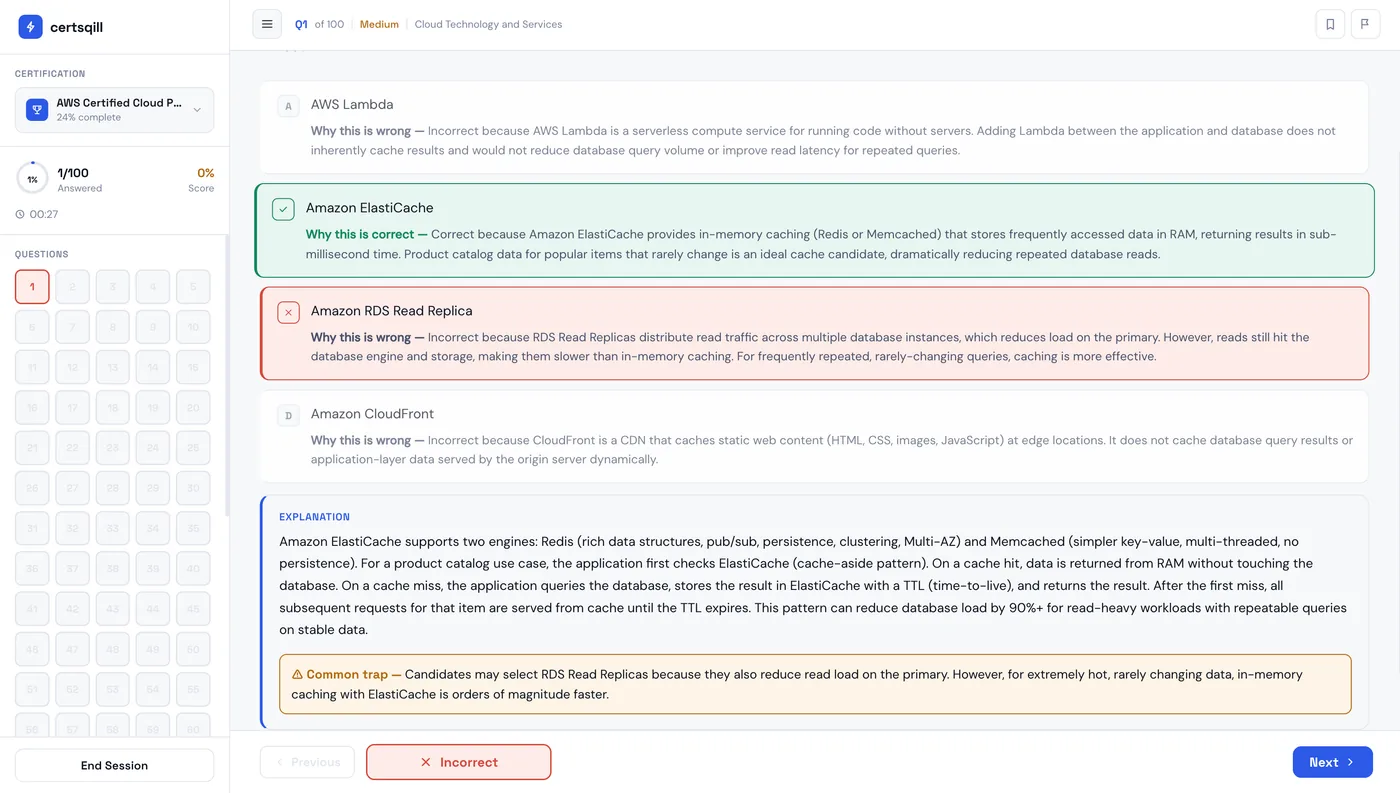
Explanations in your language, questions stay exam-accurate
Get every explanation in your language while the questions stay in exam-accurate English. Technical terms stay in English — the way the exam writes them.
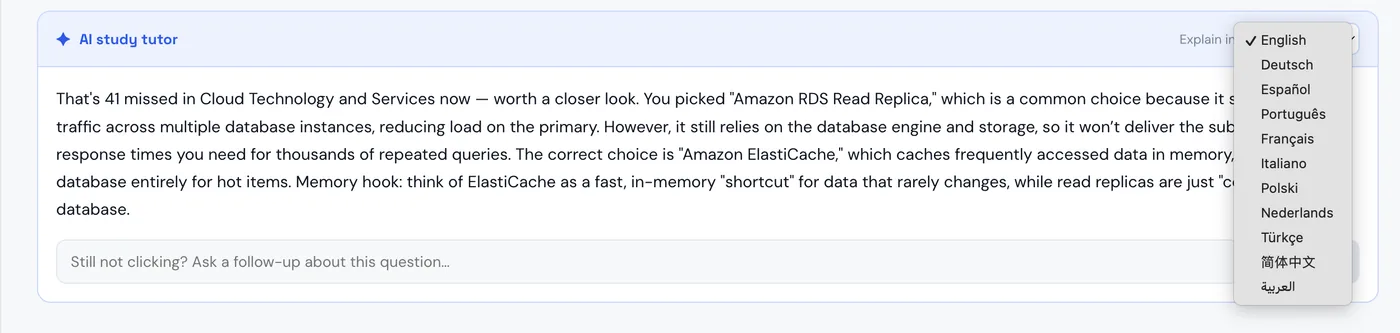
Everything you need to pass
Why you can trust these PMI-SP questions
What is the PMI-SP certification?
PMI-SP stands for PMI Scheduling Professional. It is issued by PMI, the Project Management Institute, and PMI pitches it as the way to stand out on the project team as a specialised expert: the person who develops and maintains the schedule, manages complex timelines and keeps distributed teams on track.
Unlike PMP, which covers project management as a whole, the PMI-SP certification is narrow on purpose. Every exam domain is about the schedule — strategy, planning and development, monitoring and controlling, closeout, and communicating the schedule to stakeholders.
It is aimed at people who already do this work. Every eligibility route asks for documented project scheduling experience, so it is not an entry-level cert.
Source: PMI — PMI Scheduling Professional (PMI-SP). Checked 10 October 2026.
PMI-SP requirements: experience and scheduling education
PMI offers three routes, and you need to meet one of them. The experience counts only if it is in project scheduling and falls within the last five years.
The education requirement is specific too: it must be project scheduling education, not general project management training. PMI states that it accepts hours spent in training for Microsoft Project and other scheduling tools.
Applications can be selected for audit. The PMI Certification Handbook says only a percentage are chosen, that you cannot continue until the audit is complete, and that you then have 90 days to submit documentation — so keep certificates for every course and records of your scheduling roles before you apply.
- Secondary degree: 40 months of project scheduling experience in the last 5 years and 40 hours of project scheduling education
- Four-year degree: 24 months of project scheduling experience in the last 5 years and 30 hours of project scheduling education
- Bachelor’s or post-graduate degree from a GAC-accredited programme: at least 12 months in professional project scheduling in the last five consecutive years and 30 contact hours of scheduling education
Source: PMI — PMI Scheduling Professional (PMI-SP). Checked 10 October 2026.
How much is the PMI-SP exam?
PMI does not print a dollar amount on the PMI-SP certification page. The page says only that once your application is accepted, the next step is to pay your exam fee. The PMI Certification Handbook adds that prices vary based on membership status and regional location.
Retakes cost extra: the Handbook states that fees are paid again for the second and third attempts. The binding figure for your situation is shown in PMI’s application and payment step.
Two study resources PMI names on the PMI-SP page are free for PMI members: the PMBOK Guide and the Practice Standard for Scheduling, Third Edition.
Source: PMI — Certification Handbook (revised June 2026). Checked 10 October 2026.
PMI-SP exam format and passing score
The PMI-SP exam has 170 multiple-choice questions. Of those, 20 are unscored pretest questions and 150 count towards your result. You cannot tell which questions are pretest items, so treat every one as scored.
You have 210 minutes — about one minute 14 seconds per question. PMI lists the exam in English and delivers it at Pearson VUE testing centers; the PMI-SP page does not mention an online option.
PMI does not publish a PMI-SP passing score. The Certification Handbook states only that the passing score for all PMI exams is determined by sound psychometric analysis. Any percentage you see quoted elsewhere is not from PMI.
After your application is approved you have one year to take the exam and may sit it up to three times within that year.
Source: PMI — PMI Scheduling Professional (PMI-SP). Checked 10 October 2026.
What is on the PMI-SP exam?
PMI publishes five domains with fixed weights. Monitoring and controlling the schedule is the largest at 35%, and planning and development follows at 31% — together two thirds of the scored questions. Closeout is only 6%.
That split says what kind of scheduler PMI is testing: someone who builds a realistic schedule and then keeps it honest as the project changes, not someone who only knows how to produce a network diagram once.
- Schedule Strategy — 14%
- Schedule Planning and Development — 31%
- Schedule Monitoring and Controlling — 35%
- Schedule Closeout — 6%
- Stakeholder Communications Management — 14%
Source: PMI — PMI Scheduling Professional (PMI-SP). Checked 10 October 2026.
PMI-SP training and courses
You need 30 or 40 hours of project scheduling education before you can apply, so PMI-SP training is part of the route, not an optional extra. When you compare a PMI-SP course, check one thing first: that it is scheduling education and that you will get a certificate listing the hours, because that is what an audit asks for.
PMI counts training on scheduling tools: hours spent learning Microsoft Project and other scheduling software qualify. A PMI-SP bootcamp, a weekend workshop or self-paced PMI-SP training online can all work, as long as the hours are documented and the content is scheduling.
For study, PMI points to the PMBOK Guide and the Practice Standard for Scheduling, Third Edition, both free for PMI members. Map your study plan to the five domains and their weights, since the exam does.
Source: PMI — PMI Scheduling Professional (PMI-SP). Checked 10 October 2026.
How do you renew PMI-SP?
PMI-SP runs on a three-year cycle. PMI states that holders need to earn 30 professional development units (PDUs) in each 3-year cycle to maintain the certification.
Thirty PDUs over three years is half of what PMP requires. Record them as you earn them rather than at the end of the cycle.
Source: PMI — PMI Scheduling Professional (PMI-SP). Checked 10 October 2026.
PMI-SP vs PMP
PMP is PMI’s general project management certification: 180 questions in four hours, three to five years of project management experience depending on your degree (two for GAC graduates), 35 hours of project management training and 60 PDUs every three years.
PMI-SP is the specialist route. The exam is shorter but more focused, the experience must be in scheduling rather than project management in general, and renewal takes 30 PDUs. If scheduling is your job, PMI-SP measures exactly that; if you lead whole projects, PMP is the broader credential. Holding one does not replace the other.
Source: PMI — PMP certification. Checked 10 October 2026.
Is the PMI-SP certification worth it?
PMI does not publish a PMI-SP salary figure on the certification page, and this page does not quote one from elsewhere. What PMI does say is who it is for: schedulers who want to show specialised expertise on the project team.
The practical test of whether it is worth it: do you already meet one of the three experience routes, and does your role revolve around the schedule? If yes, the exam tests work you already do. If your scheduling experience is still thin, the requirement itself will tell you to wait.
Source: PMI — PMI Scheduling Professional (PMI-SP). Checked 10 October 2026.
PMI-SP practice questions
Certsqill’s PMI-SP practice questions are expert-developed: every question explains each answer option, and a readiness score for each of the five domains shows whether monitoring and controlling, at 35% of the exam, is ready before you spend an attempt. Do not use copies of real exam questions: PMI’s Handbook treats exam content as confidential, and violations can lead to revocation or permanent suspension from PMI exams.
PMI-SP questions people ask
What is the PMI-SP certification?
The PMI Scheduling Professional certification from PMI, for specialists who develop and maintain project schedules. Source: PMI, checked 10 October 2026.
What are the PMI-SP requirements?
One of three routes: secondary degree with 40 months of scheduling experience and 40 hours of scheduling education; four-year degree with 24 months and 30 hours; or a GAC-accredited degree with 12 months and 30 hours. Source: PMI, checked 10 October 2026.
How much does the PMI-SP exam cost?
PMI does not print a price on the PMI-SP page; its Handbook says fees depend on membership status and region. The figure appears when you pay after acceptance. Checked 10 October 2026.
How many questions are on the PMI-SP exam?
170 multiple-choice questions, of which 150 are scored and 20 are unscored pretest questions, in 210 minutes. Source: PMI, checked 10 October 2026.
What is the PMI-SP passing score?
PMI does not publish one. Its Handbook says passing scores are set by psychometric analysis. Checked 10 October 2026.
Does Microsoft Project training count for PMI-SP?
Yes. PMI states that it accepts hours spent in training for Microsoft Project and other scheduling tools towards the education requirement. Source: PMI, checked 10 October 2026.
Where can I take the PMI-SP exam?
At a Pearson VUE testing center; the exam is in English. Source: PMI PMI-SP page, checked 10 October 2026.
How many times can I take the PMI-SP exam?
Up to three times within the one-year eligibility period; fees apply again to the second and third attempts. Source: PMI, checked 10 October 2026.
How do I renew PMI-SP?
Earn 30 PDUs in each three-year cycle. Source: PMI PMI-SP page, checked 10 October 2026.

